Sussex County Manufactured Home Permit & Inspection Guide
Placing or replacing a manufactured home in Sussex County is subject to county permitting and inspection requirements, with the exact scope depending on the project, parcel, flood status, and installation. Sussex County Planning & Zoning administers local permits and inspections, while Delaware state law (Title 24, Chapter 44) governs installer licensing and HUD standards (24 CFR 3285) govern the installation itself. Always verify current, project-specific requirements directly with Sussex County before beginning work, because this guide is general information and not a substitute for county instructions.
Request Mobile Home Foundation Service
Serving Millsboro and all surrounding Sussex County communities.
In This Guide
- 1.What Permits & Inspections Apply in Sussex County
- 2.What Sussex County May Require for a Permit
- 3.Manufactured Home Inspections in Sussex County
- 4.Additional Requirements for Flood-Zone Installations
- 5.Do These Requirements Apply to Repairs?
- 6.Related Content
- 7.Frequently Asked Questions & Official Sources
Manufactured Home Inspections in Sussex County
Where Sussex County requires inspections, they typically occur in stages tied to the installation sequence. The county, not a contractor, determines which inspections apply to a given project:
Footing / Footer Inspection
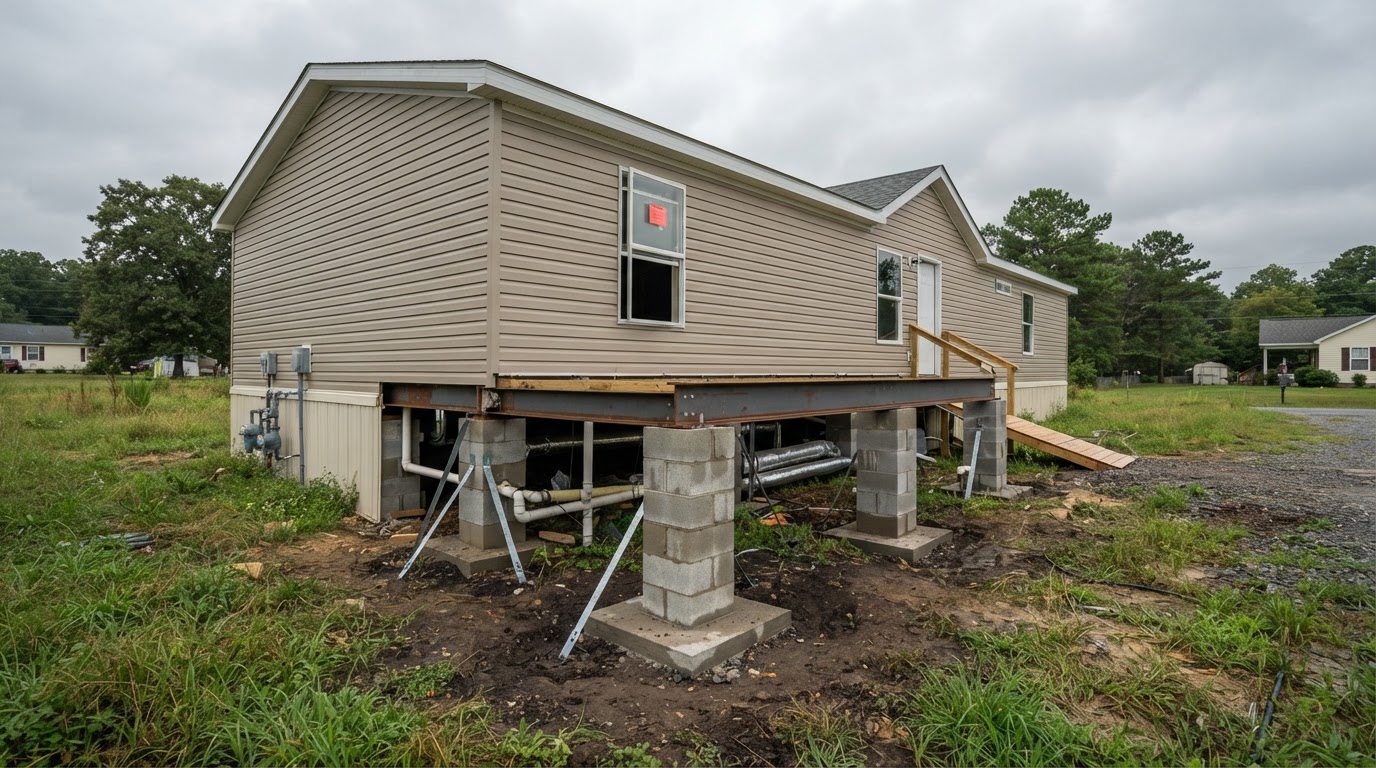
Before piers are placed, the bearing surface — footing depth, pad placement, and soil condition — is verified so supports start on an approved base.
Tie-Down Inspection
Anchoring components — ground anchors, straps, and frame connections — are inspected for placement and condition as part of the wind-resistance system.
Final Inspection
A final inspection confirms the completed installation, including piers, shims, anchoring, and any county-required items, before occupancy sign-off.
Flood-Zone Inspection Stages
Parcels in FEMA Special Flood Hazard Areas may require additional inspection stages and elevation documentation tied to Base Flood Elevation and freeboard rules.
This page does not publish footing dimensions, anchor depths, or pier construction specifications. Those values come from the manufacturer's installation instructions, HUD 24 CFR 3285, and applicable county requirements — not from a general guide. See Delaware Manufactured Home Installation & Foundation Requirements for the statewide framework.
Do These Requirements Apply to Mobile Home Repairs?
New installation and placement rules should not be automatically treated as identical to repair or adjustment work on an existing home. Whether repair work requires a permit depends on the scope and the jurisdiction:
- New placement, replacement, or relocation is generally treated as installation and triggers the full permit and inspection cycle.
- Re-leveling an existing home on its established supports is typically an adjustment, not a new installation.
- Shimming or reshimming to restore bearing contact is generally maintenance, not a new setup.
- Isolated pier, block, or pad repair corrects an existing component rather than installing a new home.
- Tie-down strap or ground-anchor replacement addresses an existing anchoring component.
- Reblocking on an existing footing is support correction, not a new placement.
- Significant footing changes, a new permanent foundation, or major structural support changes may require review even on an existing home.
Whether a specific repair requires a permit depends on the work scope and the local jurisdiction. For the repair-specific question, see Do Mobile Home Leveling & Foundation Repairs Require a Permit in Delaware?.
What Permits & Inspections Apply to Manufactured Homes in Sussex County?
Sussex County administers local permitting and inspection for manufactured-home placement, while state and federal rules set the installation standard. The exact requirements depend on the project, parcel, flood status, and the type of installation:
- •New placement of a manufactured home on a Sussex County parcel generally requires a county building permit.
- •Replacement of an existing home on the same lot typically triggers a new permit and inspection cycle.
- •Relocation or reinstallation of a home is usually treated as installation, not repair.
- •Flood-zone parcels carry additional review and elevation documentation requirements.
- •Delaware state law (Title 24, Chapter 44) requires a licensed Delaware Manufactured Home Installer for regulated installation work.
- •HUD Model Installation Standards (24 CFR 3285) and the manufacturer's written installation instructions govern the support and anchoring details.
- •Repair, re-leveling, shimming, or isolated component replacement on an existing home is a different category from new installation (see Section 5).
What Sussex County May Require for a Manufactured Home Permit
A permit application typically connects the home, the parcel, the installer, and the proposed support configuration. The exact items Sussex County requests should be confirmed with the county, but common elements include:
| Condition | Typical Scope |
|---|---|
| Footing plan | Shows the intended support and foundation configuration — pad or footing layout, pier locations, and spacing. |
| Installer information | Identifies the licensed Delaware Manufactured Home Installer responsible for the regulated installation work. |
| Manufactured-home information | Identifies the home — manufacturer, model, serial number, and HUD certification label data. |
| Property / parcel information | Connects the permit to the property — tax map number, address, and ownership documentation where applicable. |
| Bill of sale or ownership | Documents ownership of the home where the county requires it for placement or title purposes. |
| Flood information | Applies where the parcel is in a FEMA Special Flood Hazard Area and may require elevation documentation. |
Sussex County may request additional project-specific documentation. Confirm the current application package with Sussex County Planning & Zoning before submitting.
Additional Requirements for Manufactured Homes in Flood Zones
Not every Sussex County parcel is in a flood zone — flood status is property-specific. Where it applies, flood-zone installation can add requirements beyond the standard inspection sequence:
- Flood status is determined per parcel through FEMA flood maps, not by town or community name.
- Applicable installations may require extra review and inspection stages beyond the standard footing and tie-down inspections.
- Elevation documentation — such as a flood elevation certificate — may apply where the home must sit above the Base Flood Elevation plus any local freeboard.
- Enclosed crawlspaces in flood hazard areas may require engineered flood vents to equalize hydrostatic pressure.
- Anchoring in flood zones may need to address combined wind and water forces, not wind alone.
Related Delaware & Sussex County Resources
These resources connect the county process to the statewide framework and to the physical services that follow from it:
Official Sources & Regulatory Disclaimer
Primary references for Sussex County manufactured-home permitting include: 1) Sussex County Planning & Zoning and the Sussex County building permit process (sussexcountyde.gov); 2) Delaware Code Title 24, Chapter 44 — Manufactured Home Installation (delcode.delaware.gov); 3) 24 DE Admin. Code 4400 — Board of Manufactured Home Installation (regulations.delaware.gov); 4) HUD Model Manufactured Home Installation Standards, 24 CFR Part 3285 (hud.gov); and 5) FEMA Floodplain Management Regulations. DISCLAIMER: This guide is general information, not legal advice. Permit rules, inspection stages, and flood specifications vary by parcel and can change. Confirm current, project-specific requirements directly with Sussex County and a licensed Delaware installer before beginning work.
Frequently Asked Questions: Sussex County Permits & Inspections
Does Sussex County inspect manufactured-home footings?
Where Sussex County requires a footing inspection, it verifies the bearing surface before piers are placed. Whether a footing inspection applies to a specific project, and what it covers, is determined by the county — confirm current requirements with Sussex County Planning & Zoning.
Is tie-down inspection required during installation?
Tie-down inspection is a common stage in a regulated installation because the anchoring system is part of the wind-resistance design. Whether it applies to a given project is set by the county and the applicable installation standard, so verify with Sussex County.
Does flood-zone placement require extra inspections?
Parcels in FEMA Special Flood Hazard Areas may require additional review, inspection stages, and elevation documentation. Flood status is property-specific — not every Sussex County parcel is in a flood zone — so the county determines what applies to a given parcel.
Does every repair require a permit?
No. New placement, replacement, and relocation are generally treated as installation. Re-leveling, shimming, or isolated component repair on an existing home is a different category. Whether a specific repair requires a permit depends on scope and jurisdiction — see our repair-permit resource.
Who installs manufactured homes in Delaware?
Under Delaware Code Title 24, Chapter 44, regulated manufactured-home installation in Delaware must be performed by a licensed Delaware Manufactured Home Installer. Millsboro Mobile Home Leveling performs foundation, leveling, support, and anchoring services; confirm installer-licensing requirements for new installation with the Delaware Board of Manufactured Home Installation.
Is county inspection the same as engineering certification?
No. A county installation inspection is a regulatory permitting process. An engineer or architect certification is a separate professional document often tied to lender or program requirements. They are not interchangeable — see Foundation Inspection vs HUD Engineer Certification in Delaware.
Where do I verify current Sussex County requirements?
Confirm current, project-specific requirements directly with Sussex County Planning & Zoning. Permit rules and inspection stages can change, and this guide is general information rather than a substitute for county instructions.
Can an existing foundation be reused for a replacement home?
Whether an existing foundation or support system can be reused for a replacement home depends on the condition of the existing supports, the new home's requirements, and county review. Reuse is not automatic — the county and a licensed installer evaluate whether the existing system fits the new home.
Schedule a Foundation & Leveling Evaluation Near Millsboro
If you need physical foundation, leveling, support, or anchoring service on a manufactured home in Sussex County, Millsboro Mobile Home Leveling can evaluate the visible system. Call 302-449-7221 or request service online. Permit and certification questions should be directed to Sussex County and the appropriate licensed professionals.
Request Mobile Home Foundation Service
Serving Millsboro and all surrounding Sussex County communities.