Single-Wide Mobile Home Leveling Millsboro
Single-wide mobile home leveling addresses homes built on a single-section manufactured-home frame. Because a single-wide is one transportable structural section rather than multiple sections joined on site, leveling is based on that chassis and its actual support configuration. Corrections may involve evaluation of the chassis, the main I-beams, the piers, blocks, pads, shims, and support points beneath the home. Symptoms that often prompt a single-wide leveling inspection include one end feeling lower, one side appearing low, a floor that slopes lengthwise, a floor that slopes side-to-side, doors that rub, windows that bind, or movement underfoot. Millsboro Mobile Home Leveling performs this work for single-wide owners near Millsboro and throughout Sussex County, DE.
Request Mobile Home Foundation Service
Serving Millsboro and all surrounding Sussex County communities.
Single-Wide Manufactured Home Leveling Near Millsboro
A single-wide consists primarily of one transportable structural section rather than multiple sections joined together on site. That matters for leveling because the entire home is one continuous chassis, so elevation changes in one part of the frame are connected to the rest of it. Leveling a single-wide usually does not involve correcting a marriage line between two home sections, which is a multi-section concern. Owners of multi-section homes can find that work on the double-wide leveling page.
One Side of a Single-Wide Feels Low
When one side of the home sits lower than the other, the supports along that side may have settled or shifted. Side-to-side slope is often tied to the piers and pads running beneath the lower side of the frame.
One End of the Home Has Settled
A lengthwise slope usually points to the supports at one end of the chassis. Because a single-wide is one long frame, settlement at one end can be felt through much of the home.
Uneven Floors Through the Center or Hallway
A dip or slope through the center of a single-wide can reflect the supports under the primary frame members rather than the perimeter, which is why the crawlspace has to be checked, not just the interior.
Sticking Exterior or Interior Doors
When the single chassis shifts, door openings can rack with it. Both exterior and interior doors can begin to rub or fail to latch, though hardware and trim movement can also cause sticking.
Movement Beneath the Home
A single-wide that rocks or feels different underfoot may have lost consistent contact between the frame and one or more supports. Movement is a reason to inspect the support system, not to diagnose from the symptom alone.
No single symptom is enough to confirm a leveling problem on its own. The frame elevation and the supports beneath the home have to be checked before any correction is made.
How Single-Wide Mobile Home Leveling Is Evaluated
A single-wide is treated as an interconnected structural system. Correcting one visible symptom in isolation, such as shimming a single pier without understanding the rest of the frame, can shift the problem rather than solve it. The process reads the whole chassis before changing any one support.
Discuss symptoms and timing
Review what you have noticed, when it began, and whether any previous leveling or repair has been done under the home.
Map the elevation across the section
Check how the floor and frame elevation changes across the single section, both lengthwise and side-to-side.
Inspect accessible support points
Examine the piers, blocks, pads, shims, and frame support points that can be safely reached beneath the home.
Identify the scope of correction
Determine whether the correction is needed at isolated supports or across a larger portion of the single chassis.
Perform controlled corrections
Apply support and elevation corrections appropriate to the system, moving the single chassis in a controlled way.
Recheck level and support contact
Verify the corrected areas and confirm the frame bears consistently on its supports across the section.
Specific lift heights and jack placement are not described here. Lifting a single-wide chassis involves controlled load handling, and incorrect jacking can damage the frame, floor, or supports.
Foundation Supports Used Under Single-Wide Mobile Homes
The supports beneath a single-wide work together as one system under one chassis. Understanding each component helps explain why a single-wide is leveled as a whole rather than pier by pier.
Steel Frame / I-Beams
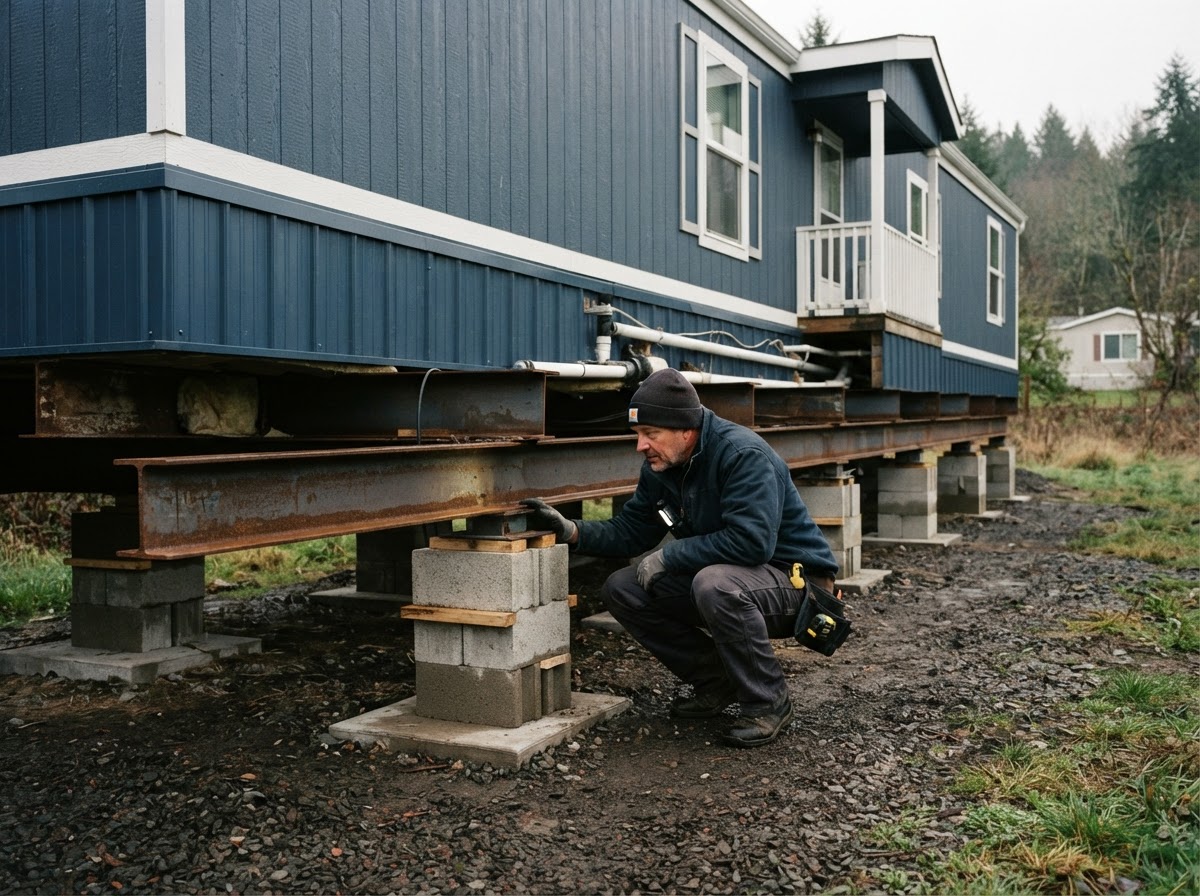
The single-wide frame is built around longitudinal steel I-beams that run the length of the home. These beams are the structural element that leveling works to return to a consistent plane, and they carry the floor, walls, and roof above them.
Piers & Blocks
Piers, commonly stacked concrete masonry blocks, transfer the frame's weight down to the bearing surface. Their height and condition set the elevation of the chassis above them.
Pads / Footings
The pad or footing beneath each pier spreads the load over the soil. A pad that cracks, sinks, or tilts can let the pier above it drop, changing the elevation of the frame.
Shims
Shims fill the gap between the top of a pier and the steel frame to create full, controlled bearing. They are a precision adjustment; loose, crushed, or missing shims are a frequent cause of localized floor movement in single-wides.
Reblocking
Reblocking means rebuilding or correcting the block and pier arrangement. When piers are poorly spaced, improperly stacked, or missing, reblocking is needed rather than a simple elevation adjustment.
Anchors & Tie-Downs
Anchors and tie-down straps resist lateral and uplift movement from wind; they do not support the weight of the home. The vertical support system and the anchoring system are separate and are not interchangeable.
Single-Wide Mobile Home Leveling in Millsboro & Sussex County
Single-wide leveling near Millsboro and across Sussex County is based on the actual conditions under each home. Service regularly extends to communities such as Long Neck, Dagsboro, Georgetown, and Harbeson. Every single-wide is evaluated according to its real support arrangement, foundation type, condition, crawlspace access, previous repairs, and settlement pattern. No blanket assumption is made based on age alone, and no claim is made about community-specific soils, because the bearing conditions beneath any given single-wide are property-specific.
Related Leveling & Foundation Services
- Mobile & Manufactured Home LevelingThe broad leveling service page covering the full category of manufactured-home leveling.
- Mobile Home Re-LevelingWhen a single-wide that was previously level has shifted or settled over time.
- Mobile Home Pier Repair & ReplacementWhen a pier under the single chassis is damaged rather than simply low.
- Mobile Home Jacking & Level CorrectionControlled hydraulic correction where shimming alone is not enough for the single chassis.
- Mobile Home Foundation & Leveling InspectionA full evaluation of frame level and support condition before any single-wide correction.
Single-Wide Mobile Home Leveling FAQs
How do I know if my single-wide mobile home is unlevel?
Signs include one side or one end feeling lower, a floor that slopes lengthwise or side-to-side, doors that rub or will not latch, windows that bind, and movement underfoot. A check of the frame elevation and the supports beneath the home confirms whether the single chassis has actually shifted.
Can one side of a single-wide settle lower than the other?
Yes. The supports along one side can settle or shift independently of the other, producing side-to-side slope. The piers and pads beneath the lower side are usually where that settlement shows up.
Can one end of a mobile home sink?
Yes. Because a single-wide is one long chassis, settlement at the supports on one end can be felt through much of the home, often as a lengthwise slope.
Does a single-wide use piers and shims?
Most do, though support configurations vary. Single-wides commonly rest on block piers over pads or footings, with shims providing the final bearing between the pier cap and the steel frame. The actual arrangement under your home has to be inspected.
Is single-wide leveling different from double-wide leveling?
Yes. A single-wide is one continuous chassis, so leveling is about that single frame and its supports. A double-wide joins two chassis along a central marriage line, which adds alignment between the two sections as a separate consideration.
Can sticking doors be caused by an unlevel single-wide?
They can be. When the single chassis shifts, door openings can rack with it and doors begin to rub or fail to latch. Sticking doors can also have other causes, so an inspection confirms whether leveling is the right fix.
What if a pier under my single-wide has shifted?
A shifted pier changes the support it gives the frame above it and should be inspected. Depending on what is found, the correction may be reblocking, pier replacement, or a leveling adjustment, not simply shimming over the shifted pier.
Can a single-wide require reblocking as well as leveling?
Yes. If the piers are poorly spaced, improperly stacked, or missing, the support arrangement itself needs correction. Reblocking addresses the layout and condition of the supports, while leveling addresses the elevation of the frame above them.
Do you level single-wide mobile homes near Millsboro?
Yes. Millsboro Mobile Home Leveling levels single-wide manufactured homes for owners in Millsboro and across Sussex County, DE, including Long Neck, Dagsboro, Georgetown, and Harbeson. Call 302-449-7221 to schedule an inspection.
Schedule Single-Wide Mobile Home Leveling Near Millsboro
Contact Millsboro Mobile Home Leveling at 302-449-7221 to arrange a single-wide leveling inspection in Millsboro or the surrounding Sussex County area.
Request Mobile Home Foundation Service
Serving Millsboro and all surrounding Sussex County communities.