Mobile Home Support System Repair Millsboro
A manufactured home's support system is made up of multiple components that work together to carry the frame and maintain proper elevation. Mobile home support system repair addresses conditions where one or more parts of that system are damaged, displaced, settled, loose, deteriorated, misaligned, or no longer providing proper support. Warning signs can include uneven floors, repeated loss of level, leaning piers, broken blocks, cracked pads, loose shims, gaps under frame supports, movement underfoot, or multiple support areas showing problems at once. Millsboro Mobile Home Leveling performs this work for homeowners near Millsboro and throughout Sussex County, DE. A support-system problem is not the same as a single failed component; the page explains how the pieces work together and when broader repair is appropriate.
Request Mobile Home Foundation Service
Serving Millsboro and all surrounding Sussex County communities.
Manufactured Home Support System Repair Near Millsboro
The support system beneath a manufactured home is the set of components that transfer the structural load from the steel frame down to the supporting base below. When several of those components are damaged or no longer working together, support-system repair addresses the system rather than only the one piece that looks worst. Reading the whole system first is what keeps the correction from chasing a single symptom while the rest of the support arrangement keeps moving.
Steel Frame / I-Beams
The steel chassis and primary I-beams are the structural members that carry the home and transfer its load down to the supports beneath them.
Piers
Piers are the vertical support points that hold the frame at specific locations, so the condition of each pier affects the elevation above it.
Blocks
Concrete masonry blocks are commonly used within pier assemblies, and their stacking, alignment, and condition affect how the pier transfers load.
Concrete Pads / Footings
Pads and footings are the bearing surfaces beneath the piers that spread the load into the supporting ground, so base condition matters as much as pier condition.
Shims
Shims complete the final support-contact and elevation adjustment where appropriate, sitting near the top of the support between the pier and frame.
Anchoring Is a Separate System
Anchors and tie-downs resist wind, lateral, and uplift forces and should not be confused with the vertical foundation supports. They are a different system performing a different job.
The support system holds the home vertically. The anchoring system helps resist movement from external forces. They work together but perform different jobs, which is why support-system repair and anchoring work are evaluated as separate scopes.
How Mobile Home Support Problems Are Evaluated
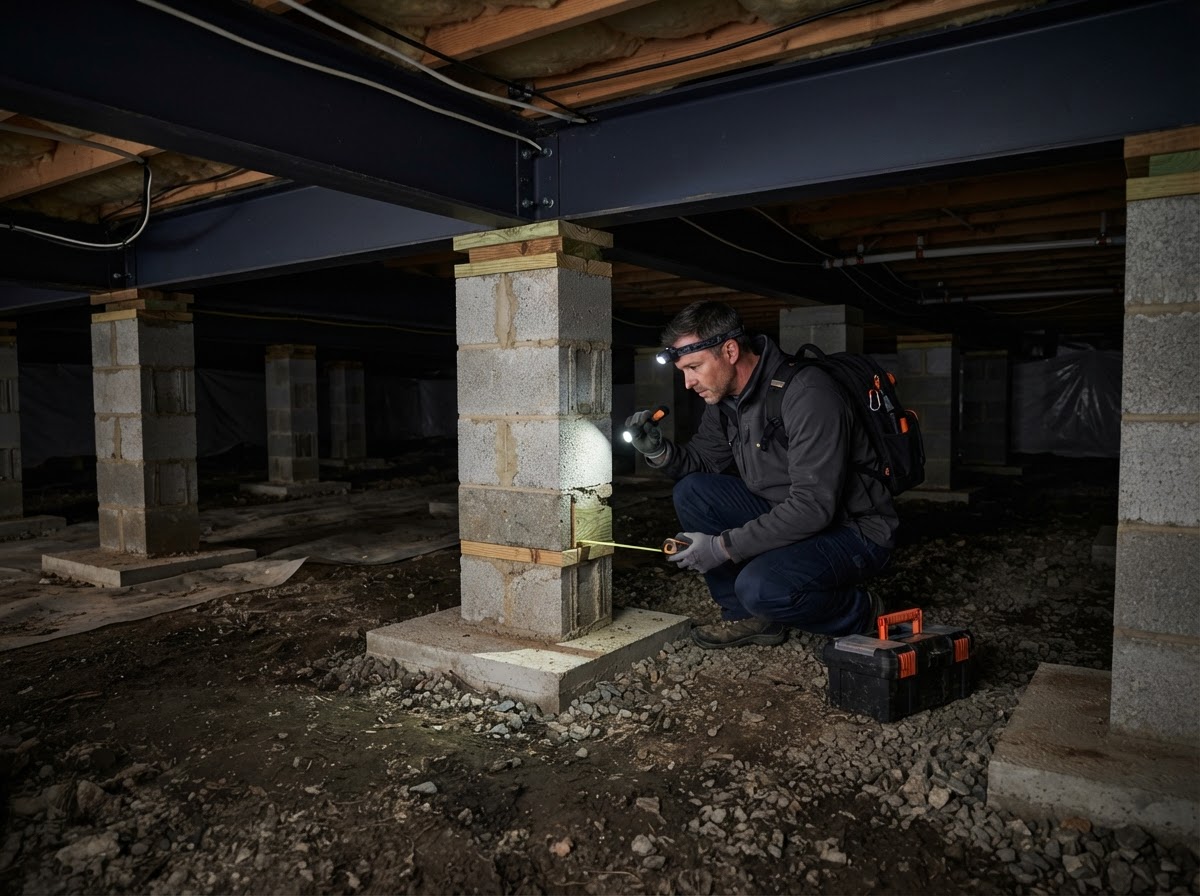
Support-system repair starts by evaluating the system as a whole rather than reducing the problem to the one component that looks worst. Several supports can move or fail at once, and correcting one without reading the others can leave the frame poorly supported.
- 1
Review symptoms and previous repair history
Discuss what has been noticed and whether the home has been leveled, repaired, or adjusted before.
- 2
Evaluate current level condition
Check how the frame is sitting now and where the elevation reads off.
- 3
Inspect accessible support components
Examine the piers, blocks, pads, shims, frame supports, and nearby crawlspace conditions that can be safely reached.
- 4
Identify which components are damaged or moved
Locate the supports that are settled, displaced, deteriorated, or no longer maintaining proper bearing.
- 5
Determine the appropriate scope
Decide whether the correction requires repair, replacement, reblocking, leveling, stabilization, or several coordinated corrections.
- 6
Complete the work and recheck the system
Perform the agreed scope and recheck how the support system bears the frame as a whole.
System-level problems should not be reduced to one visible component without evaluating the surrounding supports. Fixing the most obvious piece while the rest of the arrangement is still moving rarely holds.
Common Mobile Home Support System Problems
Support-system failures usually show up in more than one component at a time, which is why the whole arrangement is evaluated rather than one isolated support.
Pier Settlement
When one support settles, the elevation above it drops and the surrounding supports carry a changed share of the load, which can affect nearby areas.
Leaning or Damaged Block Piers
Tilted or broken block piers no longer transfer the load straight down, which changes both elevation and bearing at that point.
Cracked or Settled Pads
A base-level problem beneath a pier drops the support above it, so the pad is evaluated along with the pier rather than separately.
Loose or Missing Shims
Lost bearing contact at a shim leaves a gap between the pier and frame, which can show up as movement or slope above that support.
Multiple Areas Out of Level
Broader settlement across several supports often requires coordinated correction rather than separate one-off adjustments.
Reblocking Needs
When several supports are poorly spaced, improperly stacked, or missing, the arrangement itself needs correcting rather than individual piers.
Recurring Foundation Movement
Movement that keeps coming back after correction points toward a stabilization condition that addresses the cause of the movement.
Frame Support Gaps
Visible gaps beneath I-beams or frame members should be evaluated, because the frame is not bearing on the support the way it should.
Mobile Home Support Repair in Millsboro & Sussex County
Support-system repair for homes in Millsboro and across Sussex County varies with the actual property. Service regularly extends to communities such as Long Neck, Dagsboro, Georgetown, Frankford, and Harbeson. The scope depends on the home type, number of sections, frame layout, foundation configuration, pier arrangement, previous repairs, crawlspace accessibility, settlement history, and the condition of pads and shims. Not every manufactured home uses the same support configuration, so the system is evaluated rather than assumed.
Related Foundation Services
- Mobile Home Foundation RepairThe broader foundation-repair page for damaged support components.
- Manufactured Home Foundation StabilizationWhen recurring movement means the cause needs addressing.
- Mobile Home Pier & Beam Foundation RepairThe frame-to-pier support relationship beneath manufactured homes.
- Mobile Home Foundation & Leveling InspectionA full evaluation of frame level and support condition first.
- Mobile Home Re-LevelingWhen supports are sound and only the elevation needs resetting.
- Manufactured Home I-Beam & Frame Support RepairSupport conditions specifically involving the steel chassis and I-beams.
- Mobile Home Underpinning & Foundation SupportWhen a low or weak area needs added support beneath the frame.
- Mobile Home Setup Correction & ReblockingWhen the broader support arrangement needs correcting rather than one component.
- Mobile Home Shaking or Rocking When WalkingWhen movement underfoot points to a broader support-system cause.
Mobile Home Support System Repair FAQs
What is included in a mobile home support system?
The support system includes the components that transfer the structural load from the steel frame down to the supporting base: the steel chassis and I-beams, piers, blocks, concrete pads or footings, and shims where used. Anchoring and tie-downs are a separate system that resists wind and lateral forces.
What happens if one support point starts sinking?
A sinking support drops the elevation above it and changes how the surrounding supports share the load. The correction depends on whether the pier itself, the pad beneath it, or a broader settlement pattern is responsible, which is why the area is evaluated rather than only the one support.
Can several foundation components fail at the same time?
Yes. Because the supports work as a system, movement or failure in one component can affect the others nearby, and several can be damaged or displaced at once. System-level repair evaluates the whole arrangement rather than the single piece that looks worst.
Is support-system repair different from mobile home leveling?
Yes. Leveling corrects the elevation the frame is sitting at over otherwise sound supports. Support-system repair addresses damaged, failed, or misaligned components within the system that are no longer carrying the load correctly.
Are tie-downs part of the support system?
No. Tie-downs and ground anchors resist wind, lateral, and uplift forces and are a separate anchoring system. The vertical support system holds the home up; the anchoring system helps resist movement from external forces. They work together but perform different jobs.
Can broken blocks cause a home to become unlevel?
Yes. A broken or shifted block within a pier changes the elevation that pier provides, which can show up as slope or movement in the floor above it.
Can damaged pads affect multiple components above them?
Yes. A cracked or settled pad drops the pier resting on it, and the changed elevation can affect the shims and frame contact above. The base condition is evaluated along with the components it supports.
What is reblocking?
Reblocking is the correction of a support arrangement when piers are poorly spaced, improperly stacked, or missing. It rebuilds or repositions the support layout so the frame is supported in a way that will hold, rather than simply re-leveling over a poor arrangement.
When does support-system repair become foundation stabilization?
When the movement keeps recurring after correction, the cause beneath the supports usually needs addressing rather than another adjustment. That points toward stabilization, which targets the condition allowing continued movement so the correction can hold.
Do you repair mobile home support systems near Millsboro?
Yes. Millsboro Mobile Home Leveling provides support-system repair for homeowners in Millsboro and across Sussex County, DE, including Long Neck, Dagsboro, Georgetown, Frankford, and Harbeson. Call 302-449-7221 to schedule an evaluation.
Schedule Mobile Home Support System Repair Near Millsboro
If several support points beneath your manufactured home are damaged, moved, or no longer bearing properly, contact Millsboro Mobile Home Leveling at 302-449-7221 to arrange a support-system evaluation in Millsboro or the surrounding Sussex County area.
Request Mobile Home Foundation Service
Serving Millsboro and all surrounding Sussex County communities.