Mobile Home Wind & Anchoring Requirements in Coastal Delaware
Manufactured home wind and anchoring requirements in coastal Delaware are governed by federal HUD Construction and Safety Standards (24 CFR 3280.305), under which Sussex County is designated in HUD Wind Zone II (100 mph fastest-mile basic design speed). Anchoring systems must be installed according to the home's DAPIA-approved manufacturer installation manual, Delaware Code Title 24 Chapter 44, and local Sussex County building codes. Rather than a single fixed strap count, the required number and spacing of ground anchors, diagonal frame ties, and stabilizer plates depend on overall home dimensions, soil bearing test probe readings, wall height, and roof pitch. Proper wind anchoring works alongside vertical foundation piers, but anchoring alone cannot make a home hurricane-proof or resolve flood elevation requirements.
Request Mobile Home Foundation Service
Serving Millsboro and all surrounding Sussex County communities.
In This Guide
- 1.Coastal Delaware Wind Exposure & Hazard Risk
- 2.HUD Wind Zone II Classification Explained
- 3.Foundation Support vs. Wind Anchoring (Load Path)
- 4.Components of a Coastal Anchoring Assembly
- 5.Delaware Installation Statute & Installer Rules
- 6.Why Strap Count Depends on Home & Soil Engineering
- 7.Older Manufactured Homes & Anchoring Retrofits
- 8.Sussex County & Coastal Community Context
- 9.Wind Anchoring vs. Flood Hazard Elevation Rules
- 10.Can Anchoring Make a Mobile Home Hurricane-Proof?
- 11.Official Sources & Regulatory References
- 12.Frequently Asked Questions
Key Components of a Coastal Delaware Anchoring Assembly
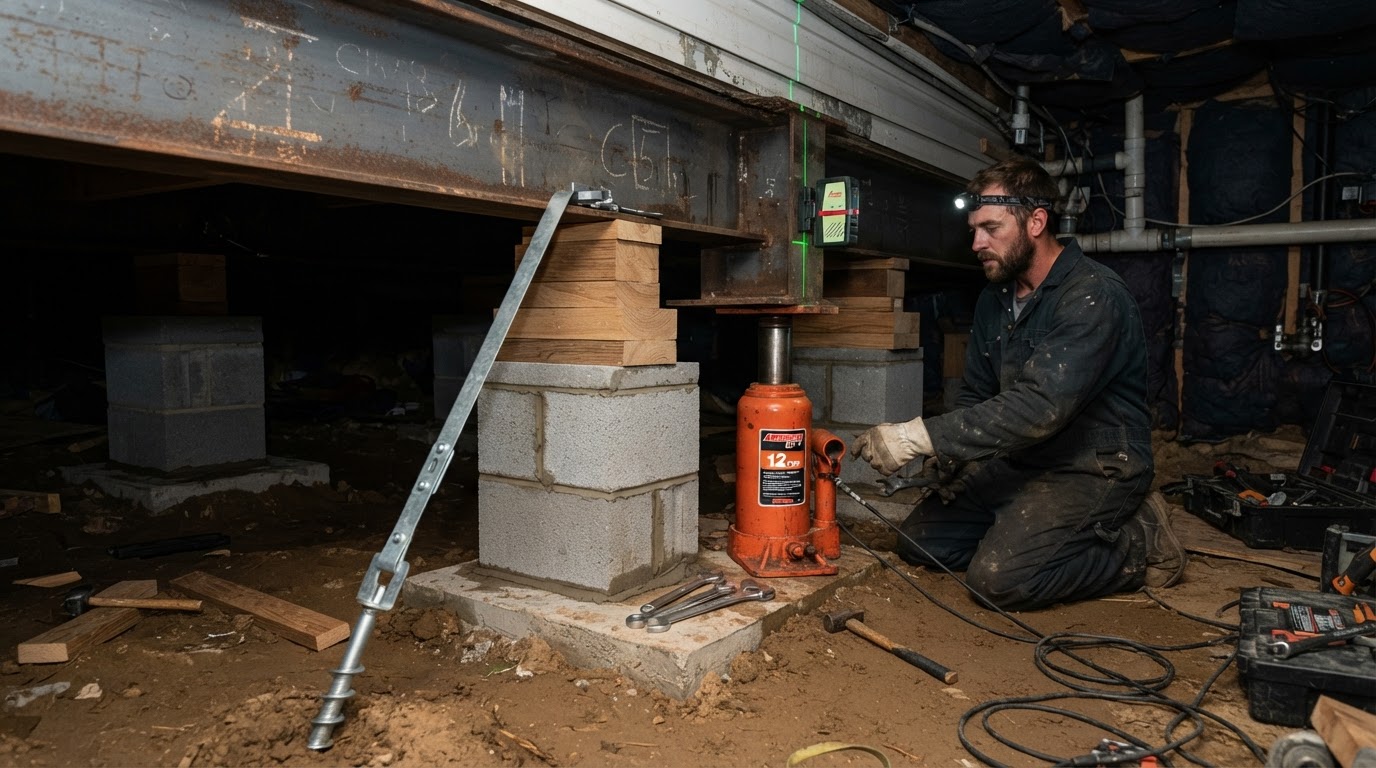
An anchoring system works as a continuous steel connection chain from the main chassis I-beam deep into subsoil bearing layers:
1) Helical Earth Anchors — Heavy-gauge steel rods with welded helical auger blades at the bottom that screw into subsoil layers to provide mechanical uplift resistance; 2) Diagonal Tie-Down Strapping — Certified 1.25-inch galvanized steel banding with zinc coating (meeting ASTM D3953 specifications) tested to a minimum breaking strength of 4,725 pounds; 3) Frame Beam Clamps — Heavy steel brackets clamped directly around the bottom flange of longitudinal steel I-beams, transferring tension without drilling holes in the beam; 4) Stabilizer Plates — Metal plates driven vertically into topsoil beside anchor heads to prevent the anchor shaft from slicing horizontally through sandy soil under lateral wind shear; 5) Slotted Tensioning Bolts — Rotating split-bolts mounted on anchor heads that wind steel strapping tight with a socket wrench and lock in place with mechanical keepers; and 6) Over-The-Top Roof Ties — Straps running over roof trusses on older single-wide models to hold roof framing down during severe wind storms.
Why Strap Count Depends on Home & Soil Engineering
Homeowners frequently search for a simple formula like 'how many tie-downs for an 80-foot double wide in Delaware?' In engineering practice, strap counts cannot be calculated from a generic rule of thumb. Factors determining total anchor count include: 1) Overall length and width — a longer sidewall presents greater wind sail area; 2) Single-wide vs. double-wide — double-wides present a wider stance but require central marriage-line anchor points; 3) Wall height and roof slope — steep roofs increase wind drag; 4) Soil torque probe test results — soil classification (Class 2, 3, 4A, or 4B) dictates whether standard 30-inch anchors or longer 48-inch double-helix anchors are required to achieve required holding tension; and 5) Manufacturer manual specification — the primary engineering reference is always the DAPIA manual provided by the home manufacturer.
Sussex County & Coastal Community Context
Coastal Sussex County communities face unique soil and weather factors that impact anchor longevity and performance:
- Millsboro & Long Neck: High water tables and sandy loam soil require soil probe testing to select correct anchor helix sizes.
- Ocean View & Bethany Beach: Salt air exposure accelerates strap corrosion, making heavy zinc-coated galvanized strapping essential.
- Lewes & Rehoboth Beach: Open coastal exposure increases wind gust velocity during nor'easters and tropical storms.
- Dagsboro & Selbyville: Agricultural runoff and standing ground water in low areas can soften upper soil layers around anchor heads.
Routine crawlspace inspections help coastal homeowners spot rusted straps or loose anchors before coastal storm season arrives.
Coastal Delaware Wind Hazard Risk & Storm Exposure
Coastal Sussex County, DE — spanning Millsboro, Long Neck, Ocean View, Bethany Beach, Lewes, and Rehoboth Beach — sits along the Delaware Bay and Atlantic coastline. This geographic position exposes manufactured homes to severe coastal winds, tropical storms, and nor'easters that generate extreme wind shear, uplift pressures, and lateral overturning forces.
- •Under federal HUD standards (24 CFR 3280.305), Sussex and Kent Counties in Delaware are classified in HUD Wind Zone II (100 mph fastest-mile basic wind speed design rating)
- •Wind pressure on a manufactured home acts simultaneously as lateral overturning force against side walls and vertical suction uplift over the roof deck
- •Flat coastal terrain and open water coastal exposures (Exposure Category C/D) allow high-velocity wind gusts to hit structural chassis beams with unmitigated force
- •Proper anchoring transfers wind uplift and overturning shear through diagonal steel strapping and helical ground anchors deep into stable soil
- •Delaware state law mandates that anchoring systems be installed by licensed manufactured home installers in accordance with approved DAPIA manual specifications
- •Loose, corroded, or missing tie-down straps jeopardize structural integrity during tropical weather events
- •Wind resistance requires complete system integration: sound foundation piers carry downward gravity loads while anchors hold the structure against uplift
Foundation Support vs. Wind Anchoring System Comparison
A common misunderstanding among homeowners is confusing vertical foundation piers with wind tie-down anchors. The two systems serve opposite mechanical load directions:
| Condition | Typical Scope |
|---|---|
| Primary Mechanical Purpose | Foundation Piers: Carries downward gravity weight (holding the home UP). Anchoring System: Resists upward suction & lateral shear (holding the home DOWN). |
| Key Structural Components | Foundation Piers: Concrete pads, CMU blocks, cap boards, hardwood shims. Anchoring System: Helical ground anchors, galvanized steel strapping, I-beam clamps, split-bolts. |
| Direction of Load Resistance | Foundation Piers: Vertical compression loads into subsoil. Anchoring System: Diagonal tension pull & horizontal stabilizer plate resistance. |
| Common Failure Symptoms | Foundation Piers: Sloping floors, sticking doors, crushed shims, cracked blocks. Anchoring System: Rusted straps, loose slack, missing anchors, displaced anchor heads. |
| Interdependence | Foundation Piers: A level home on good piers can still flip or slide if anchors fail. Anchoring System: Intact anchors cannot prevent a home from going unlevel if piers settle. |
A complete, safe setup requires both systems to be fully functional and structurally sound.
Understanding HUD Wind Zone II Regulations
The U.S. Department of Housing and Urban Development (HUD) regulates manufactured home construction under 24 CFR 3280. The federal code divides the nation into three distinct structural wind zones:
HUD Wind Zone I (Inland Baseline)
Covers inland non-coastal states designed for standard inland wind pressures (baseline fastest-mile wind speed design). Standard inland anchor spacing applies.
HUD Wind Zone II (100 MPH Coastal)
Applies to coastal Atlantic and Gulf counties, including Sussex and Kent Counties in Delaware. Homes built for Zone II feature heavier roof truss fastening, reinforced exterior wall framing, and increased anchor strap connection points.
HUD Wind Zone III (110 MPH Hurricane Risk)
Applies to high-risk coastal zones such as southern Florida, coastal North Carolina, and Hawaii, requiring maximum uplift design resistance.
Data Plate Wind Verification
Every HUD-code manufactured home features an interior paper Data Plate (usually located inside the master closet or electrical panel). The Data Plate contains a map verifying the exact HUD Wind Zone for which the unit was engineered at the factory.
Zone II Setup Compliance
A home designed only for Wind Zone I cannot legally be installed in Sussex County, DE unless engineered and approved by the state or local authority having jurisdiction.
DAPIA Manual Authority
The primary design authority for anchor positioning is the manufacturer's Design Approval Primary Inspection Agency (DAPIA) installation manual provided with the home.
Older Manufactured Homes & Anchoring Retrofits
Homeowners living in older manufactured homes or preparing for property sales often encounter existing tie-down deficiencies:
- Severe rust and flaking on galvanized steel straps caused by humid crawlspace conditions and coastal salt air
- Slack or sagging straps that have lost tension, rendering them ineffective during sudden wind gusts
- Missing ground anchors or anchors pulled loose from sandy subsoil during previous storms
- Absence of stabilizer plates beside diagonal anchors, allowing anchor shafts to bend under lateral loads
- Rusted frame clamps that have slipped off main steel I-beam flanges
- Mortgage Lender Requirements — FHA, VA, and USDA financing require an engineering inspection confirming anchors meet HUD Permanent Foundations Guide criteria
Delaware Installation Statute & Installer Regulations
Under Delaware Code Title 24, Chapter 44, the state established the Delaware Manufactured Home Installation Board within the Division of Professional Regulation. Key legal requirements include: 1) State License Mandatory — All manufactured home installations in Delaware must be performed by a licensed Delaware Manufactured Home Installer; 2) Decal Verification — Installers must place an official state approval decal on the home upon setup completion showing license number and setup date; 3) HUD Code Alignment — State setup regulations mandate full compliance with HUD Part 3285 standards and manufacturer DAPIA manuals; and 4) Inspection Authority — Sussex County building officials conduct mandatory footing and tie-down inspections prior to issuing Certificates of Occupancy.
Wind Anchoring vs. Flood Hazard Elevation Rules
In coastal Sussex County, flood hazard regulations and wind anchoring rules address two completely different coastal risks:
- ?Wind Anchoring Rules (24 CFR 3280 / Title 24 Ch 44) govern structural tie-downs, strap tension, and soil anchor depth to prevent wind uplift.
- ?Flood Plain Rules (FEMA / Sussex County Flood Ordinance) govern minimum floor elevation above Base Flood Elevation (BFE) in designated Flood Zones AE or VE.
- ?A home can have a perfectly compliant Wind Zone II tie-down system while still violating flood elevation rules if placed below required flood height.
- ?Enclosed crawlspaces in designated flood zones require engineered flood vents (1 sq in per 1 sq ft enclosed floor area) to equalize hydrostatic water pressure.
- ?Anchoring systems in flood hazard zones must be engineered to withstand wave action and buoyant forces in addition to 100 mph wind shear.
Homeowners in mapped flood hazard areas should consult local Sussex County building officials to verify flood elevation requirements.
Official Legal & Regulatory References
This educational guide synthesizes current official government standards. Homeowners and housing professionals can consult primary legal references: 1) HUD Manufactured Home Construction and Safety Standards — 24 CFR § 3280.305 Structural Design Requirements (hud.gov); 2) HUD Model Manufactured Home Installation Standards — 24 CFR Part 3285 (hud.gov); 3) Delaware Code Title 24, Chapter 44 — Manufactured Home Installation (delcode.delaware.gov); 4) Delaware Board of Manufactured Home Installation — Division of Professional Regulation (dpr.delaware.gov); and 5) Sussex County Building Code & Floodplain Ordinance (sussexcountyde.gov). REGULATORY DISCLAIMER: This guide is educational and does not constitute legal or structural engineering advice. Specific anchoring specifications depend on home data plates, DAPIA manuals, site soil tests, and local authority approval.
How Professional Technicians Evaluate Coastal Anchoring Systems
Evaluating a coastal manufactured home anchoring system involves a systematic crawlspace inspection:
- 1
Crawlspace Entry & Anchor Mapping
Locate every ground anchor, diagonal strap, vertical tie, and I-beam clamp along both main chassis beams.
- 2
Strap Corrosion & Tension Test
Inspect galvanized steel straps for section loss, surface rust, fraying, loose slack, and proper split-bolt engagement.
- 3
Anchor Head & Soil Collar Check
Verify anchor shafts are fully driven into soil and that stabilizer plates are present beside diagonal anchors.
- 4
Beam Clamp Attachment Assessment
Confirm beam clamps are securely fastened to I-beam bottom flanges without slippage or deformation.
- 5
Repair Plan Formulation
Provide the homeowner with a clear report detailing loose straps requiring retensioning and rusted straps or missing anchors requiring replacement.
Frequently Asked Questions About Coastal Delaware Wind Anchoring
What HUD Wind Zone is Sussex County, Delaware in?
Sussex County, DE is classified under federal HUD standards (24 CFR 3280.305) in HUD Wind Zone II, which requires manufactured homes and anchoring systems to be engineered for 100 mph basic fastest-mile design wind speeds.
Where can I find my mobile home's official HUD Wind Zone rating?
Every HUD-code manufactured home built after 1976 has an interior paper Data Plate (typically located inside the master bedroom closet, utility room, or electrical panel) displaying the wind zone map and engineering ratings.
Are ground anchors the same as vertical foundation piers?
No. Concrete piers and pads carry downward gravity weight (holding the home up), whereas steel ground anchors and diagonal straps resist wind uplift and horizontal shear (holding the home down).
How many tie-down straps does a mobile home need in coastal Delaware?
There is no single universal strap count. Required anchor count is determined by home length, width, wall height, roof pitch, soil probe torque test ratings, and the manufacturer's DAPIA installation manual.
Does salt air in coastal Delaware cause tie-down straps to rust faster?
Yes. Humid crawlspaces and salt air exposure near coastal areas like Long Neck, Bethany Beach, and Rehoboth Beach accelerate steel corrosion. Rusted straps with flaking metal should be replaced to maintain wind resistance.
Are stabilizer plates required beside ground anchors in Delaware?
Yes. HUD standards require metal or concrete stabilizer plates driven vertically beside diagonal ground anchors to prevent anchor shafts from slicing sideways through topsoil under heavy wind loads.
Does wind tie-down anchoring satisfy flood elevation requirements?
No. Wind anchoring and flood elevation rules address different risks. Homes in FEMA flood zones must also comply with minimum elevation requirements and have flood vents installed in enclosed crawlspaces.
Does proper anchoring make a mobile home hurricane-proof?
No system can make a home hurricane-proof against extreme storms, but certified Wind Zone II anchoring significantly reduces the risk of home overturning or sliding off foundation piers.
Who can install tie-downs on a manufactured home in Delaware?
Under Delaware Code Title 24 Chapter 44, new manufactured home setups and major tie-down installations must be performed by a licensed Delaware Manufactured Home Installer.
How do I schedule a tie-down inspection in Sussex County, DE?
Contact Millsboro Mobile Home Leveling at 302-449-7221 or submit a service request to schedule a professional crawlspace tie-down and anchor evaluation.
Schedule a Coastal Tie-Down & Anchor Inspection Near Millsboro
Ensure your manufactured home's wind anchoring system is prepared for Atlantic storm season. Contact Millsboro Mobile Home Leveling at 302-449-7221 to schedule a crawlspace anchor inspection in Millsboro or Sussex County, DE.
Request Mobile Home Foundation Service
Serving Millsboro and all surrounding Sussex County communities.