Mobile Home I-Beam Sagging or Frame Deflection Millsboro
A manufactured-home I-beam that appears bowed, sagged or deflected can indicate a frame-support problem, uneven loading, lost support contact or structural damage to the steel itself. It should not be assumed to be a simple leveling issue because the frame itself may need evaluation separate from the piers beneath it. Homeowners in Millsboro and throughout Sussex County, DE often notice a visible bow in the main chassis rail, a floor dip that lines up with one structural line, or a gap that has opened between a beam and the pier below it. The key question is whether the steel is bending because the support beneath it moved, whether the steel itself has changed shape, or both. Millsboro Mobile Home Leveling evaluates the frame, the supports beneath it and the level of the home together to determine whether the issue appears to be support loss, frame deflection, or a combination that may also require a structural professional.
Request Mobile Home Foundation Service
Serving Millsboro and all surrounding Sussex County communities.
Signs a Mobile Home Frame May Be Sagging or Deflecting
Frame deflection usually shows up as a visible change in the shape of the steel chassis or as a floor symptom that lines up with a structural line beneath it. The observations below may indicate frame sagging, but any single sign should be evaluated rather than assumed to confirm structural damage on its own.
Visible Bow in the Steel Frame
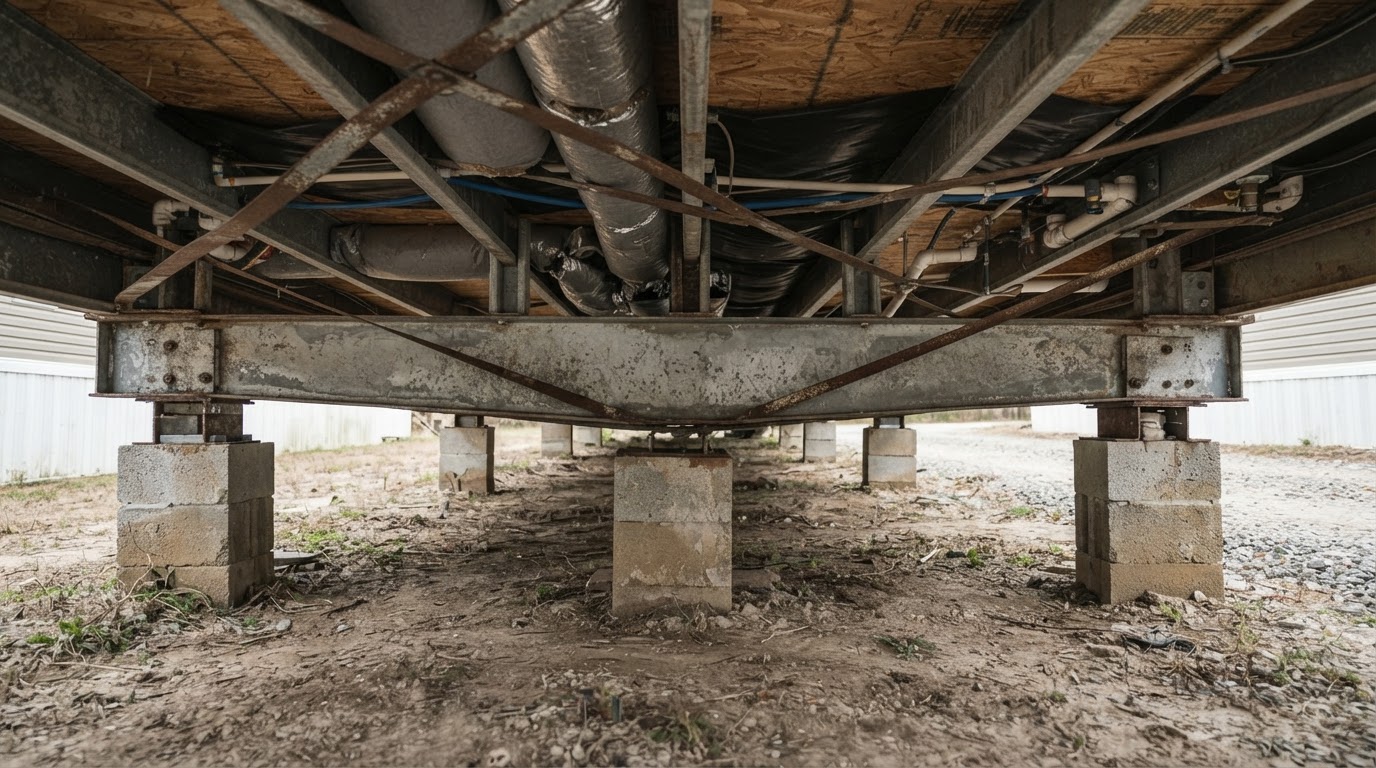
A main I-beam or chassis rail that no longer runs straight and shows a visible mid-span bow or dip may indicate deflection under load, especially where the beam is no longer fully supported along its length.
Floor Dip That Aligns With the Frame
An interior low spot that runs along the same line as the main frame may indicate that the steel beneath that area has sagged, separate from a simple elevation change.
Changing Support Contact
When a beam visibly lifts away from a pier, or bears harder on one side of a support than the other, the frame may be deflecting between support points.
Gap Between Beam and Pier
A visible opening between the bottom of the I-beam and the top of a pier can mean the frame has shifted or the support has dropped out of contact.
Interior Slope Along One Structural Line
A slope that tracks a single beam rather than affecting the whole home evenly may point to deflection along that frame line.
Marriage-Line Changes on a Double-Wide
On a multi-section home, a frame that has deflected can shift the marriage-line relationship between the two halves, producing alignment changes along the seam.
Repeated Shimming at the Same Location
When shims keep being added at the same pier, the beam above it may be moving or deflecting rather than simply settling.
Frame deflection is a structural concern that may warrant evaluation by an appropriately qualified structural professional depending on the extent of the bow. A visible sag does not automatically mean the home is unsafe, but it should be understood rather than corrected by forcing the frame with shims.
What Can Cause Manufactured Home Frame Deflection
Frame sag can come from the supports beneath the frame, from the frame itself, or from loads the frame was not designed to carry alone. The causes below describe the most common contributors, and the actual cause on any property has to be inspected rather than assumed.
Lost Support Contact
When a pier drops away from the beam, the span between the remaining supports grows, and the steel can deflect more under the same load.
Settled Pier
A pier that has sunk can remove support from one point along the frame, allowing the beam to sag between the supports on either side of it.
Damaged or Tilted Pad
A bearing pad that has moved can let the pier above it shift, which changes how the frame bears at that point.
Missing or Loose Shim
A lost shim removes the contact between the frame and a pier, leaving that span of the beam to carry more of the load.
Excessive Unsupported Span
Where supports are spaced too far apart for the load, the steel can sag between them even when each support is individually intact.
Previous Impact or Damage
A frame that has been struck, overloaded during a move, or damaged in a prior repair can carry a permanent bend.
Corrosion-Related Section Loss
Heavy corrosion that has thinned the steel can reduce the beam's capacity, letting it sag under a load it previously carried.
Altered Load From an Addition
An attached porch, deck or room addition that transfers load to the frame can change how the beam carries weight and contribute to deflection.
Frame Deflection vs Foundation Settlement
Foundation settlement and frame deflection are related but different problems, and a home can have either one without the other. Understanding which is present determines whether the fix is support work, frame work, or both.
Foundation Settlement
The supports beneath the frame have moved — piers, pads or blocks have sunk, shifted or tilted — while the steel frame itself may still be straight. The fix is usually support repair, re-leveling or reblocking.
Frame Deflection
The structural steel itself has bent or sagged, whether or not the supports beneath it have moved. The fix may involve restoring support contact, but the frame's condition also has to be evaluated.
Both Together
A home can lose support at a pier (settlement) and then develop a sag in the beam between the remaining supports (deflection). In those cases both the support system and the frame have to be read.
When Frame Sagging Needs Professional Evaluation
Frame deflection should be evaluated when a bow is visible, when support contact has been lost, when a beam has deformed, or when floor symptoms persist after leveling. The evaluation reads the frame, the supports beneath it, and the level of the home together to determine whether the appropriate path is support repair, reblocking, or a referral for structural review.
- ▸A visible bow or dip in the main steel chassis rail
- ▸A gap between the I-beam and a pier that has opened or grown
- ▸Repeated shimming at the same pier without the level holding
- ▸Corrosion along the same beam that now shows a sag
- ▸A floor slope that lines up with one frame line rather than the whole home
- ▸Marriage-line alignment changes on a double-wide
- ▸Frame deformation near a prior repair or addition attachment
Millsboro Mobile Home Leveling does not perform engineering-level structural analysis or welding unless separately verified. Depending on the extent of frame deformation, evaluation by an appropriately qualified structural professional may also be necessary.
Related Services
- Manufactured Home I-Beam & Frame Support RepairThe frame support repair service for beam and chassis issues.
- Mobile Home Structural Support RepairWhen the broader structural support beneath the frame needs correction.
- Mobile Home Foundation & Leveling InspectionThe evaluation that reads frame, supports and level together.
- Mobile Home Foundation RepairWhen a failed support component is contributing to the sag.
- Mobile Home Setup Correction & ReblockingWhen the support arrangement itself needs broader correction.
Mobile Home I-Beam Sagging & Frame Deflection FAQs
Is every visible I-beam bend a structural failure?
No. Some apparent bows reflect lost support contact or a settled pier beneath the beam rather than damage to the steel itself. The frame and the supports beneath it have to be read together before assuming the beam has failed.
Can a sinking pier make the frame appear sagged?
Yes. When a pier drops away from the beam, the span between the remaining supports grows and the steel can sag under the same load, producing a visible deflection that resolves once support is restored.
Can re-leveling fix frame deflection?
Re-leveling can correct elevation when the supports are the problem, but it will not straighten a beam that has permanently bent or lost section to corrosion. Where the steel itself has changed shape, the frame condition has to be evaluated separately.
Can corrosion contribute to frame sag?
Yes. Heavy corrosion that thins the steel can reduce the beam's load capacity and let it sag under a load it previously carried. Corrosion and deflection can appear together, which is why both are evaluated.
Can additions affect the manufactured-home frame?
An attached porch, deck or room addition that transfers load to the frame can change how the beam carries weight and contribute to deflection, especially where the addition and the home move differently.
Is frame deflection the same as floor sag?
No. Floor sag can come from the floor system itself, from the frame, or from the supports beneath the frame. An evaluation separates a floor-system cause from a frame or foundation cause because the repair is different.
When should a structural engineer be involved?
Where the beam shows significant visible bow, section loss from corrosion, or deformation that may affect structural capacity, evaluation by an appropriately qualified structural professional may be necessary in addition to foundation and leveling service.
Can support repair be needed along with frame repair?
Yes. Frame deflection and foundation settlement often appear together. Restoring support contact and reading the frame condition are both part of determining the full scope.
Do you evaluate sagging mobile home I-beams near Millsboro?
Yes. Millsboro Mobile Home Leveling evaluates frame sagging and deflection concerns for homeowners in Millsboro and across Sussex County, DE. Call 302-449-7221 to schedule.
Concerned About a Sagging Mobile Home Frame?
If a manufactured-home I-beam appears bowed, sagged or deflected, contact Millsboro Mobile Home Leveling at 302-449-7221 to schedule a frame, support and leveling evaluation in Millsboro or the surrounding Sussex County area.
Request Mobile Home Foundation Service
Serving Millsboro and all surrounding Sussex County communities.