Mobile Home Pier Repair & Replacement Millsboro
Piers are the individual support points that hold up many manufactured and mobile homes, transferring the steel frame's load down to pads, footings, or other approved bearing surfaces. Mobile home pier repair and replacement is appropriate when a pier is damaged, sinking, leaning, displaced, deteriorated, or no longer properly supporting the frame above it. Signs that a single pier may need attention include a pier visibly leaning, a pier no longer centered beneath its support point, a cracked or damaged block, a pier sinking into the supporting surface, missing or displaced shims, a gap between the support and the frame, floor slope above the affected area, or repeated leveling issues at the same spot. Millsboro Mobile Home Leveling performs this work for homeowners near Millsboro and throughout Sussex County, DE. This page is narrower than the general foundation repair page, focused on the pier itself rather than the whole support system.
Request Mobile Home Foundation Service
Serving Millsboro and all surrounding Sussex County communities.
Mobile Home Pier Repair Near Millsboro
Pier repair is appropriate when a support point beneath a manufactured home is damaged, displaced, deteriorated, sinking, or no longer properly supporting the frame above it. A pier can fail in more than one way, and each condition points toward a different correction, which is why the pier itself is inspected rather than only the floor slope above it.
Sinking Piers
A pier that has dropped into its supporting surface lowers the frame above it and creates slope or a dip in the floor. Settlement is often tied to the bearing condition beneath the pier, which may need to be addressed along with the pier itself.
Leaning or Shifted Piers
A pier that has tilted or moved off its support point is no longer transferring the frame's load straight down. Alignment and bearing both matter, and a leaning pier is a component condition rather than just a height problem.
Cracked or Broken Pier Components
A block that has cracked, spalled, or broken apart is a deteriorated support component. Damaged components usually need rebuilding or replacement rather than shimming over the break.
Pier No Longer Making Proper Contact
When a pier and the frame above it are separated by a gap, the pier is no longer providing the bearing it should. That can come from a displaced shim, a settled pad, or a shifted block, and the cause determines the repair.
Repeated Problems at the Same Support
When the same pier keeps being the source of movement, the underlying condition beneath it is usually the reason. Recurring issues at one support point may require a broader correction than simply repairing the visible pier again.
Not every visible imperfection in a pier means it needs replacement. Some conditions are corrected by re-seating the pier, re-shimming, or addressing the pad beneath it. An inspection determines whether a pier can be corrected or whether it needs to be rebuilt or replaced.
How Mobile Home Pier Problems Are Evaluated
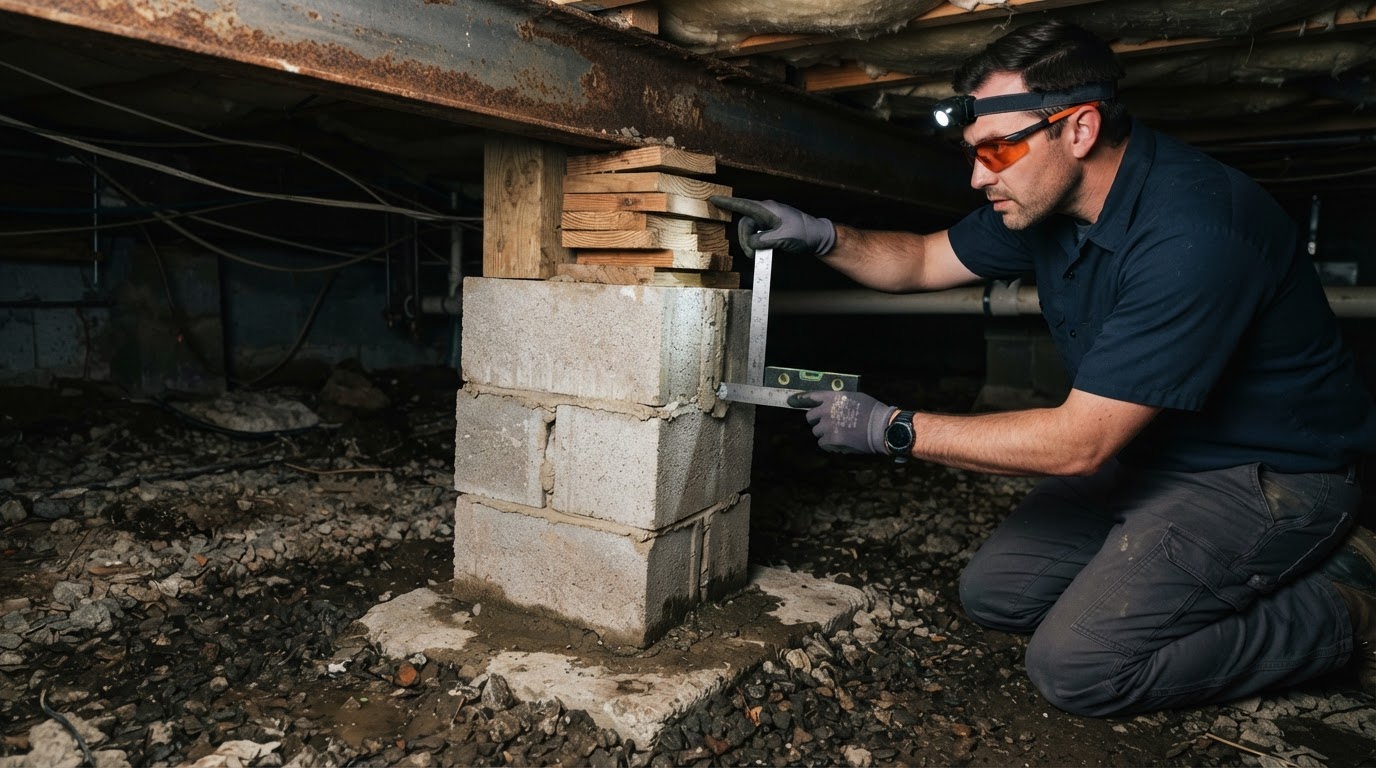
Pier repair starts by reading the pier itself, the pad or footing beneath it, and the frame it supports. The goal is to understand why the pier moved or failed before changing it, because simply swapping a visible component without considering why it failed rarely lasts.
Identify symptoms and affected areas
Discuss what you have noticed, where in the home it shows up, and which support point may be involved.
Inspect accessible piers and nearby components
Examine the pier in question along with the supports around it, since movement at one point can be related to conditions next to it.
Evaluate frame support and level conditions
Check how the frame bears on the pier and how the elevation reads across the area above it.
Examine pads, blocks, shims, and bearing
Look at the pad or footing beneath the pier, the block stack, the shims, and the visible bearing surface to find the failed component.
Determine repair vs. replacement
Decide whether the pier can be corrected in place or needs to be rebuilt or replaced, and whether the pad beneath it also needs attention.
Complete the support correction and recheck
Perform the agreed pier work and recheck the area to confirm the frame is properly supported and the correction holds.
Pier replacement should address the support system, not just swap a visible component. Detailed instructions for lifting or temporarily supporting the home are not provided here; incorrect load handling around a failed pier can damage the frame, floor, or adjacent supports.
When a Mobile Home Pier May Need Repair or Replacement
Distinguishing pier repair from pier replacement, and from broader foundation work, is what keeps this page focused on the individual pier rather than the whole support system. The condition found during inspection determines which is appropriate.
Minor Position or Bearing Correction
Some pier conditions involve correcting the support contact or alignment rather than replacing the pier. A pier that is sound but has lost bearing, shifted slightly, or lost its shim may be corrected by re-seating or re-shimming once the cause is addressed.
Damaged Block Components
When blocks are cracked, spalled, or broken, the support material itself has failed and usually needs rebuilding or replacement. Shimming over a broken block does not restore the load path the pier was designed to provide.
Significant Pier Settlement
A pier that has settled substantially may need to be rebuilt or replaced, and the bearing surface beneath it may need attention as well. Resetting the height over a pier that is still sinking will not hold.
Failed Pad or Footing Below the Pier
Replacing the pier alone will not solve a failed base condition. When the pad or footing beneath a pier has cracked, sunk, or deteriorated, that base has to be repaired or replaced before the pier above it can hold.
Reblocking
When the issue is the spacing, stacking, or layout of the piers rather than one damaged pier, reblocking corrects the support arrangement as a whole. Reblocking is broader than individual pier repair because it addresses the layout beneath the frame.
Foundation Stabilization
When a pier keeps moving after repair, the condition beneath it becomes a stabilization issue rather than a pier problem alone. Stabilization targets the cause of the continued movement so the repaired or replaced pier can hold.
Mobile Home Pier Repair in Millsboro & Sussex County
Pier repair near Millsboro and across Sussex County depends on the actual conditions under each home rather than a one-size approach. Service regularly extends to communities such as Long Neck, Dagsboro, Georgetown, Frankford, and Harbeson. The repair decision depends on the home configuration, the pier type, the support location, the existing pads and footings, the settlement pattern, the condition of the blocks, the shim condition, crawlspace accessibility, and any previous repairs. No unsupported statement is made about local soils or foundation codes; an inspection determines what the pier and the support beneath it actually need.
Related Foundation Services
- Mobile Home Foundation RepairThe broad foundation repair page covering the full range of support component failures.
- Mobile Home Pier & Beam Foundation RepairRepair of the I-beam-to-pier relationship across the whole support system.
- Manufactured Home Foundation StabilizationWhen a repaired pier keeps moving and the condition beneath it needs stabilizing.
- Mobile Home Block Pier Repair & ReplacementRebuilding damaged block pier stacks to proper bearing and alignment.
- Mobile Home Concrete Footing & Pad RepairRepair or replacement of the pad or footing beneath a settling pier.
- Mobile Home Foundation & Leveling InspectionA full evaluation of support condition before any pier is repaired or replaced.
- Mobile Home Pier Sinking & Settlement RepairWhen a pier drops downward rather than failing as a component.
- Leaning or Shifted Mobile Home Pier RepairWhen a pier has moved sideways or out of alignment beneath the frame.
Mobile Home Pier Repair & Replacement FAQs
How can I tell if a mobile home pier is failing?
Signs include a pier visibly leaning, a pier no longer centered beneath its support point, a cracked or damaged block, a pier sinking into the supporting surface, missing or displaced shims, a gap between the pier and the frame, floor slope above the affected area, or repeated leveling issues at the same support. A physical inspection of the pier and the pad beneath it confirms whether it has actually failed.
Can a leaning pier be repaired?
It depends on the condition. A pier that has shifted slightly but is otherwise sound may be corrected by re-seating or reblocking it once the cause is addressed. A pier that has tilted because its blocks have cracked or its pad has failed usually needs rebuilding or replacement rather than just pushing it back upright.
When does a pier need to be replaced?
A pier generally needs replacement when its blocks are cracked, spalled, or broken, when it has settled substantially, or when it can no longer be corrected in place. If the pad or footing beneath it has also failed, that base has to be addressed before a replacement pier can hold.
What causes a mobile home pier to sink?
A pier can sink when the bearing surface beneath it loses capacity, compacts, or shifts, or when the pad or footing under it cracks or settles. Saturated soil, poor drainage, or washout can all contribute. No specific local soil is assumed; the cause is determined by inspecting the pad and the ground beneath the pier.
Can a damaged pad cause a pier to settle?
Yes. The pad or footing beneath a pier spreads the load over the soil. A cracked, broken, or sunken pad can let the pier above it drop or tilt, and the pad often has to be repaired or replaced before the pier can hold. Replacing the pier alone will not solve a failed base condition.
Can loose shims make a pier appear unsupported?
Yes. Shims provide the final bearing contact between a pier cap and the steel frame. When shims are loose, crushed, or missing, the gap can make it look as though the pier is not supporting the frame, even if the pier itself is sound. Re-shimming restores contact, but only after confirming the support beneath the shim is stable.
Is pier repair the same as reblocking?
No. Pier repair or replacement addresses an individual support point. Reblocking corrects the layout and condition of the whole pier arrangement beneath the home, such as poorly spaced, improperly stacked, or missing piers. Reblocking is broader and is used when the support arrangement itself is the problem rather than one damaged pier.
Can one damaged pier affect the floor above it?
Yes. Because the steel frame is one connected structure, a pier that drops or shifts can change the elevation of the I-beam above it, which shows up as slope, dip, or movement in the floor over that area. The repair usually targets both the pier and the bearing condition beneath it.
Should recurring pier settlement be investigated further?
Yes. When the same pier keeps settling after repair, the cause is usually the condition beneath it rather than the pier itself. Recurring settlement points toward a stabilization or base condition that deserves evaluation rather than another repair of the visible pier.
Do you repair and replace mobile home piers near Millsboro?
Yes. Millsboro Mobile Home Leveling repairs and replaces mobile home piers for homeowners in Millsboro and across Sussex County, DE, including Long Neck, Dagsboro, Georgetown, Frankford, and Harbeson. Call 302-449-7221 to schedule an inspection.
Schedule Mobile Home Pier Repair Near Millsboro
If a pier beneath your manufactured home is sinking, leaning, damaged, or no longer supporting the frame, contact Millsboro Mobile Home Leveling at 302-449-7221 to arrange a pier inspection in Millsboro or the surrounding Sussex County area.
Request Mobile Home Foundation Service
Serving Millsboro and all surrounding Sussex County communities.