What Causes a Mobile Home to Become Unlevel?
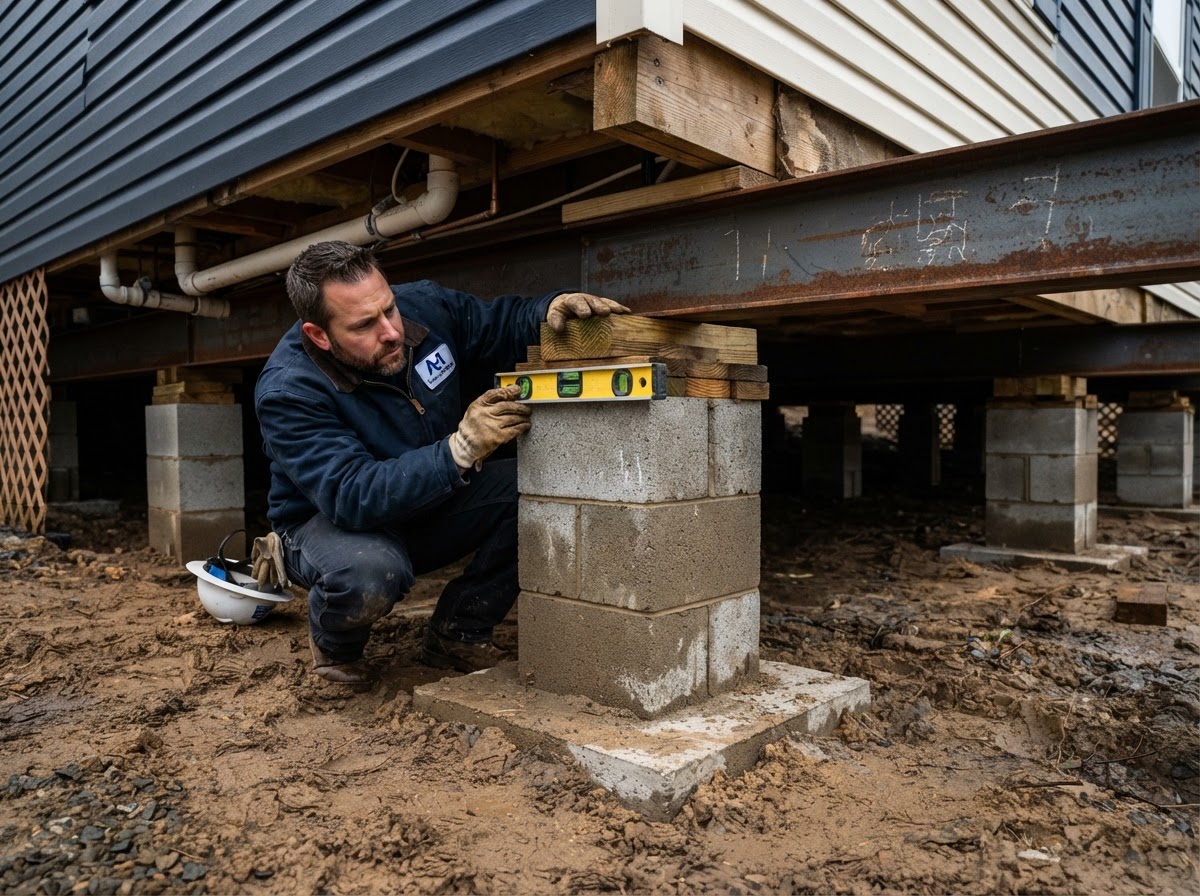
A mobile home becomes unlevel when one or more support points beneath the frame change elevation or lose contact. Common causes include settling piers, movement beneath concrete pads or footings, loose or missing shims, shifted block supports, erosion or washout, poor prior reblocking, and differential movement between the two sections of a double-wide. The visible floor slope is the symptom; the important step is determining what caused the support elevation to change before any correction is made.
Request Mobile Home Foundation Service
Serving Millsboro and all surrounding Sussex County communities.
In This Guide
- 1.How a Manufactured Home Becomes Unlevel
- 2.Pier Settlement
- 3.Concrete Pad or Footing Settlement
- 4.Loose, Missing or Displaced Shims
- 5.Leaning or Shifted Piers
- 6.Reblocking & Setup Problems
- 7.Erosion & Washout
- 8.Heavy Rain & Changing Site Conditions
- 9.Double-Wide / Multi-Section Differential Settlement
- 10.Previous Repairs That Did Not Address the Root Cause
- 11.Foundation Stabilization Problems
- 12.Does Age Alone Make a Home Unlevel?
- 13.Signs the Home May Be Becoming Unlevel
- 14.How the Cause Is Determined
- 15.Frequently Asked Questions
Signs the Home May Be Becoming Unlevel
These symptoms can suggest the support elevation is changing. None of them proves the home is out of level by itself, but several appearing together — or the same symptom returning after a previous leveling — warrant an inspection.
- New floor slope in one direction
- One side of the home feels lower
- Furniture rocks or no longer sits level
- Doors begin sticking or stop latching
- Windows become difficult to open
- Marriage-line floor transition changes in a double-wide
- Shims become loose or go missing
- Pier movement is visible beneath the home
- The home shakes or rocks more than before
- The same symptoms return after a previous leveling
For a fuller symptom guide, see Signs Your Mobile or Manufactured Home Is Out of Level.
How the Cause Is Determined
Finding the cause of an unlevel condition follows a logical sequence. The goal is to identify which support points have moved and why, so the correction matches the actual problem rather than just the visible symptom.
- 1
1. Review the symptoms
Note which rooms feel low, where doors stick, and whether the symptoms are new or recurring after a prior leveling.
- 2
2. Evaluate level and elevation
Map high and low areas across the home to locate where the support relationship has changed.
- 3
3. Inspect the supports
Examine accessible piers, blocks, pads, footings, shims, and frame contact points beneath the home.
- 4
4. Compare affected areas
Look at the supports beneath the low or high areas identified during the elevation check.
- 5
5. Identify failed or moving components
Determine whether a pier has settled, a pad has moved, a shim has loosened, or a section has shifted.
- 6
6. Match the service to the cause
Decide whether the correct service is leveling, foundation repair, reshimming, reblocking, stabilization, or another correction.
1.Pier Settlement
A pier can drop relative to the supports around it. When one pier settles, the floor above that point may become low, a shim gap can open between the pier cap and the beam, and the same area may repeatedly lose level after each adjustment. Pier settlement is often tied to what is happening beneath the pier — a pad, footing, or bearing condition — rather than the pier block itself. Correcting only the elevation without evaluating the support below is a common reason the same low spot returns.
2.Concrete Pad or Footing Settlement
A pier can be completely intact while the bearing surface beneath it moves. If a concrete pad or footing settles, cracks with displacement, or loses bearing, the pier above it drops along with it. Visible signs can include a pier that has dropped with its pad, a pad edge becoming exposed, a crack that shows movement, or the same area repeatedly becoming low. Because the problem starts below the pier, reshimming alone usually will not hold.
3.Loose, Missing or Displaced Shims
Shims sit between the pier cap and the steel beam to maintain full bearing contact. They can move, compress, fall out, or lose contact over time. A loose shim is often the first visible sign a homeowner notices — but a loose shim is not always the root cause. It can be a symptom of settlement below, where the pier has dropped and left the shim behind. Replacing the shim without finding out why it loosened is a common reason the problem returns.
4.Leaning or Shifted Piers
Not all support movement is vertical. A pier can tilt, shift sideways, or become off-center under the beam, which is a different problem from straight downward settlement. A leaning or shifted pier can lose proper bearing contact even if its elevation has not changed much, and it can create an unstable support condition. This is distinct from a pier that has simply sunk straight down, and the correction is different.
5.Reblocking & Setup Problems
Reblocking refers to the broader arrangement of block supports beneath the home. An unlevel condition can come from multiple block supports set at inconsistent heights, a poor prior correction, or a support arrangement that has shifted over time. When the problem is the arrangement of supports rather than one isolated point, correcting a single pier will not resolve the overall condition — the support layout itself needs to be evaluated.
6.Erosion & Washout
Water movement can remove supporting material from around or beneath support bases. Erosion and washout can expose pads, disturb bearing, and allow supports to settle into the void left behind. This does not mean every rainstorm causes movement — but when water has visibly moved material away from a support area, that loss of bearing is a plausible cause of a new low spot. The water source and the support damage are both worth evaluating.
7.Heavy Rain & Changing Site Conditions
Heavy rainfall may reveal a pre-existing weak support condition, increase erosion around already vulnerable support areas, or coincide with new symptoms. Rain does not simply 'soften the soil and make the home sink' as a universal explanation. The concern is whether water movement changed the bearing or support conditions beneath the home. When new symptoms appear after wet weather, the supports beneath the affected area should be evaluated rather than assuming the home only needs a quick re-level.
8.Double-Wide / Multi-Section Differential Settlement
A double-wide is two structural sections joined along a marriage line. One section can change elevation differently from the other, producing symptoms along the center seam: a marriage-line floor transition that changes, one side sitting higher or lower, trim separation, or door alignment changes near the center. This is differential settlement between sections, and it requires coordinated evaluation across both halves rather than treating the home as a single frame.
9.Previous Repairs Did Not Address the Root Cause
When a home has been leveled before and the same symptoms return, it often means the earlier correction addressed elevation without addressing what caused the elevation to change. A failed pad, a sinking pier, erosion, an unstable support arrangement, or recurring settlement can all keep producing the same low spot if the underlying cause is left in place. Repeatedly correcting elevation without diagnosis is a pattern, not a solution.
10.Foundation Stabilization Problems
There is a difference between a one-time level correction and recurring movement. A home that repeatedly becomes unlevel may need evaluation for stabilization or broader support correction rather than another adjustment. If the bearing beneath the supports keeps changing, leveling alone will keep failing. Stabilization addresses the ongoing movement so the elevation correction has a chance to hold.
Does Age Alone Make a Mobile Home Become Unlevel?
No. Age by itself does not prove foundation movement. An older home can remain level for many years when its supports, bearing, and drainage are sound. Age is often associated with older support components, previous repairs, or materials that have been in place longer — but those are condition factors, not a rule that older homes automatically go out of level. The condition of the support system matters more than the model year.
- —Older shims may have compressed over time, but that is a condition issue, not age alone
- —Older pads may have settled, but a sound pad can hold elevation indefinitely
- —Previous repairs on an older home may or may not have addressed the cause
- —A well-maintained support system can keep a home level regardless of age
Evaluating the actual support condition — not the home's age — is what determines whether movement has occurred.
How a Manufactured Home Becomes Unlevel
A manufactured home sits on a continuous support path. Weight travels from the home and its steel chassis down through the I-beams, into shims or bearing contact, onto piers or block supports, onto pads or footings, and finally into the supporting surface below. If any link in that path changes elevation or loses contact, the floor above can also change elevation. Understanding this load path is the first step in understanding why a home becomes unlevel — and why the visible slope is almost never the root cause by itself.
- •Home / chassis → I-beams → shims / bearing contact → piers / blocks → pads / footings → supporting surface
- •A change at any single support point can create a low area, a high area, or a side-to-side difference
- •The same floor slope can come from very different causes — a loose shim, a settled pad, or a shifted pier
- •Diagnosing the cause means inspecting the support path, not just measuring the floor above
- •For a deeper look at how these components fit together, see our guide to Mobile Home Foundation Types Explained
Frequently Asked Questions About Unlevel Mobile Homes
What is the most common reason a mobile home becomes unlevel?
There is no single most common cause that applies to every home. Settlement beneath one or more supports — whether at the pier, pad, or bearing surface — is a frequent factor, but the specific cause can only be determined by inspecting the supports beneath the affected area.
Can one sinking pier make a mobile home unlevel?
Yes. A single pier that drops relative to the supports around it can create a localized low spot, a shim gap, or a floor dip directly above it, depending on its location and how much it has moved.
Can loose shims cause a home to feel unlevel?
Potentially. A loose or missing shim can create a gap between the pier and the beam, which can produce a low area or movement. However, the loose shim is often a symptom of settlement below it, so the support beneath should be evaluated before simply replacing the shim.
Can heavy rain cause a mobile home to become unlevel?
It can, but not automatically. Rain becomes a concern when water movement erodes or disturbs the bearing beneath pads or footings. If new symptoms appear after wet weather, the supports beneath the affected area should be inspected rather than assuming the home only needs a quick re-level.
Can a double-wide become unlevel between the two sections?
Yes. One structural section can settle differently from the other, which often shows up along the marriage line as a changing floor transition, trim separation, or door alignment differences near the center seam.
Why does my mobile home keep becoming unlevel after it was leveled?
Recurring unlevel conditions usually mean the earlier correction addressed the elevation without addressing what caused it to change. A failed pad, a sinking pier, erosion, an unstable support arrangement, or ongoing settlement can keep producing the same low spot until the underlying cause is corrected.
Does an unlevel home always need foundation repair?
No. If the supports are sound and the elevation has simply drifted, re-leveling or reshimming may be appropriate. Foundation repair is needed when a support component has actually failed, settled, shifted, or deteriorated. An inspection determines which applies.
Can reblocking correct an unlevel mobile home?
Potentially, where the support arrangement itself is the cause — for example, multiple blocks set at inconsistent heights or a shifted support layout. Reblocking corrects the broader pier and block arrangement, which is more involved than a simple elevation adjustment.
Can the home become unlevel without obvious foundation damage?
Yes. Minor shim compaction or small elevation drift can produce a noticeable slope without any visibly broken or failed support component. An inspection confirms whether the supports are sound or whether a component has failed.
Should I inspect the foundation before re-leveling?
Yes. Diagnosis matters because re-leveling over a failed pier, a settled pad, or an eroded bearing area will usually fail. Identifying the cause first ensures the correction matches the actual problem.
Who checks mobile home leveling problems near Millsboro?
Millsboro Mobile Home Leveling evaluates unlevel conditions and the support causes beneath them throughout Millsboro and Sussex County, DE. Call 302-449-7221 or request service online to schedule an evaluation.
Find Out Why Your Home Became Unlevel
If your manufactured home has new floor slope, recurring settlement, or visible foundation-support movement, Millsboro Mobile Home Leveling can evaluate the system and help determine whether leveling or another foundation correction is appropriate.
Request Mobile Home Foundation Service
Serving Millsboro and all surrounding Sussex County communities.