Mobile Home Shimming & Reshimming Millsboro
Shims are used at selected support points to help establish proper bearing and contact between the manufactured-home frame and the supporting pier system. Mobile home shimming and reshimming corrects that final contact when shims loosen, compress, move, deteriorate, or go missing. Signs include a visible gap above a pier, loose shim material, a shim that has shifted out of position, repeated movement in one floor area, floor slope, creaking or movement associated with support changes, a home that becomes unlevel after a prior correction, or a support point that no longer contacts the frame correctly. Millsboro Mobile Home Leveling performs this work for homeowners near Millsboro and throughout Sussex County, DE. Not every floor noise is caused by shims; an inspection determines whether the contact at a support point actually changed and why.
Request Mobile Home Foundation Service
Serving Millsboro and all surrounding Sussex County communities.
Mobile Home Shimming Near Millsboro
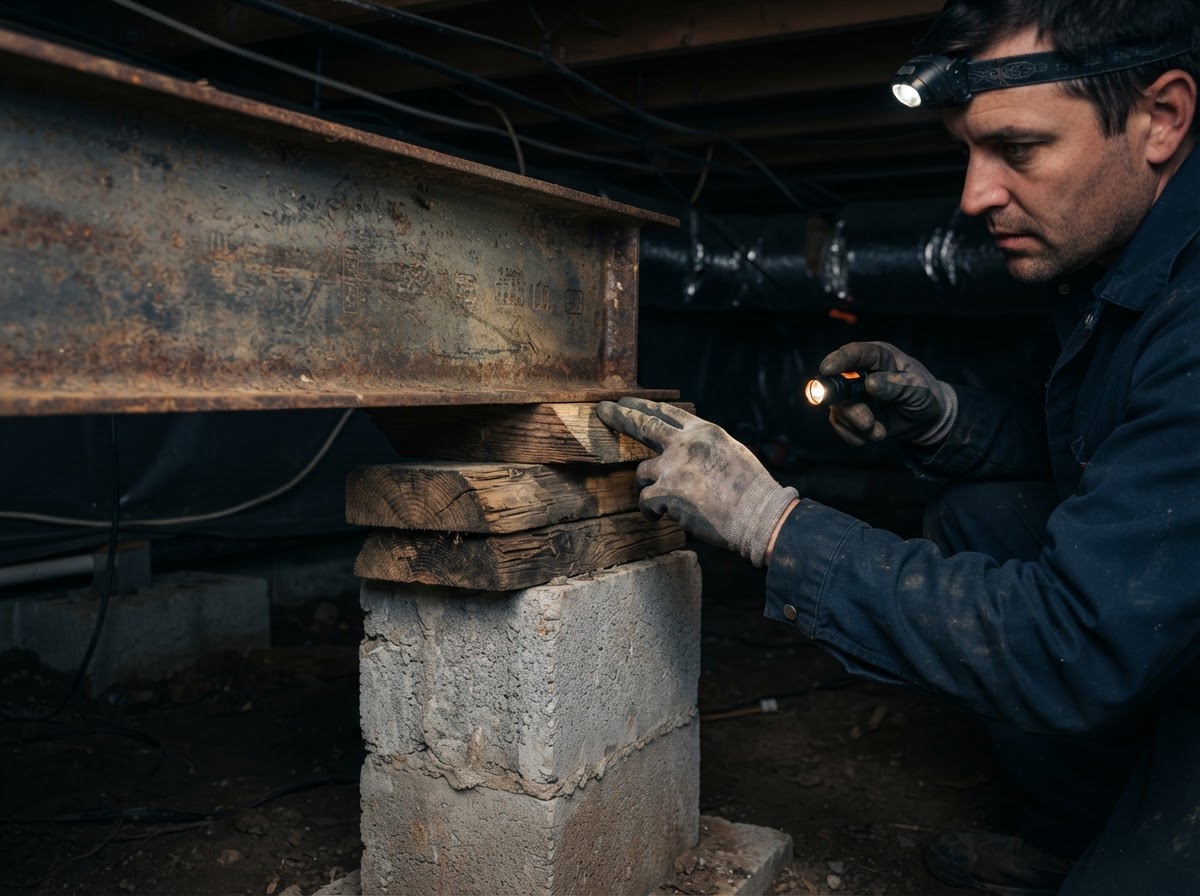
Shims help create final bearing contact and fine elevation adjustment between certain manufactured-home support points and the frame above them. In the load path, piers provide the primary vertical support, pads or footings support the pier below, and shims complete the final contact near the top where appropriate. Shims are one component of that system: they are not a substitute for a failed pier, and they cannot correct a sinking pad by themselves. Proper reshimming requires understanding why the support contact changed in the first place, not just filling the visible gap.
Loose Shims
A shim that has loosened no longer holds the firm bearing contact it was meant to provide. A loose shim can rattle, shift, or fall out, and the gap it leaves changes how the frame bears on the pier below it.
Missing Shims
A shim that has fallen out or was never installed leaves a direct gap between the pier cap and the frame. Missing shims remove bearing at that support point, which can let the frame drop toward the pier or move underfoot.
Compressed Shims
Shim material can compress over time under load, especially if it was not suited to the bearing it carries. A compressed shim thins out until it no longer holds the intended contact, which slowly changes the elevation above it.
Displaced Shims
A shim that has shifted sideways out of its bearing position is no longer doing its job even if it is still present. Displacement can come from frame movement, vibration, or a support that is still settling underneath.
Gaps Between Support & Frame
A visible gap between a pier and the frame means that support point is not carrying its share of the load. The gap can come from a loose, missing, compressed, or displaced shim — or from a pier or pad that has dropped — and the cause determines the fix.
Shims After Re-Leveling
When a home is re-leveled, the shim contact at corrected supports is rechecked so the frame bears properly on the adjusted piers. Reshimming is often part of a larger re-leveling process rather than a standalone fix, because the elevation correction and the contact correction work together.
Reshimming should follow the actual support condition rather than simply forcing material into a visible gap. A gap can exist because a shim failed, because a pier settled, or because a pad dropped — and each cause points to a different correction.
How Mobile Home Shimming & Reshimming Is Evaluated
Shim service starts by reading the contact at the top of the pier, the pier itself, and the pad beneath it together. The goal is to understand why the contact changed before adding or replacing any shim material, because forcing shims into a gap without finding the cause rarely lasts.
Identify symptoms and suspected support areas
Discuss what you have noticed, where in the home it shows up, and which support point may be involved.
Check level and elevation conditions
Read how the frame sits and where the elevation changes across the area in question.
Inspect piers, frame contact, pads, and existing shims
Examine the accessible piers, the contact area at the top of each pier, the pads or footings below, and the shims already in place.
Determine why shim contact changed
Find whether the gap came from a failed shim, a settled pier, a dropped pad, or broader movement of the support system.
Decide whether reshimming alone is appropriate
Determine whether reshimming is enough or whether leveling, pier repair, pad repair, or stabilization is also needed before the contact is corrected.
Correct support contact and recheck the area
Restore proper bearing contact and recheck the elevation and support above the corrected point.
Reshimming should follow the actual support condition rather than simply forcing material into visible gaps. Detailed DIY wedge placement or hammering instructions are not provided here; incorrect shimming over a settling pier or failed pad can hide a worsening condition instead of fixing it.
When Mobile Home Reshimming May Require Additional Repair
This section is what makes shimming useful as its own page rather than a repeat of general leveling. A gap at a support point can mean a simple contact problem or a deeper support problem, and telling them apart is what decides whether reshimming alone is enough or whether more is needed.
Shim Moved but Pier Remains Stable
When a shim has loosened, compressed, or shifted but the pier beneath it is plumb, sound, and bearing on a stable pad, the issue is an isolated support-contact problem. Reshimming restores the contact, and that may be all the support point needs.
Pier Is Sinking
If the pier beneath the shim is settling, adding more shim material does not correct the cause of the settlement. The shim stack simply grows while the pier keeps dropping, which is why a sinking pier is a pier or base problem rather than a shim problem.
Pad or Footing Has Settled
When the pad or footing under the pier has dropped, the base issue has to be considered first. Reshimming over a settled pad hides the gap temporarily but does not stop the base from continuing to move.
Block Pier Has Shifted
A block pier that has shifted out of alignment changes where the shim bears on the stack. A misaligned support may need pier correction before the shim contact can be restored in the right place.
Home Is Broadly Out of Level
When the whole home or a large section is out of level, reshimming individual points is usually part of a larger re-leveling process rather than a standalone fix. The elevation correction and the contact correction are done together.
Repeated Shim Movement
When shims keep coming loose at the same spot, the cause is usually the support beneath them still moving. Recurring shim movement can signal a stabilization or support problem that deserves evaluation rather than another reshim.
Reshimming corrects support contact. Re-leveling corrects elevation. Pier or pad repair corrects failed support components. Knowing which one the symptom points to is what determines whether reshimming alone will hold.
Mobile Home Reshimming in Millsboro & Sussex County
Shim-related service near Millsboro and across Sussex County depends on the actual support system under each home rather than a single approach. Service regularly extends to communities such as Long Neck, Dagsboro, Georgetown, Frankford, and Harbeson. The work depends on the existing pier system, frame configuration, home size, settlement pattern, previous leveling work, pad and footing condition, block-pier condition, and crawlspace accessibility. No unsupported assumption is made about home age or local soils; an inspection determines why the contact at a support point actually changed.
Related Leveling & Foundation Services
- Mobile & Manufactured Home LevelingThe broad leveling page covering the full support and elevation relationship.
- Mobile Home Re-LevelingRe-leveling when the whole home needs elevation correction, not just contact.
- Mobile Home Foundation RepairThe broad foundation repair page covering damaged supports of every kind.
- Mobile Home Pier Repair & ReplacementWhen the pier beneath the shim is the failed component.
- Mobile Home Foundation & Leveling InspectionA full evaluation of contact, pier, and pad condition before any reshim.
- Mobile Home Setup Correction & ReblockingWhen the support arrangement beneath the frame needs correcting as a whole.
- Loose or Missing Mobile Home ShimsThe problem page for a shim that has loosened, compressed, or gone missing.
Mobile Home Shimming & Reshimming FAQs
What do shims do under a mobile home?
Shims help create final bearing contact and fine elevation adjustment between certain manufactured-home support points and the frame above them. Piers provide the primary vertical support, pads support the pier below, and shims complete the contact near the top. They are one component of the support system, not a substitute for a failed pier or pad.
How can I tell if a mobile home shim is loose?
Signs include a visible gap above a pier, loose shim material at a support point, a shim that has shifted out of position, or movement and creaking in the floor over that area. A loose shim no longer holds the firm bearing contact it was meant to provide, and an inspection confirms whether the contact actually changed.
Can missing shims cause floor movement?
Yes. A missing shim leaves a direct gap between the pier cap and the frame, removing bearing at that support point. That can let the frame drop toward the pier or move underfoot, which shows up as movement or slope in the floor above.
Can shims compress over time?
Yes. Shim material can compress under load, especially if it was not suited to the bearing it carries. A compressed shim thins out until it no longer holds the intended contact, which slowly changes the elevation above it and can look like gradual settlement.
Is reshimming the same as re-leveling?
No. Reshimming corrects support contact at the top of a pier. Re-leveling corrects the elevation the frame is sitting at across the home. Reshimming is often part of a larger re-leveling process, but the two are not the same — a contact problem and an elevation problem can have different causes.
Can I just add more shims if there is a gap?
The reason for the gap should be evaluated first. A gap can come from a failed shim, a settled pier, or a dropped pad, and each cause points to a different correction. Forcing more material into a gap over a settling pier or failed pad hides the symptom temporarily instead of fixing the condition beneath it.
What if a shim keeps coming loose?
When a shim keeps coming loose at the same spot, the cause is usually the support beneath it still moving rather than the shim itself. Recurring shim movement can signal a stabilization or support problem that deserves evaluation rather than another reshim that will not hold.
Can a sinking pier be fixed with shims?
No, shimming alone generally does not correct the cause of a sinking support. Adding shims over a settling pier simply grows the shim stack while the pier keeps dropping. The pier or the pad beneath it has to be addressed before the contact above it can hold.
Are shims used under single-wide and double-wide homes?
Yes, shims are used at selected support points under both single-wide and double-wide manufactured homes, though the number and arrangement of support points vary with the home's configuration. The shim's role — final bearing contact at the top of a pier — is the same regardless of home type.
Do you provide mobile home reshimming near Millsboro?
Yes. Millsboro Mobile Home Leveling performs mobile home shimming and reshimming for homeowners in Millsboro and across Sussex County, DE, including Long Neck, Dagsboro, Georgetown, Frankford, and Harbeson. Call 302-449-7221 to schedule an inspection.
Schedule Mobile Home Shimming Near Millsboro
If shims beneath your manufactured home are loose, missing, compressed, or no longer providing proper bearing contact, contact Millsboro Mobile Home Leveling at 302-449-7221 to arrange a shimming inspection in Millsboro or the surrounding Sussex County area.
Request Mobile Home Foundation Service
Serving Millsboro and all surrounding Sussex County communities.