Manufactured Home Foundation Inspection Checklist for Home Buyers
Before buying a manufactured home, buyers should understand the condition of the home's level, piers, blocks, pads or footings, shims, frame support, anchoring system, and — on a double-wide — the marriage-line relationship between sections. The goal is not to diagnose every problem yourself, but to identify conditions that deserve professional evaluation before you commit to the property. This is a foundation-focused buyer checklist, not a substitute for a full home inspection, engineering inspection, pest inspection, or appraisal.
Request Mobile Home Foundation Service
Serving Millsboro and all surrounding Sussex County communities.
In This Guide
- 1.Quick Buyer Checklist
- 2.Start With the Home's Level
- 3.Check Piers & Block Supports
- 4.Check Pads & Footings
- 5.Check Shims & Support Contact
- 6.Check Frame / I-Beam Support
- 7.Double-Wide Marriage Line Checklist
- 8.Anchoring & Tie-Down Checklist
- 9.Look for Water, Erosion & Washout
- 10.Ask About Previous Foundation Work
- 11.What If the Home Was Recently Re-Leveled?
- 12.What If the Buyer Inspection Finds Foundation Problems?
- 13.Pre-Purchase Foundation Inspection vs. Full Home Inspection
- 14.Sussex County & Millsboro Buyer Context
- 15.Frequently Asked Questions
Double-Wide Marriage Line Checklist
On a double-wide, the buyer's checklist gains a section-to-section consideration. Look for an uneven floor transition at the center, one section sitting lower than the other, trim separation along the seam, wall or ceiling seam changes, doors near the center that have shifted, or visible support differences beneath the two sections. Cosmetic movement can exist without foundation failure, so not every seam symptom is structural — but it is worth evaluating.
- •Uneven floor transition at the center seam
- •One section lower than the other
- •Trim separation along the marriage line
- •Wall or ceiling seam changes near the center
- •Doors near the center that have shifted
- •Visible support differences beneath the two sections
For how section relationships change, see Single-Wide vs. Double-Wide Mobile Home Leveling.
Quick Buyer Checklist
Use these four categories as a starting point. None of these signs proves a problem by itself; several appearing together warrant professional evaluation.
- Exterior / interior symptoms: floors feel uneven, one side appears lower, doors stick, windows bind, the home shakes or rocks, or a double-wide center seam feels uneven
- Under-home / foundation conditions: leaning or sinking pier, broken block, cracked or settled pad, loose or missing shim, frame support gap, visible washout, or previous reblocking
- Anchoring conditions: rusted strap, loose strap, missing strap, missing or damaged ground anchor, or disconnected components
- Documentation / history: previous leveling, previous foundation repair, inspection reports, repair records where available, and installation or foundation documentation where available
Sellers are not automatically required to provide every record listed above beyond what applicable disclosure law requires. This checklist is educational and does not guarantee that any condition exists or is absent.
1.Start With the Home's Level
Before anything else, notice whether the home feels level. Floor slope, one side that appears lower, uneven room transitions, furniture that rocks, or doors and windows that have changed can all point to foundation or support movement. A buyer does not need to diagnose the cause — the point is to notice the symptom so it can be evaluated. For a fuller symptom list, see Signs Your Mobile or Manufactured Home Is Out of Level.
2.Check Piers & Block Supports
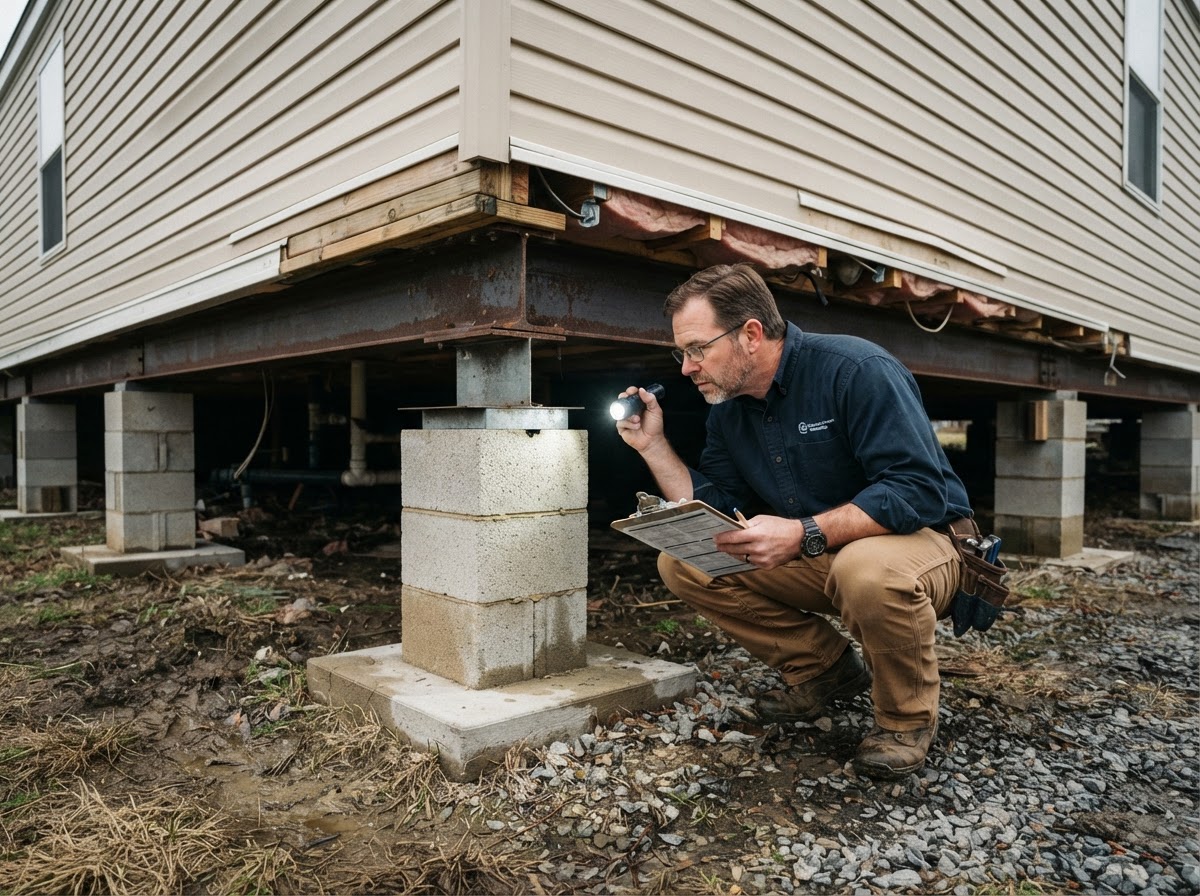
Where the crawlspace is safely accessible, visible piers and block supports can be checked for leaning, sinking, cracking, shifting, or inconsistent support. A leaning or sinking pier warrants evaluation regardless of how the floor feels. Buyers should not crawl beneath a home where access or stability is uncertain — visible inspection from safe, accessible areas is appropriate.
3.Check Pads & Footings
Concrete pads and footings sit beneath the piers and carry the load to the ground. Signs worth evaluating include settlement, cracks that show displacement rather than harmless surface cracking, an exposed pad edge, and erosion or washout around the bearing area. A pad can move while the pier above it remains intact, so pad and footing condition matter independently.
4.Check Shims & Support Contact
Shims sit between the pier cap and the beam to maintain bearing contact. Loose, missing, or displaced shims can be a visible sign of support movement — but the shim is often a symptom, not the root cause. The movement below (a settled pier or pad) is usually what created the gap. A loose shim deserves evaluation, not just replacement.
5.Check Frame / I-Beam Support
A manufactured home's steel frame and I-beams carry the home's load to the support points. Buyers should look for appropriate support relationships at the intended support points — gaps, uneven bearing, or visible distortion can warrant further evaluation. Frame damage should not be diagnosed from photos alone; a professional evaluation is the right next step.
Look for Water, Erosion & Washout
Water movement can change the bearing beneath supports over time. Visible signs a buyer might notice include erosion channels, exposed pads, material loss around supports, water flow paths beneath the home, or repeatedly wet areas. Visible water does not automatically mean foundation damage — but it does mean the drainage and support area deserve evaluation.
- •Erosion channels through the crawlspace or around supports
- •Exposed pad edges where bearing material has been lost
- •Visible material loss around a footing or support
- •Water flow paths beneath the home after rain
- •Repeatedly wet or pooled areas near supports
Pre-Purchase Foundation Inspection vs. Full Home Inspection
A foundation-focused evaluation is narrower than a full home inspection. They are not interchangeable, and a buyer may reasonably want both:
| Condition | Typical Scope |
|---|---|
| Foundation-focused evaluation | Level/elevation, piers and blocks, pads and footings, shims, frame support, marriage-line issues, and visible anchoring concerns. |
| Full home inspection | Broad home systems — electrical, plumbing, roof and exterior, HVAC, and general property condition — in addition to any visible structural items. |
Exact scope depends on the provider. This page does not claim any particular licensing or certification for any inspector.
What If the Buyer Inspection Finds Foundation Problems?
If the buyer's own observations or a foundation-focused evaluation turn up conditions that warrant further work, the next steps are generally:
- Obtain a foundation-focused evaluation to scope the actual support condition
- Understand whether re-leveling, pier, pad, shim, or anchoring work is needed
- Review the scope and what each item addresses
- Coordinate transaction decisions with the appropriate real-estate, legal, and lender professionals
What If the Home Was Recently Re-Leveled?
Recent leveling can be routine maintenance, or it can be a sign that the home has a recurring movement problem. Useful questions include: Why was it leveled? Was a pier or pad problem found during that work? Did the same symptoms return afterward? Was only elevation corrected, or was broader support work performed? A recent leveling by itself is neither a red flag nor a clean bill of health — the reason it was needed is what matters. For the causes behind recurring movement, see What Causes a Mobile Home to Become Unlevel? and our guide on Mobile Home Leveling vs. Foundation Repair.
Anchoring & Tie-Down Checklist
The anchoring system is separate from the vertical supports. Visible buyer concerns include rusted straps, loose straps, missing straps, missing or damaged ground anchors, and disconnected components. If the system's condition is unknown, a professional can evaluate it. Buyers should not judge compliance with installation requirements themselves — that is a question for a qualified professional and, where applicable, the local authority.
Ask About Previous Foundation Work
Where records are available, questions about prior work help frame the home's foundation history. These are suggested buyer questions, not legal demands — what a seller must disclose is governed by applicable disclosure law.
- ?Has the home been re-leveled? When, and why?
- ?Has it been reblocked at any point?
- ?Have piers been replaced or rebuilt?
- ?Have pads or footings been repaired?
- ?Have tie-downs or ground anchors been replaced?
- ?Has recurring settlement been noted at the same area?
- ?Is there documentation available — repair records or inspection reports?
This is not legal advice. Disclosure obligations depend on the transaction and jurisdiction; a real-estate or legal professional can advise on what applies to your purchase.
Sussex County & Millsboro Buyer Context
Buyers shopping for manufactured homes in Millsboro, Long Neck, Dagsboro, Georgetown, Frankford, Harbeson, Selbyville, and Millville should evaluate the actual home and property rather than assume foundation condition based on community alone. Support condition varies from home to home within the same neighborhood, and the same buyer checklist applies whether the home sits inland or closer to the coast. What matters is the condition of the supports, pads, shims, anchoring, and — for double-wides — the marriage line beneath that specific home.
Frequently Asked Questions: Buying a Manufactured Home
Should I inspect the foundation before buying a manufactured home?
Yes. Understanding the condition of the level, piers, pads, shims, frame support, anchoring, and marriage line (on a double-wide) helps you identify conditions that deserve professional evaluation before you commit. A buyer cannot fully inspect the foundation themselves, but recognizing warning signs is useful.
What is the biggest foundation warning sign when buying?
There is no single universal 'biggest' sign. Combined symptoms matter more than any one item — for example, a low side together with a loose shim and an exposed pad edge is more concerning than any one of those alone. Several symptoms appearing together warrant a professional evaluation.
Is a leaning pier always serious?
It warrants evaluation, but severity varies. A pier that has shifted slightly may be a different scope than one that has leaned significantly or lost bearing contact. A professional evaluation can determine whether repair is needed.
Should rusted tie-down straps concern a buyer?
They should be evaluated. Surface rust is not automatically a failure, but heavy corrosion, flaking, a loose or disconnected strap, or a missing anchor all deserve a closer look by a qualified professional.
Does an uneven double-wide center seam mean the foundation is bad?
Not automatically. Some seam movement is cosmetic and can exist without foundation failure. But a changing floor transition, or one that returns after correction, warrants evaluation of both sections and the supports beneath them.
Should I worry if the home was recently re-leveled?
Not automatically. Recent leveling can be routine, or it can point to a recurring movement problem. The right question is why it was needed and whether the same symptoms have returned — not simply that leveling was performed.
Is a foundation inspection the same as a full home inspection?
No. A foundation-focused evaluation looks at level, piers, pads, shims, frame support, marriage-line issues, and visible anchoring. A full home inspection covers broader systems such as electrical, plumbing, roof, and HVAC. They are different scopes and a buyer may reasonably want both.
Can a buyer request a foundation-focused inspection?
Generally yes, as part of due diligence where allowed, but transaction rules depend on the purchase agreement and jurisdiction. A real-estate or legal professional can advise on what applies to your transaction.
Does a foundation inspection guarantee there are no hidden problems?
No. An inspection evaluates accessible and visible conditions. It cannot guarantee the absence of every hidden issue, and this page makes no such guarantee. Documentation and a qualified evaluation reduce uncertainty but do not eliminate it.
Should I inspect a used single-wide differently from a double-wide?
The core checklist is the same — level, piers, pads, shims, frame support, and anchoring. A double-wide adds a section-to-section and marriage-line consideration that a single-wide does not have.
Who provides manufactured-home foundation evaluations near Millsboro?
Millsboro Mobile Home Leveling performs foundation and leveling evaluations throughout Millsboro and Sussex County, DE. Call 302-449-7221 or request service online to schedule an evaluation.
Schedule a Pre-Purchase Foundation Evaluation Near Millsboro
If you are buying a manufactured home and want a foundation-focused evaluation of the level, supports, and anchoring system, Millsboro Mobile Home Leveling can evaluate the visible system and help determine the appropriate next step before you commit.
Request Mobile Home Foundation Service
Serving Millsboro and all surrounding Sussex County communities.