Mobile Home Leveling vs. Foundation Repair: What’s the Difference?
Mobile home leveling and foundation repair address two fundamentally different aspects of under-home support. Mobile home leveling is an elevation correction service performed when structural supports remain sound but parts of the steel chassis frame sit too high or too low relative to surrounding points. Using controlled hydraulic jacks and water level altimeters, technicians adjust the frame to bring the floor back to true level. Foundation repair is a structural component repair service performed when support elements — such as concrete pads, CMU block piers, cap boards, or steel I-beams — have physically cracked, settled into soil, leaned out of plumb, or deteriorated. A home can require leveling without foundation repair, foundation repair without major re-leveling, or both services combined when a failed support causes elevation loss.
Request Mobile Home Foundation Service
Serving Millsboro and all surrounding Sussex County communities.
In This Guide
- 1.Core Differences: Leveling vs. Foundation Repair
- 2.What Is Mobile Home Leveling?
- 3.What Is Mobile Home Foundation Repair?
- 4.Direct Comparison Matrix
- 5.When Leveling Alone Is Appropriate
- 6.When Foundation Repair Is Required
- 7.When Both Services Are Needed Together
- 8.Leveling vs. Reshimming
- 9.Leveling vs. Reblocking & Setup Correction
- 10.Leveling vs. Foundation Stabilization
- 11.Leveling vs. Wind Tie-Down Anchoring
- 12.How Technicians Determine Which Service You Need
- 13.Cost Considerations: Leveling vs. Repair
- 14.Frequently Asked Questions
What Is Mobile Home Foundation Repair?
Mobile home foundation repair is a structural restoration service that replaces or rebuilds damaged, settled, or deteriorated support elements:
Foundation repair is required when an under-home support element loses its structural capacity to carry weight. Common foundation repair tasks include: 1) Pier Rebuilding — Tearing down leaning, cracked, or crushed CMU block piers and reconstructing them plumb with fresh cap blocks; 2) Concrete Pad Footing Repair — Replacing cracked, broken, or settled concrete footings with new reinforced pads; 3) Reblocking — Resetting or adding new piers under unsupported chassis sections or heavy marriage-line load points; 4) Frame Repair — Reinforcing sagging or damaged steel I-beams with supplementary steel underpinning or jack stands; and 5) Erosion Repair — Restoring washed-away ground bearing beneath footings after heavy rain or flooding.
When Foundation Repair Is Required
Foundation repair is mandatory before or during leveling if any of the following structural conditions exist: 1) Sinking Piers — A pier has dropped significantly because the concrete pad beneath it cracked or settled into soft soil; 2) Leaning or Shifted Piers — CMU blocks have tilted out of vertical plumb, risking collapse under chassis vibration; 3) Cracked or Crumbled CMU Blocks — Concrete masonry blocks show vertical fractures, spalling, or mortar deterioration; 4) Crushed or Missing Shims — Softwood shims have crushed or fallen out, leaving a structural gap under the beam; 5) Soil Washout — Rain or flood runoff has eroded soil from under concrete footings; and 6) Double-Wide Marriage Line Sag — Central marriage-line support posts have dropped, causing section-to-section seam separation.
Distinguishing Other Under-Home Service Scopes
Clarifying other related service terms helps homeowners compare repair proposals:
- Reshimming: A narrow subset of leveling where loose or missing shims are replaced above sound piers. Does not involve lifting the frame significantly.
- Reblocking: Rebuilding or resetting multiple pier columns across the home to correct improper pier spacing or out-of-plumb block stacks.
- Foundation Stabilization: Installing ground bearing enhancements, wider pads, or soil stabilization beneath footings to stop ongoing settlement.
- Tie-Down & Anchoring: Replacing rusted straps or installing ground anchors to resist wind uplift. Anchoring is a separate safety system from vertical load leveling.
Asking your contractor to explain which specific scopes are included in a proposal prevents surprises.
Understanding Under-Home Terminology
Homeowners facing sloping floors, sticking doors, or floor bounce frequently use 'leveling' and 'foundation repair' interchangeably. However, in the manufactured housing industry, these two terms describe completely different service scopes, technical methods, and material requirements.
- •Mobile Home Leveling = Elevation Correction: Adjusting frame height above intact piers using hydraulic lifting and shim placement
- •Foundation Repair = Component Reconstruction: Rebuilding cracked block piers, replacing broken concrete footings, or fixing sagging steel I-beams
- •Leveling assumes the underlying piers and pads are structurally sound and capable of holding load
- •Foundation repair fixes damaged or compromised supports so they can hold weight safely before or during leveling
- •Re-leveling over a cracked pad or leaning pier without fixing the pier causes the home to go out of level again within weeks
- •Proper diagnosis identifies whether the root cause is a simple elevation shift or a failed structural support component
Direct Comparison Matrix: Leveling vs. Foundation Repair
The matrix below contrasts the core characteristics of leveling and foundation repair services:
| Condition | Typical Scope |
|---|---|
| Primary Focus | Leveling: Frame Elevation & Floor Flatness. Foundation Repair: Structural Integrity of Piers & Footings. |
| Underlying Support Status | Leveling: Piers & pads are sound; height is misaligned. Foundation Repair: Piers, blocks, or pads are cracked, leaning, or broken. |
| Typical Equipment Used | Leveling: Precision water levels, hydraulic bottle jacks, hardwood shims. Foundation Repair: Hydraulic lifting, CMU masonry blocks, concrete, rebar, steel stands. |
| Work Location | Leveling: Top of pier cap block under steel beam flange. Foundation Repair: Entire pier column, footing pad, subsoil bearing zone. |
| Root Cause Addressed | Leveling: Minor elevation drift or shim compression. Foundation Repair: Component fracture, footing settlement, soil washout, or structural overload. |
| Durability If Misapplied | Leveling: Leveling over a broken pier will fail quickly. Foundation Repair: Rebuilding the pier without re-leveling leaves the floor sloping. |
A thorough crawlspace inspection determines whether your home requires one service or a combined repair plan.
What Is Mobile Home Leveling?
Mobile home leveling (or re-leveling) is an elevation adjustment process designed to restore the steel chassis frame to a flat, true horizontal plane:
When Leveling Is Used
Appropriate when ground consolidation or minor shim compaction causes small elevation differences across the chassis while piers, blocks, and pads remain fully intact.
Technical Execution
Technicians place heavy hydraulic jacks under main I-beams near low points, read frame elevation with precision fluid water levels, raise the beam to match baseline height, and insert hardwood shims.
Primary Goal
Eliminates floor slope, realigns door and window frames, closes interior drywall seam gaps, and restores double-wide marriage line alignment.
Component Impact
Leveling does not replace or rebuild masonry blocks, concrete pads, or ground anchors — it adjusts height above existing sound supports.
When Both Services Are Needed Together
In practice, foundation repair and re-leveling frequently occur together as a two-stage repair sequence:
- Stage 1 (Foundation Repair): Technicians place temporary hydraulic jacks to support the frame, rebuild cracked piers, reset settled pads, or repair eroded soil bearing zones.
- Stage 2 (Re-Leveling): Once all structural supports are reconstructed and sound, technicians raise the chassis to precise water-level alignment and install permanent hardwood shims.
- Executing both steps ensures that the home is brought back to flat level AND that the underlying supports will hold that elevation long-term.
When Leveling Alone Is Appropriate
Leveling alone is the correct service when the crawlspace inspection confirms that: 1) All concrete pads and footings are uncracked, level, and sitting firmly on subsoil; 2) All CMU block piers are plumb, uncracked, and structurally sound; 3) The floor slope is caused merely by minor shim compaction or minor uniform soil consolidation; 4) No ground washout or water pooling is eroding pad edges; and 5) Steel I-beams show no structural deformation. In these cases, adjusting height with hydraulic jacks and inserting fresh pressure-treated hardwood shims restores true level without needing component masonry work.
Symptom & Service Path Guide
Use this quick guide to understand which evaluation path corresponds to common homeowner symptoms:
- ?Symptom: Broad floor slope across a room, piers & pads uncracked → Likely Path: Re-leveling and reshimming.
- ?Symptom: Single deep floor dip over one pier, pier visible leaning → Likely Path: Pier rebuild / pad repair + localized re-leveling.
- ?Symptom: Doors sticking, drywall cracking, double-wide center seam separated → Likely Path: Dual-chassis marriage line re-leveling and pier check.
- ?Symptom: Floor bouncing or shaking when walking → Likely Path: Shim tightness check, supplementary pier addition, or floor joist inspection.
- ?Symptom: Soil washed away under pier pads after heavy rain → Likely Path: Erosion repair, pad resetting, pier rebuilding, and re-leveling.
- ?Symptom: Rusted, dangling metal straps under crawlspace → Likely Path: Tie-down strap replacement (Anchoring service, distinct from leveling).
A crawlspace inspection confirms the exact condition beneath your home.
Cost & Project Scope Considerations
Because leveling adjusts height above sound supports, a straightforward re-leveling job is generally less involved than comprehensive foundation repair. Foundation repair involves additional masonry materials, concrete footing work, and structural preparation. However, trying to save money by paying for 'cheap re-leveling' over broken piers is a false economy: shimming over a leaning pier will fail as the pier continues to settle. For detailed cost breakdowns in Delaware, explore our companion guides: 'How Much Does Mobile Home Leveling Cost in Delaware?' and 'How Much Does Mobile Home Foundation Repair Cost in Sussex County?'
How Professional Technicians Determine Which Service You Need
Determining whether your home needs leveling, foundation repair, or both follows a methodical 5-step diagnostic process:
- 1
1. Interior Elevation Mapping
Measure floor height across the floor plan using a precision water level altimeter to map high and low points.
- 2
2. Crawlspace Physical Inspection
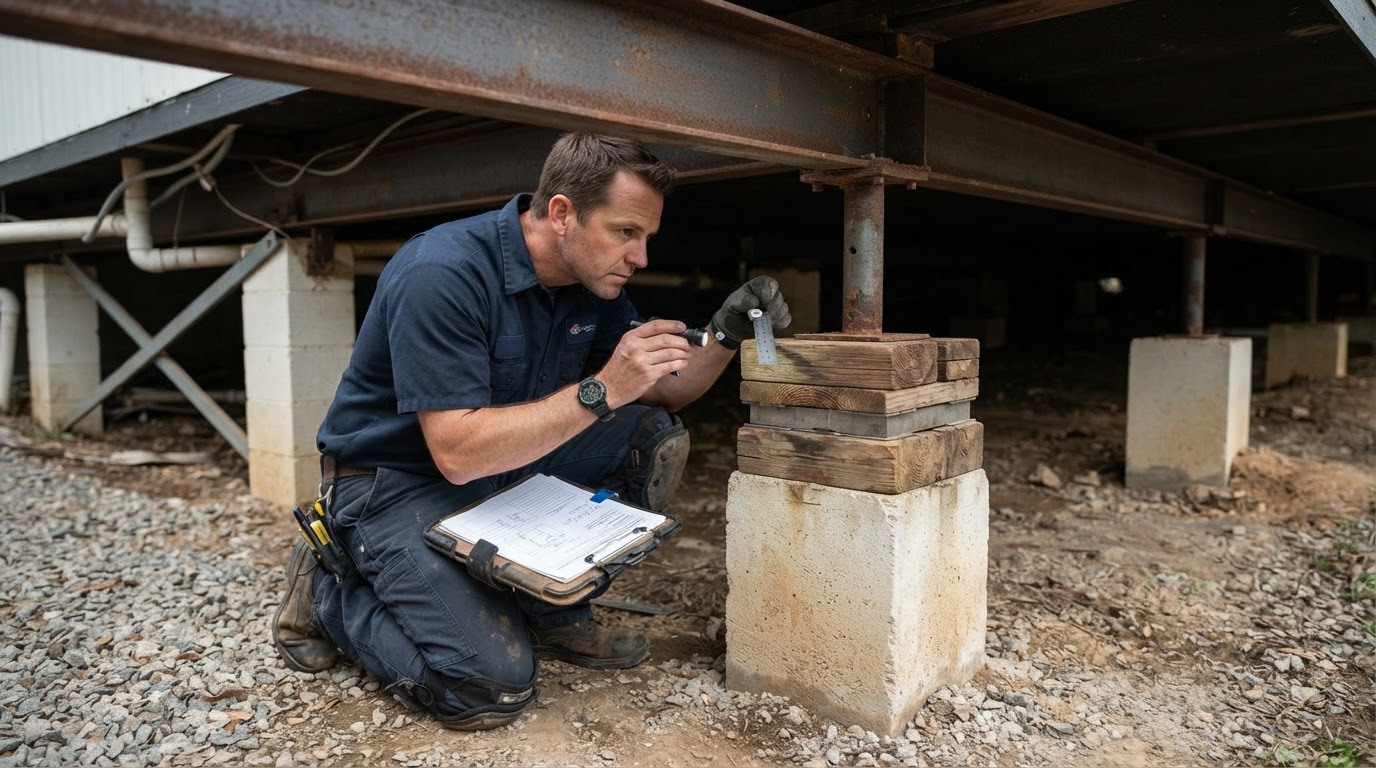
Inspect every accessible pier, block stack, concrete pad, cap board, shim stack, and I-beam flange under the home.
- 3
3. Structural Component Evaluation
Classify support conditions: Are piers plumb and uncracked? Are pads stable? Are shims tight? Is soil dry and firm?
- 4
4. Cause Identification
Determine why elevation changed: Simple shim compaction vs. cracked pad settlement vs. leaning block pier vs. soil erosion.
- 5
5. Targeted Scope Recommendation
Formulate a clear proposal: Re-leveling alone if supports are sound, or pier/pad foundation repair combined with re-leveling if components have failed.
Frequently Asked Questions About Leveling vs. Foundation Repair
Is mobile home leveling the same as foundation repair?
No. Leveling adjusts the frame height of a home whose structural supports are already sound. Foundation repair physically rebuilds or replaces damaged, leaning, or cracked piers, pads, or steel frame components.
Can a mobile home be re-leveled if a concrete pier is cracked?
No. Re-leveling over a cracked or leaning pier will fail because the broken pier cannot hold weight. The cracked pier must be repaired or rebuilt first before final elevation adjustments are made.
How do I know if my mobile home needs leveling or foundation repair?
A crawlspace inspection determines the service path. If piers and pads are uncracked and plumb but the floor slopes, re-leveling is needed. If piers are leaning, blocks are cracked, or pads are sinking, foundation repair is required.
What is the difference between reshimming and re-leveling?
Reshimming is inserting hardwood shims into small gaps above existing piers to restore full contact. Re-leveling is a broader process using hydraulic jacks to lift low points of the steel frame back to true horizontal alignment.
What is reblocking a mobile home?
Reblocking involves resetting, rebuilding, or adding new pier columns across the chassis to correct improper pier spacing or unplumb block stacks.
Does foundation stabilization level the home?
Stabilization fixes the ground bearing beneath footings to stop ongoing settlement. Re-leveling is then performed to bring the frame back to flat elevation.
Are tie-downs part of mobile home leveling?
No. Tie-downs and ground anchors are a separate wind resistance safety system. While technicians inspect anchors during crawlspace work, tie-down replacement is a distinct service from load-bearing leveling.
Can a double-wide need marriage line alignment without foundation repair?
Yes. If the center marriage-line piers are structurally sound but have settled slightly, re-leveling the central beam restores alignment without requiring pier rebuilding.
How long does mobile home leveling take compared to foundation repair?
A straightforward re-leveling typically takes several hours to a single day. Foundation repair involving pier rebuilds, pad replacements, or reblocking may take one to two days depending on scope.
How do I schedule a crawlspace inspection near Millsboro, DE?
Contact Millsboro Mobile Home Leveling at 302-449-7221 or request service online to schedule an expert under-home evaluation in Sussex County.
Schedule an Under-Home Evaluation Near Millsboro
Unsure whether your manufactured home needs re-leveling, pier repair, or foundation stabilization? Contact Millsboro Mobile Home Leveling at 302-449-7221 to schedule a comprehensive crawlspace evaluation in Millsboro or Sussex County, DE.
Request Mobile Home Foundation Service
Serving Millsboro and all surrounding Sussex County communities.