What Happens During a Mobile Home Re-Leveling?
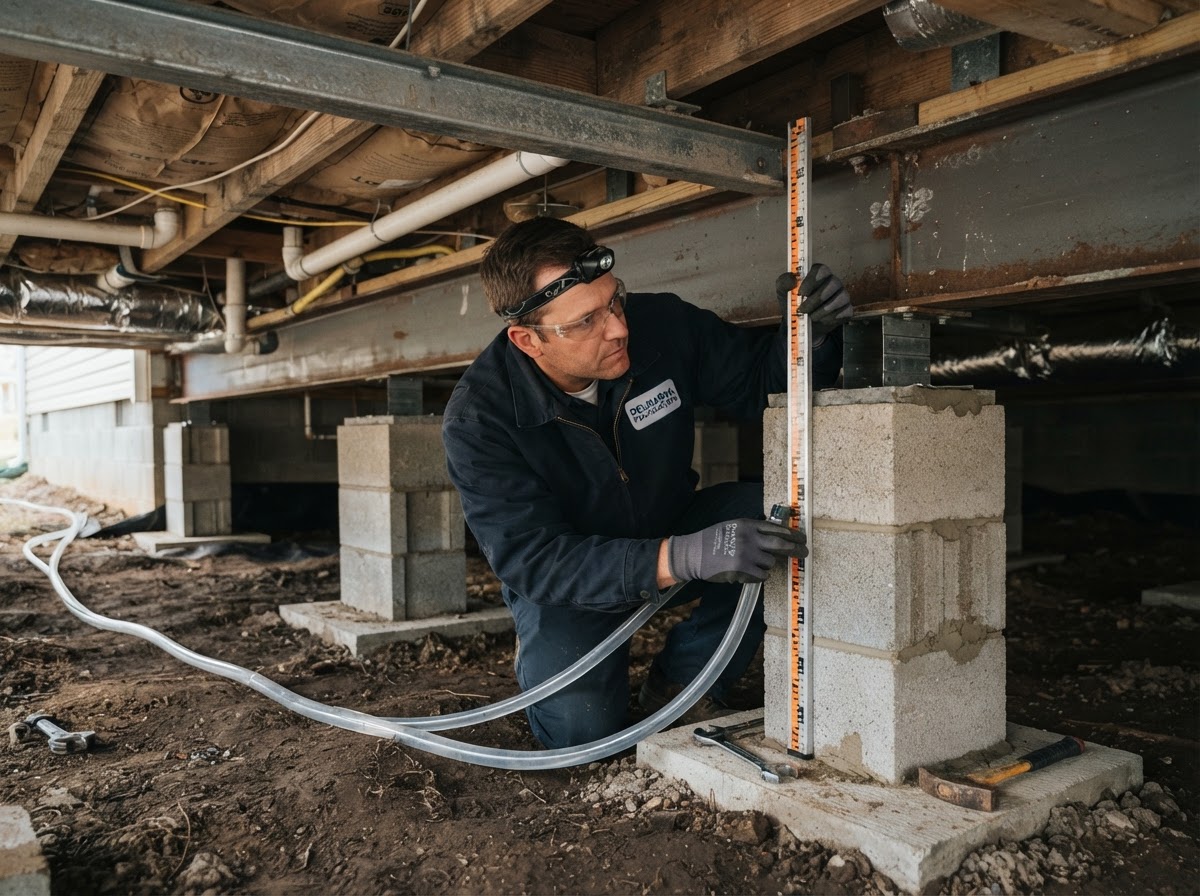
During a mobile home re-leveling, the home's elevation is checked, the accessible support system is inspected, low or high areas are identified, and the support relationship is adjusted where appropriate so the frame returns to a more consistent level condition. A professional should also look for underlying problems such as sinking piers, settled pads, loose shims, reblocking issues, or recurring settlement before treating the job as a simple adjustment. Re-leveling corrects elevation; it does not automatically repair failed support components.
Request Mobile Home Foundation Service
Serving Millsboro and all surrounding Sussex County communities.
In This Guide
- 1.Before Leveling Begins: Identify the Symptoms
- 2.Step 1: Evaluate the Home's Level / Elevation
- 3.Step 2: Inspect the Support System
- 4.Step 3: Determine Why the Home Became Unlevel
- 5.Step 4: Decide Whether Leveling Alone Is Appropriate
- 6.Step 5: Controlled Level Correction
- 7.Step 6: Shim / Bearing Contact Adjustments
- 8.Step 7: Double-Wide / Multi-Section Alignment
- 9.Step 8: Recheck Supports & Elevation
- 10.What Re-Leveling Does NOT Automatically Fix
- 11.How Long Does Re-Leveling Take?
- 12.Do You Need to Leave the Home During Re-Leveling?
- 13.What Happens After Re-Leveling?
- 14.Frequently Asked Questions
Do You Need to Leave the Home During Re-Leveling?
There is no universal answer. Job conditions, contractor procedures, and safety requirements vary from project to project. Some level corrections can be performed while the home is occupied; others may require the homeowner to vacate specific areas or the entire home depending on the scope. The contractor should provide project-specific instructions based on the actual work being performed. This page does not make safety claims about whether a home can remain occupied during any particular job.
The Re-Leveling Process, Step by Step
A professional re-leveling follows a logical sequence. The goal is to correct elevation while also identifying whether an underlying support problem needs to be addressed first or at the same time. This is a conceptual overview of what professionals evaluate and why — not a do-it-yourself procedure.
- 1
1. Evaluate the home's level and elevation
The technician assesses relative elevation to identify low areas, high areas, side-to-side differences, end-to-end differences, and section-to-section differences using professional leveling and elevation tools.
- 2
2. Inspect the support system
Accessible piers, blocks, pads, footings, shims, and frame or I-beam support points are examined. Leveling should not ignore visibly failed supports, because adjusting elevation over a failed component will not hold.
- 3
3. Determine why the home became unlevel
Possible underlying causes are considered: pier settlement, pad settlement, shim movement, shifted supports, a reblocking problem, washout, double-wide differential settlement, or recurring foundation movement.
- 4
4. Decide whether leveling alone is appropriate
Some homes primarily need an elevation correction. Others may first need or simultaneously need pier repair, pad repair, reshimming, reblocking, stabilization, or underpinning before a level correction will hold.
- 5
5. Controlled level correction
Where appropriate, the home's support relationship is adjusted in a controlled manner to restore elevation. Professional leveling uses controlled structural adjustment rather than abrupt lifting.
- 6
6. Shim and bearing contact adjustments
Support contact may be corrected, loose or missing shims may be addressed, and the frame-to-pier relationship is rechecked so bearing is consistent across support points.
- 7
7. Double-wide / multi-section alignment
For multi-section homes, elevation is considered across both sections, the marriage-line transition is evaluated, and one section's relationship to the other is checked since each section can settle differently.
- 8
8. Recheck supports and elevation
Final evaluation considers level, support contact, pier position, shim contact, the section relationship, and any remaining repair needs before the job is considered complete.
What Re-Leveling Does NOT Automatically Fix
Setting realistic expectations matters. Re-leveling corrects the elevation of the frame above the supports. It does not automatically repair components or systems that are separate from the elevation adjustment.
- •Broken or soft subfloor
- •Door hardware or window hardware problems
- •Major interior finish cracks that need cosmetic repair
- •A failed concrete pad beneath a pier
- •A corroded tie-down strap or missing ground anchor
- •Ongoing washout or erosion around the supports
- •The underlying cause of recurring settlement
If any of these are present, they may need to be addressed separately or as part of a broader scope. See our guide to Mobile Home Leveling vs. Foundation Repair for the distinction.
Before Leveling Begins: Identify the Symptoms
A re-leveling starts with the symptoms the homeowner has noticed. Common reports include floor slope, one side feeling low, sticking doors, a marriage-line transition that has changed, shaking or rocking when walking, visible support changes, or a level condition that has returned after a previous correction. These symptoms help guide the inspection, but they do not determine the repair by themselves — the same symptom can come from very different causes beneath the home.
- •Floor slope or a low side reported by the homeowner
- •Doors or windows that have begun sticking
- •A marriage-line floor transition that has changed in a double-wide
- •Shaking or rocking felt when walking through the home
- •Visible support changes noticed beneath the home
- •A level condition that returned after a previous leveling
What Happens After Re-Leveling?
After a re-leveling, homeowners should monitor the home for recurring symptoms and address any conditions that could cause movement to return.
- Watch for any new floor slope in the weeks and months after the correction
- Note any shim or support movement visible beneath the home
- Address drainage or washout concerns where water may be reaching the support area
- Schedule further evaluation if the same symptoms return, since recurring movement points to an underlying cause
- For guidance on how often to check the foundation, see How Often Should a Mobile Home Be Re-Leveled?
How Long Does Mobile Home Re-Leveling Take?
There is no fixed duration that applies to every home. Project time depends on home size, whether it is a single-wide or double-wide, the number of affected supports, crawlspace access, whether repair work is needed beyond the level correction, settlement severity, reblocking, and any foundation damage discovered during inspection. A straightforward level correction on a smaller home with good access is generally shorter than a job that uncovers failed supports requiring repair. A contractor can give a project-specific estimate after evaluating the home.
Frequently Asked Questions About the Re-Leveling Process
What does mobile home re-leveling actually do?
Re-leveling checks the home's elevation, inspects the accessible supports, identifies low or high areas, and adjusts the support relationship so the frame returns to a more consistent level condition. It corrects elevation — it does not automatically rebuild failed supports.
Does re-leveling mean lifting the whole home?
Not necessarily. Re-leveling involves controlled adjustment of the support relationship at specific points, not lifting the entire structure at once. Professionals use controlled structural adjustment rather than abrupt lifting, and the scope depends on what the elevation check and support inspection reveal.
Are piers checked before leveling?
They should be evaluated where accessible and relevant. Inspecting the supports before adjusting elevation matters because leveling over a failed or settled pier will usually not hold. The support inspection is a normal part of determining whether leveling alone is appropriate.
Are shims adjusted during re-leveling?
Potentially. Where support contact has changed, loose or missing shims may be addressed and the frame-to-pier bearing rechecked. However, a loose shim is often a symptom of settlement below, so the support beneath is evaluated rather than simply replacing the shim.
Can a sinking pier be fixed by re-leveling alone?
Not necessarily. If a pier has settled because the pad or bearing beneath it has moved, adjusting elevation above it will not correct the cause. The pier or pad may need repair before or alongside the level correction so the adjustment holds.
Can a double-wide be re-leveled?
Yes. A double-wide is re-leveled with additional consideration for the two sections: elevation is checked across both halves, the marriage-line transition is evaluated, and one section's relationship to the other is considered since each section can settle differently.
Does re-leveling fix sticking doors?
It may improve door alignment if foundation movement caused the sticking. However, if the sticking is from door hardware, frame warping, or a non-foundation cause, re-leveling will not resolve it and separate door repair may still be needed.
Does leveling fix cracked concrete pads?
No. Leveling adjusts elevation above the supports; it does not repair a cracked or settled pad. If a pad has failed, it may need repair before or alongside the level correction, or the home may simply go out of level again.
Can a home become unlevel again later?
Yes. If support conditions change, settlement recurs, or an underlying cause was not addressed, the home can lose level again. Monitoring after the correction and addressing drainage or support issues helps, but recurring movement points to a cause that should be evaluated.
Is re-leveling the same as reblocking?
No. Re-leveling adjusts elevation. Reblocking corrects or rebuilds a broader pier and block support arrangement. Reblocking often includes level considerations, but it is more comprehensive than a simple elevation adjustment.
Who provides mobile home re-leveling near Millsboro?
Millsboro Mobile Home Leveling performs re-leveling and support inspection throughout Millsboro and Sussex County, DE. Call 302-449-7221 or request service online to schedule an evaluation.
Schedule a Re-Leveling Evaluation Near Millsboro
If you are not sure whether your manufactured home needs leveling, foundation repair, or anchoring service, Millsboro Mobile Home Leveling can evaluate the visible support system and help determine the appropriate next step.
Request Mobile Home Foundation Service
Serving Millsboro and all surrounding Sussex County communities.