Refinancing a Manufactured Home in Delaware: Foundation Inspection, Certification & Repair Considerations
Whether you need a foundation inspection or engineer certification to refinance a manufactured home in Delaware depends on the loan program, lender, foundation type, property classification (personal property vs. real property), and existing documentation. FHA, VA, and conventional real-estate loans frequently require documented compliance with federal guidelines (such as the HUD Permanent Foundations Guide for Manufactured Housing), whereas chattel financing or streamline refinances may have different criteria. Homeowners should always ask their lender for the specific foundation documentation required before ordering inspections or ordering work.
Request Mobile Home Foundation Service
Serving Millsboro and all surrounding Sussex County communities.
In This Guide
- 1.Do You Need a Foundation Inspection to Refinance?
- 2.Why Refinance Foundation Requirements Vary
- 3.Foundation Inspection vs. Engineer Certification
- 4.Foundation Conditions That May Affect Refinancing
- 5.Repair Before Final Lender Review
- 6.Foundation Document Checklist Before Refinancing
- 7.Frequently Asked Questions & Official Sources
Foundation Inspection vs. Engineer Certification During Refinancing
Homeowners often confuse contractor foundation inspections with licensed engineer certifications. They serve entirely different purposes during a mortgage refinance:
Contractor Foundation Inspection
Performed by a specialized foundation contractor to evaluate physical conditions — chassis level, pier stability, pad condition, shim contact, and visible anchoring. Helps define physical repair needs.
Licensed Engineer Certification
A formal structural document issued and stamped by a licensed Professional Engineer (PE) or architect. Verifies that the foundation design meets specific federal or lender structural criteria.
Regulatory Installation Inspection
Conducted by Sussex County or local building officials during original placement or major permitted structural modifications to verify building code compliance.
Contractor inspections and engineer certifications are complementary, not interchangeable. If a lender requires a stamped engineer certification, a contractor inspection report alone will not fulfill that underwriting condition. However, if the engineer identifies physical support deficiencies, a foundation contractor is hired to execute the required physical repairs.
Foundation Document Checklist Before Refinancing
Preparing your foundation documentation early can prevent unnecessary closing delays during a manufactured home refinance in Delaware:
- Ask your loan officer for the exact foundation document requirements for your specific loan program.
- Locate any prior engineering foundation certifications or structural reports from when you purchased the home.
- Gather receipts, invoices, or service records for any previous re-leveling, pier repair, or tie-down work.
- Confirm whether your home is titled as real property or personal property with Sussex County Assessment.
- Inspect visible perimeter skirting to ensure crawlspace ventilation and access doors are intact.
- Check for obvious interior indicators of settlement — sticking doors, unlevel floors, or ceiling seam gaps.
- If physical support issues are visible, schedule a foundation evaluation before ordering a paid engineer certification.
Millsboro Mobile Home Leveling performs physical foundation repair, re-leveling, pier rebuilding, and anchoring services. We do not issue engineering seals or guarantee loan approval.
Do You Need a Foundation Inspection to Refinance a Manufactured Home in Delaware?
There is no single statewide rule that applies to every manufactured-home refinance. Requirements vary significantly based on how the transaction is structured and which lending guidelines govern the mortgage:
- •Government-backed loans (FHA, VA, USDA) often require a permanent foundation engineering certification demonstrating compliance with HUD 4930.3G standards.
- •Conventional real-estate refinances may require structural or foundation documentation acceptable to Fannie Mae or Freddie Mac guidelines.
- •Personal-property (chattel) loans typically focus on home value, age, and title rather than permanent foundation engineering.
- •Streamline refinance programs (such as FHA Streamline or VA IRRRL) may waive updated physical foundation checks if prior acceptable documentation exists on file.
- •Homes classified as real property generally face stricter foundation documentation rules than homes titled as personal property.
- •The best first step is to request the lender's exact written foundation requirement before scheduling inspections or contractor repairs.
Why Manufactured Home Refinance Requirements Vary
Foundation criteria differ because different loan programs manage structural risk and property classification differently. Below is a general overview of common financing categories:
| Condition | Typical Scope |
|---|---|
| FHA / HUD Refinance | Typically requires evidence that the foundation meets the HUD Permanent Foundations Guide for Manufactured Housing (PFGMH 4930.3G), certified by a licensed professional engineer or architect. |
| VA Refinance | Generally requires a permanent foundation that meets VA and HUD structural requirements, including proper anchoring, perimeter enclosure, and site suitability. |
| Conventional Mortgage | Fannie Mae and Freddie Mac guidelines usually require the home to be affixed to a permanent foundation, taxed as real property, and verified by an appraisal or engineer report. |
| Chattel / Personal Property Loan | Secured by the home title rather than real estate. Usually does not require a HUD permanent foundation certification, though physical stability is still required. |
| Streamline / Express Refinance | May reuse existing foundation documentation if the original loan was government-backed and no major structural alterations have occurred since. |
This overview provides general context and is not financial or mortgage lending advice. Always verify loan-specific foundation guidelines directly with your mortgage lender.
Foundation Conditions That May Affect a Refinance
An engineer or appraiser evaluating a manufactured home foundation for a refinance looks for physical conditions that compromise structural stability or code compliance. Common issues include:
Chassis Level & Elevation Deficits
Noticeable floor slopes, sagging main rails, or double-wide marriage line separation that indicate unaddressed settlement.
Shifted or Damaged Piers
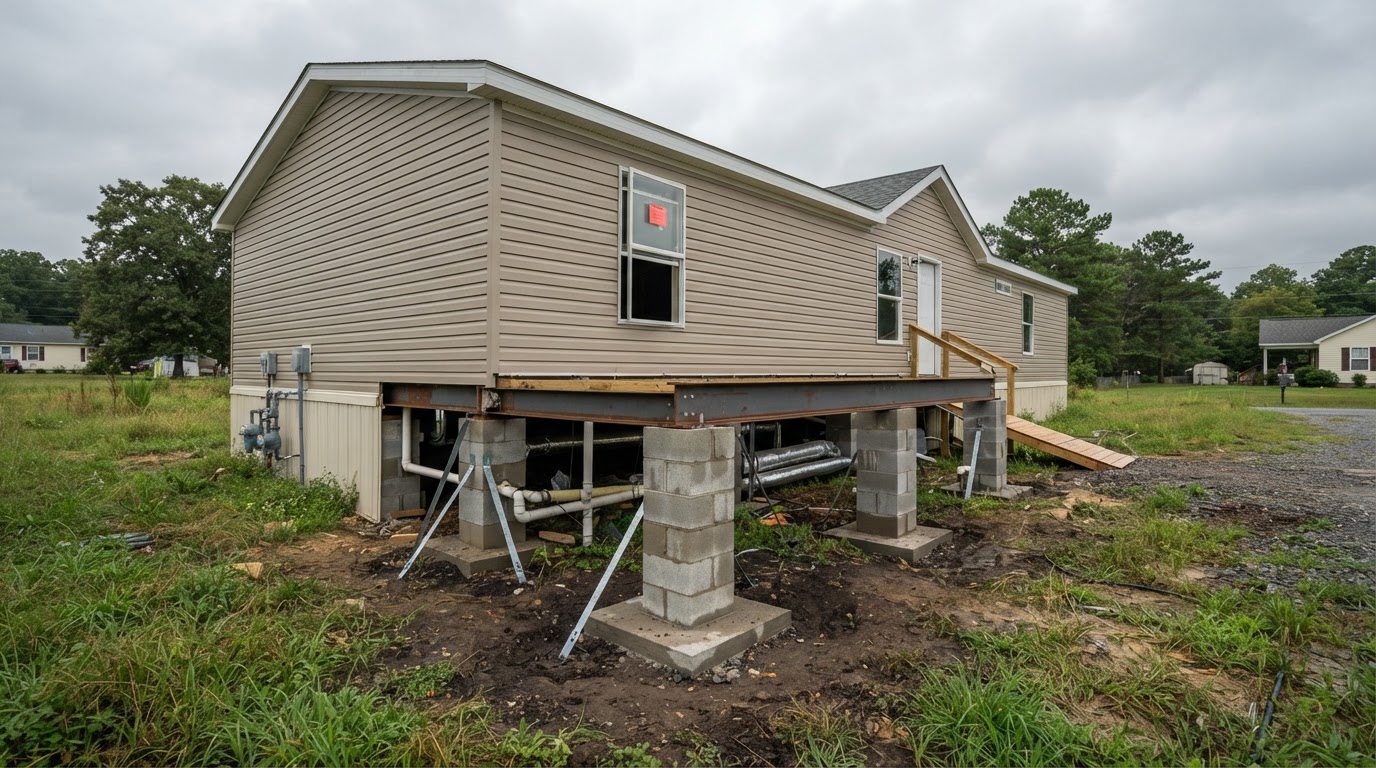
Leaning CMU block piers, cracked concrete blocks, or piers resting on soil without adequate concrete footing pads.
Crushed or Missing Shims
Wooden shims that have decayed, compressed, or fallen out, leaving air gaps between support piers and main I-beams.
Deteriorated Anchoring Systems
Rusted tie-down straps, missing ground anchors, or loose frame connectors that fail wind-resistance requirements.
Unapproved Alterations or Additions
Attached porches, carports, or room additions that transfer loads onto the manufactured home frame without independent support.
Drainage & Standing Water Issues
Washout or standing water in the crawlspace that threatens footing bearing capacity or accelerates component decay.
What If Foundation Repairs Are Needed Before Final Review?
If an inspection reveals physical defects, repairs must typically be completed before the lender's final underwriting approval or engineer re-inspection:
- Step 1: Obtain the specific list of foundation deficiencies from your lender, appraiser, or structural engineer.
- Step 2: Contact a specialized foundation contractor to evaluate the physical scope — re-leveling, pier rebuilding, pad repair, or tie-down replacement.
- Step 3: Complete approved foundation and anchoring repairs according to standard manufactured home structural practices.
- Step 4: Request a follow-up visit or photo verification from the engineer or inspector to confirm repair completion.
- Step 5: Provide the updated contractor documentation or engineer seal to your mortgage lender for clear-to-close signoff.
Official Sources & Regulatory Disclaimer
Primary references for manufactured-home refinancing guidelines include: 1) HUD Permanent Foundations Guide for Manufactured Housing, 4930.3G (hud.gov); 2) HUD Title I and Title II Loan Insurance Programs (hud.gov); 3) Fannie Mae Single Family Selling Guide B5-2-02 (fanniemae.com); 4) VA Pamphlet 26-7, Chapter 11 — Lender Handbook (va.gov); and 5) Sussex County Department of Assessment (sussexcountyde.gov). DISCLAIMER: This guide provides general educational information only and does not constitute mortgage, financial, legal, or engineering advice. Loan requirements vary by lender and program. Confirm all documentation requirements directly with your mortgage lender.
Frequently Asked Questions: Refinancing & Foundation Requirements
Does every manufactured home refinance require an engineer certification?
No. Government-backed loans (FHA/VA) and many conventional real-estate loans frequently require a stamped engineer certification. However, chattel refinancing, express streamline programs, or lenders with prior documentation on file may not require a new engineering report.
Can a contractor foundation inspection satisfy my lender's engineer requirement?
No. A contractor inspection evaluates physical conditions for service purposes. If your lender's underwriting conditions specify a stamped engineer certification under HUD 4930.3G, it must be performed by a licensed Professional Engineer or architect.
Can an existing foundation certification be reused for a refinance?
Sometimes. If the original certification was completed under acceptable federal standards and no structural additions or foundation modifications have occurred since, some lenders may accept the existing report. Check with your loan officer.
What if an addition was attached to my mobile home since the last inspection?
Unapproved additions (porches, carports, sunrooms) that transfer loads onto the manufactured home frame can cause a foundation inspection or engineer certification to fail. Additions usually must be self-supporting.
Does a permanent foundation guarantee refinance approval?
No. Foundation compliance is only one underwriting condition. Credit, income, appraisal value, debt-to-income ratios, and title status also determine refinance eligibility.
Can foundation repairs be completed before ordering the engineer report?
Yes. Addressing visible floor slopes, leaning piers, crushed shims, or loose tie-downs beforehand can help ensure the initial engineering review passes without requiring costly re-inspections.
Does Millsboro Mobile Home Leveling issue HUD engineer certifications?
No. Millsboro Mobile Home Leveling is a specialized foundation contractor that executes physical re-leveling, pier repair, reblocking, pad repair, and anchoring work. Engineering certifications must be issued by a licensed Professional Engineer.
What is the first step if my lender requests a foundation certification?
First, ask your lender for the written engineering guidelines specified for your loan type. Next, inspect your crawlspace or have a contractor evaluate physical support conditions, then hire a licensed structural engineer if required.
Need Physical Foundation Repairs Before Refinancing?
If your lender or engineer identified physical settlement, pier damage, or tie-down deficiencies on your Sussex County manufactured home, Millsboro Mobile Home Leveling can help. Call 302-449-7221 or request service online.
Request Mobile Home Foundation Service
Serving Millsboro and all surrounding Sussex County communities.