Do Mobile Home Leveling & Foundation Repairs Require a Permit in Delaware?
Permit and inspection requirements for mobile-home foundation work in Delaware depend on the scope of work and the local jurisdiction. New installation or replacement is regulated differently from many repair or adjustment situations, so the applicable county or municipality should be contacted before significant foundation work begins. There is no universal yes-or-no answer — a re-level on an existing home is not the same regulatory event as placing a new home, and a major structural change may require review even on an existing foundation.
Request Mobile Home Foundation Service
Serving Millsboro and all surrounding Sussex County communities.
In This Guide
- 1.How Delaware Regulates Manufactured Home Installation
- 2.Foundation Work That May Require Permit or Inspection Review
- 3.What About Re-Leveling, Shimming, Pier Repair & Tie-Down Work?
- 4.Why Property Jurisdiction Matters
- 5.How to Confirm Whether Your Project Needs a Permit
- 6.Related Resources
- 7.Frequently Asked Questions & Official Sources
How Delaware Regulates Manufactured Home Installation
Delaware separates regulated installation from ordinary repair. Understanding that separation is the first step in answering the permit question:
Installation Is Regulated
Under Delaware Code Title 24, Chapter 44, manufactured-home installation is a regulated activity governed by state law and the Delaware Board of Manufactured Home Installation (24 DE Admin. Code 4400).
Licensed Installers
Covered installations must be performed by a licensed Delaware Manufactured Home Installer or certified master installer.
Installation Inspections
Regulated installations are subject to inspection — footing, tie-down, and final stages — administered by the local authority.
Local Authorities Participate
Counties and municipalities administer local building permits and inspections alongside the state installation framework.
The key distinction is between installation — placing, replacing, or reinstalling a home — and repair or maintenance on a home that is already installed. Delaware's installation rules target the former; they do not automatically classify every repair as a new installation. See Delaware Manufactured Home Installation & Foundation Requirements for the full statewide framework.
What About Re-Leveling, Shimming, Pier Repair & Tie-Down Work?
Common repair and adjustment work on an existing home is generally a different category from new installation. Each item below is evaluated on its own scope — do not assume the same permit treatment applies to all of them:
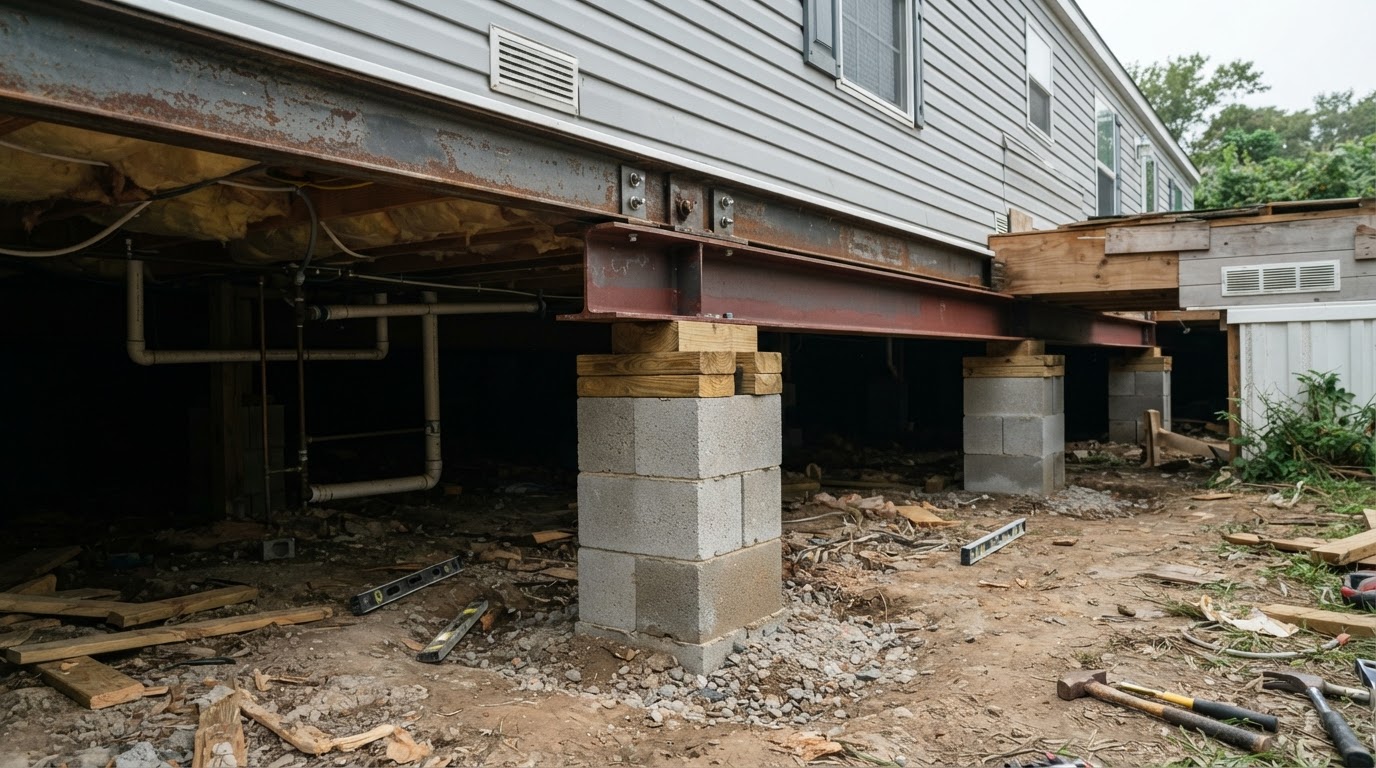
- Re-leveling: correcting elevation on an already-installed home to address floor slope or bearing loss.
- Shimming / reshimming: restoring bearing contact between a pier cap and the beam above.
- Pier repair: correcting a damaged, leaning, or settled individual pier on an existing footing.
- Block correction: replacing or repositioning concrete masonry blocks in an existing pier stack.
- Pad repair: repairing or resetting a settled or damaged concrete pad beneath an existing support.
- Reblocking: rebuilding the support arrangement on an existing footing.
- Tie-down replacement: swapping a rusted or damaged strap for a new strap on an existing anchor system.
- Ground-anchor correction: replacing a missing, bent, or corroded anchor in an existing system.
Exact permit requirements for any of these depend on the work scope and the local jurisdiction. Do not guess — confirm with the applicable authority when the scope is unclear or significant.
The Short Answer: It Depends on Scope and Jurisdiction
The permit question turns on two things — what the work actually is, and which authority has jurisdiction over the parcel:
- •New installation, replacement, or relocation of a manufactured home is regulated installation under Delaware law.
- •Repair, re-leveling, shimming, or isolated component replacement on an existing home is generally a different category.
- •Major structural changes — a new permanent foundation, significant footing changes, or large retrofits — may require review even on an existing home.
- •Delaware sets statewide installation rules; counties and municipalities administer local permit and inspection processes.
- •The applicable county or municipality, not a contractor, determines whether a specific project needs a permit.
- •This page is general information, not legal advice — verify requirements for your specific project before beginning work.
Foundation Work That May Require Permit or Inspection Review
Some categories of foundation work are closer to installation than to repair and may require permit or inspection review. Use 'may require' — whether a specific project does depends on the jurisdiction:
| Condition | Typical Scope |
|---|---|
| New home placement | Generally treated as installation; triggers the full permit and inspection cycle. |
| Replacement home on the same lot | Typically treated as a new installation even though the lot is existing. |
| Relocation or reinstallation | Moving a home or resetting it is usually installation, not repair. |
| New foundation system | Building a new permanent foundation may require review even on an existing home. |
| Significant footing changes | Substantial changes to the bearing system may go beyond routine repair. |
| Permanent foundation construction | A poured concrete crawlspace or engineered retrofit may require permits and design review. |
| Major structural support changes | Large-scale support reconfiguration may cross from repair into regulated work. |
| Significant retrofit work | A foundation retrofit for financing or certification may require review. |
This list is not exhaustive and uses cautious language on purpose. Confirm whether a specific project requires a permit with the applicable county or municipality.
Why Property Jurisdiction Matters
Delaware creates statewide installation rules, but counties and municipalities administer the local permit and inspection processes that decide whether a specific project needs a permit:
- Delaware Code Title 24, Chapter 44 sets the statewide installation framework and installer licensing.
- Counties — including Sussex County — administer local building permits and inspections.
- Municipalities may have their own permit requirements separate from county rules.
- Sussex County rules are not statewide county rules — they apply within Sussex County.
- The authority that answers the permit question is the one with jurisdiction over the parcel.
Official Sources & Regulatory Disclaimer
Primary references include: 1) Delaware Code Title 24, Chapter 44 — Manufactured Home Installation (delcode.delaware.gov); 2) 24 DE Admin. Code 4400 — Board of Manufactured Home Installation (regulations.delaware.gov); 3) Sussex County Planning & Zoning (sussexcountyde.gov); 4) HUD Model Manufactured Home Installation Standards, 24 CFR Part 3285 (hud.gov). DISCLAIMER: This page is general information, not legal advice. Permit and inspection requirements vary by scope and jurisdiction and can change. Confirm requirements for your specific project with the applicable authority before beginning work.
How to Confirm Whether Your Project Needs a Permit
A safe administrative sequence — no construction advice — for working through the permit question before any work begins:
- 1
Confirm property jurisdiction
Identify whether the parcel is in Sussex County, an incorporated municipality, or another jurisdiction, since the applicable authority follows the parcel.
- 2
Describe the exact work proposed
Write down the scope — re-level, pier repair, reblock, tie-down replacement, new foundation, or replacement home — so the authority can answer precisely.
- 3
Classify the project
Determine whether the project involves installation, replacement, relocation, or repair. Installation-type work is regulated differently from repair.
- 4
Contact the applicable permitting authority
Ask the county or municipality with jurisdiction whether the described scope requires a permit and which inspections apply.
- 5
Confirm inspection stages
If a permit is required, confirm which inspection stages apply — footing, tie-down, final, or flood-zone stages.
- 6
Confirm licensing requirements
For regulated installation, confirm that the work will be performed by a licensed Delaware Manufactured Home Installer where state law requires it.
- 7
Retain documentation
Keep permits, inspection records, and any installer documentation for the property file.
Frequently Asked Questions: Repair Permits in Delaware
Does re-leveling always require a permit?
No. Re-leveling an existing home on its established supports is generally an adjustment, not a new installation. Whether a specific re-level requires a permit depends on scope and jurisdiction, so confirm with the applicable authority when the scope is unclear.
Does pier replacement require a permit?
Isolated pier repair on an existing footing is generally repair, not installation. A pier replacement that is part of a larger structural change may require review. Confirm the scope with the applicable authority.
Does tie-down repair require inspection?
Replacing a rusted strap or a damaged anchor on an existing system is generally component repair. A full anchoring system replacement or a new installation is a different category. Whether inspection applies depends on the scope and jurisdiction.
Does a permanent foundation require additional review?
Building a new permanent foundation — a poured crawlspace, reinforced slab, or engineered retrofit — may require permits and design review even on an existing home. Permanent foundation work is closer to construction than to routine repair.
Who issues permits for mobile home foundation work in Delaware?
Counties and municipalities issue local building permits and inspections. Delaware state law sets the installation framework and installer licensing. The authority that applies is the one with jurisdiction over the parcel.
Does Delaware require licensed installers?
Yes, for regulated installation. Under Delaware Code Title 24, Chapter 44, covered manufactured-home installation must be performed by a licensed Delaware Manufactured Home Installer. Repair and adjustment work on an existing home is a separate question.
Are county requirements the same across Delaware?
No. Delaware sets statewide installation rules, but each county and municipality administers its own permit and inspection process. Sussex County requirements are not the same as requirements in other Delaware counties.
Is permitting the same as HUD certification?
No. A local permit is a regulatory permitting process. HUD permanent foundation certification is a separate professional document often tied to lender or program requirements. They are not interchangeable.
Need Foundation or Leveling Service on an Existing Home?
Millsboro Mobile Home Leveling performs leveling, pier and pad repair, reblocking, and anchoring service on existing manufactured homes near Millsboro. Permit and certification questions should be directed to the applicable authority. Call 302-449-7221 or request service online to schedule an evaluation.
Request Mobile Home Foundation Service
Serving Millsboro and all surrounding Sussex County communities.