Mobile Home Tie-Down & Anchor Requirements in Delaware
Mobile home tie-down and anchor requirements in Delaware are governed by state installation laws (Delaware Code Title 24, Chapter 44), HUD federal installation standards (24 CFR 3285), manufacturer written installation instructions, and local county or municipal building code requirements. There is no single universal 'strap count' for all homes. The required number, spacing, and type of ground anchors and diagonal tie-down straps depend on the home's HUD wind zone designation, overall length, single-wide vs. double-wide configuration, soil test classification, anchor head type, and the manufacturer's approved anchoring manual. Licensed Delaware manufactured home installers must install anchoring systems according to approved standards, and Sussex County requires building permits and inspections for qualifying installations.
Request Mobile Home Foundation Service
Serving Millsboro and all surrounding Sussex County communities.
In This Guide
- 1.Overview of Delaware Anchoring Standards
- 2.What Is a Manufactured Home Anchoring System?
- 3.Why There Is No Universal Strap Count
- 4.Delaware Installation Law (Title 24, Chapter 44)
- 5.Federal HUD Installation Role (24 CFR 3285)
- 6.Ground Anchors vs. Tie-Down Straps Comparison
- 7.Sussex County Local Permitting & Inspection Context
- 8.Existing Rusted, Loose or Missing Components
- 9.Do Older Manufactured Homes Require Anchoring Upgrades?
- 10.What Happens During a Tie-Down Inspection?
- 11.Official Sources & References
- 12.Frequently Asked Questions
Why There Is No Universal 'Strap Count' Rule
Homeowners frequently ask 'how many tie-down straps does my mobile home need?' Regulatory standards establish that anchor counts must be calculated based on home-specific engineering factors rather than a single fixed number.
The required number of ground anchors and diagonal ties varies according to multiple design variables: 1) Overall home length and width — longer homes present larger wind sail areas, requiring additional tie points; 2) Single-wide vs. double-wide configuration — double-wide homes present a wider base and different center-of-gravity dynamics, altering diagonal strap angles; 3) Wall height and roof pitch — higher walls increase lateral wind overturning moment; 4) Soil class rating — sandy coastal soils (Class 4B or Class 4A) require larger helix augers or stabilization plates compared to dense clay (Class 2 or 3); 5) Anchor head capacity — certified ground anchors must hold minimum working loads (typically 3,150 lbs working load, 4,725 lbs ultimate load); and 6) Manufacturer written manual instructions — the primary authority for any manufactured home built after 1976 is the manufacturer's DAPIA-approved installation manual. Consequently, an installation manual might specify 4 diagonal ties per side on a 50-foot single-wide, while an 80-foot double-wide in coastal Sussex County may require 8 to 12 anchors per side depending on soil probe readings.
Federal HUD Installation Standards (24 CFR Part 3285)
The U.S. Department of Housing and Urban Development (HUD) regulates manufactured home construction and safety standards nationwide under 24 CFR 3280 and installation under 24 CFR 3285. In states like Delaware, federal installation standards set minimum requirements for site preparation, foundation footings, pier construction, clearance, drainage, and anchoring. Key HUD anchoring rules specify that: ground anchors must be installed to their full depth; anchor heads must sit flush with stabilizer plates; straps must be certified galvanized steel with a minimum breaking strength of 4,725 pounds; and soil torque probe tests must be conducted at the site to determine correct anchor length and soil class selection.
Existing Home Repair: Rusted, Loose or Missing Components
While new installations require comprehensive permit compliance, existing Delaware homeowners frequently discover deteriorated tie-down components during routine crawlspace checks or pre-sale buyer inspections:
- Heavy rust flaking or corrosion holes on steel tie-down straps
- Slack or sagging straps that have lost mechanical tensioning
- Missing ground anchors or anchors pulled partially out of the ground
- Corroded tensioning head bolts that can no longer hold adjustment
- Straps disconnected from I-beam frame clamps
- Absence of stabilizer plates beside diagonal ground anchors
- Improper strap wrapping around beams causing metal chafing
Replacing rusted straps or installing new ground anchors on an existing home restores wind safety. Technicians replace damaged components with certified 1.25-inch galvanized steel strapping and new heavy-duty ground anchors.
Overview of Delaware Anchoring & Tie-Down Regulations
Anchoring systems are engineered safety mechanisms designed to hold manufactured homes securely to the earth, resisting extreme wind uplift, lateral overturning, and sliding forces during coastal Atlantic storms. In Delaware, these systems are regulated through a combination of state statutes, federal housing standards, manufacturer specifications, and county building inspections.
- •Delaware Code Title 24, Chapter 44 governs manufactured home installation and installer licensing
- •HUD Federal Model Manufactured Home Installation Standards (24 CFR Part 3285) provide foundational engineering baselines
- •Manufacturer DAPIA-approved written installation manuals dictate primary anchor spacing and strap placement
- •Delaware Board of Manufactured Home Installation oversees state installer licensing and compliance
- •Delaware is categorized under HUD Wind Zone I, requiring specific wind load resistance engineering
- •Soil test probe torque readings determine ground anchor length, helix size, and soil class rating
- •Sussex County Building Code requires permits, footing inspections, and tie-down inspections for new setups
- •Existing home repair scope differs from new installation compliance under state and local codes
Ground Anchors vs. Tie-Down Straps Comparison
Understanding how ground anchors and tie-down straps interact clarifies why both components must be in sound condition for the system to function.
| Condition | Typical Scope |
|---|---|
| Ground Anchor (Helical Steel Shaft) | Drives into soil; provides primary holding tension against ground uplift and lateral pull |
| Diagonal Frame Tie-Down Strap | Connects I-beam clamp to anchor head at a 40° to 50° angle to resist horizontal wind shear |
| Vertical / Over-The-Top Strap | Extends from roof truss to anchor head to prevent home overturning in severe uplift winds |
| Stabilizer Plate Collar | Installs vertically beside anchor head to stop anchor shaft from slicing laterally in soil |
| Tensioning Slotted Bolt | Rotates with a socket wrench to draw strap taut and locks with a mechanical keeper bolt |
All anchoring components must be certified to HUD standard 24 CFR 3285.306 and carry visible manufacturer identification stamps.
Components of a Manufactured Home Anchoring System
A manufactured home anchoring system works as an integrated assembly where each component performs a distinct mechanical role in resisting wind forces:
Ground Anchors (Helix & Stabilization Plates)
Steel shafts driven into the soil with helical auger plates at the bottom and tensioning heads at the top. Ground anchors transfer uplift and lateral forces deep into firm subsoil.
Tie-Down Straps (Galvanized Steel)
Heavy-gauge, zinc-coated steel banding (typically 1.25-inch width) that wraps around longitudinal main steel I-beams or extends over the roof structure to secure the chassis to ground anchors.
Frame Clamps & Connectors
Heavy steel brackets that clamp securely to the bottom flange of the main steel I-beam without drilling holes that could weaken the structural beam.
Stabilizer Plates (Lateral Soil Collars)
Metal or concrete plates driven vertically into the soil on the inside of diagonal anchors to prevent ground anchors from slicing horizontally through upper soil layers under wind loads.
Tensioning Heads & Split Bolts
Slotted steel bolts mounted on ground anchor heads that wind and clamp galvanized strapping tight, removing all slack from the tie-down assembly.
Roof Ties (Over-The-Top Straps)
Concealed or exposed steel straps extending over the roof trusses on older single-wide models to hold the roof assembly down during extreme uplift winds.
Sussex County Permitting & Inspection Context
In Sussex County, local building permit requirements interface with state installation laws for new setups and major retrofits:
- Building permits are required from Sussex County Planning & Zoning for manufactured home placement or replacement
- Footing inspections must be conducted before pouring concrete or placing precast piers
- Tie-down and anchoring inspections are performed by county inspectors to verify strap tension, anchor count, and stabilizer plate installation
- Homes located in designated Special Flood Hazard Areas (SFHA) must comply with additional Sussex County floodplain elevation and flood-resistant anchoring rules
- Certificate of Occupancy (CO) is withheld until county building inspectors approve the anchoring and utility connections
Delaware Installation Law (Title 24, Chapter 44)
Under Delaware Code Title 24, Chapter 44, the state established the Delaware Manufactured Home Installation Board within the Division of Professional Regulation. Key legal requirements include: 1) Installer Licensing — Anyone engaging in the business of installing manufactured homes in Delaware must hold a valid Delaware Manufactured Home Installer License; 2) Installation Standards Compliance — Installations must comply with the state installation code, which incorporates HUD federal standards and manufacturer instructions; 3) Inspection & Certification — Installed homes must be inspected by certified Delaware inspectors or local code officials to verify proper pier support, footing depth, and anchor installation before occupancy permits are issued; and 4) Consumer Protection — Licensed installers must provide written warranties covering installation workmanship and anchor positioning.
Do Older Manufactured Homes Require Anchoring Upgrades?
Delaware state law does not mandate that an existing, inhabited manufactured home built prior to current codes must automatically be retrofitted with new anchors, UNLESS one of the following triggers occurs:
- ?The home is being relocated and re-installed on a new lot or community pad in Delaware
- ?Major structural alterations, additions, or foundation retrofits are performed requiring a county building permit
- ?A prospective home buyer's mortgage lender (FHA, VA, USDA, or conventional) requires an engineering foundation inspection confirming compliance with HUD Permanent Foundations Guide for Manufactured Housing
- ?A severe storm or flood damages existing anchors, requiring replacement as part of insurance repair scope
- ?A local county or municipal code enforcement officer issues an unsafe structure violation due to collapsed or detached supports
Homeowners seeking FHA or VA mortgage financing are frequently required to upgrade existing anchoring to meet HUD Permanent Foundation guidelines.
Official Legal & Regulatory References
This educational guide synthesizes current official government standards. Homeowners and professionals can consult these primary legal sources for full statutory text: 1) Delaware Code Title 24, Chapter 44 — Manufactured Home Installation (delcode.delaware.gov); 2) Delaware Board of Manufactured Home Installation — Division of Professional Regulation (dpr.delaware.gov); 3) HUD Model Manufactured Home Installation Standards — 24 CFR Part 3285 (hud.gov); 4) Sussex County Planning & Zoning / Building Code — Manufactured Home Requirements (sussexcountyde.gov); and 5) Manufactured Housing Institute (MHI) National Installation Manuals.
What Happens During a Professional Tie-Down Inspection?
A professional tie-down and anchor inspection evaluates the physical safety and structural integrity of the wind resistance system:
- 1
Crawlspace Safety Entry & Visual Mapping
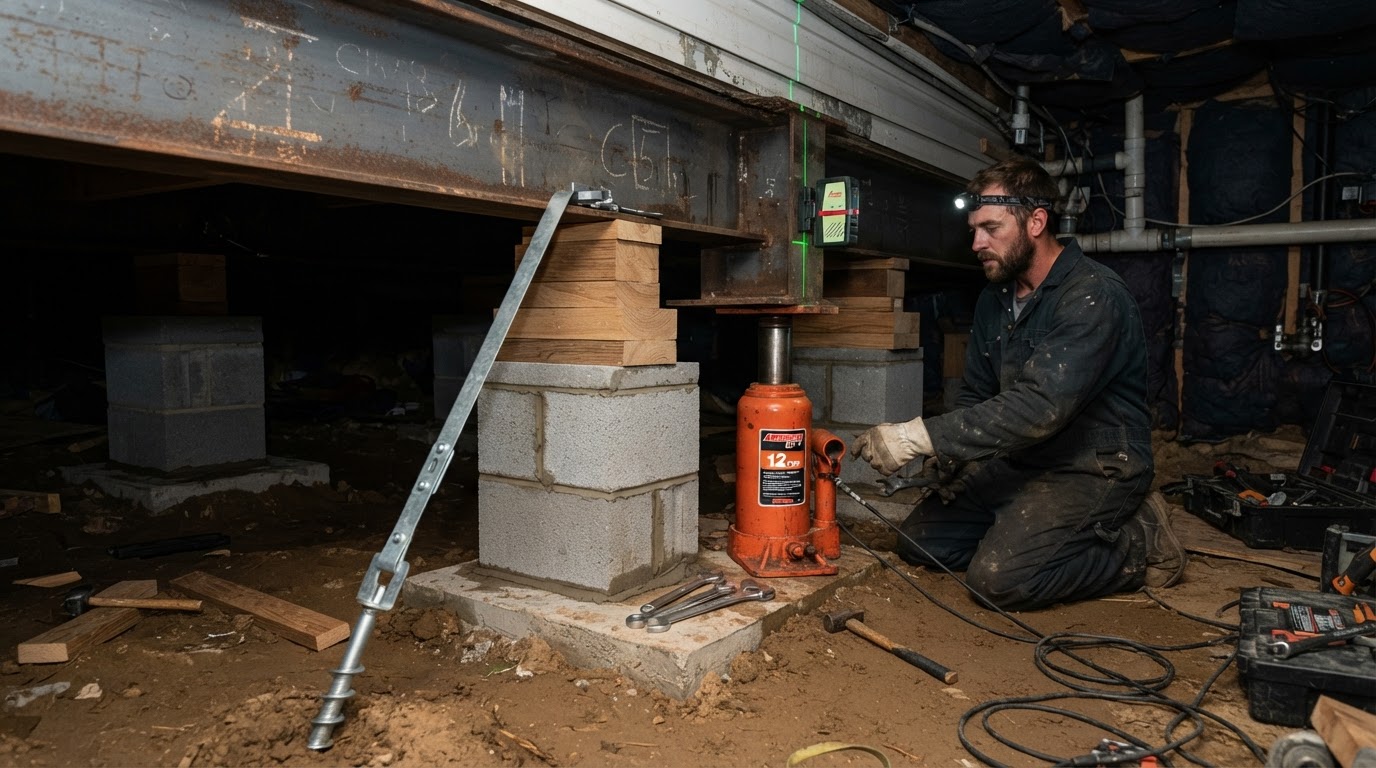
Technicians enter the crawlspace to locate every ground anchor, frame clamp, and tie-down strap along both main I-beams.
- 2
Strap Corrosion & Tension Verification
Inspect each strap for surface rust, structural section loss, fraying, loose slack, and proper engagement with tensioning bolts.
- 3
Ground Anchor Shaft & Soil Condition Check
Examine anchor heads for soil displacement, bending, pull-out movement, or missing stabilizer plates.
- 4
Frame Clamp & Beam Attachment Assessment
Verify that beam clamps are securely fastened to I-beam flanges and have not slipped or deformed.
- 5
Documentation & Repair Recommendations
Provide the homeowner with a detailed condition report identifying sound components, loose straps requiring retensioning, and rusted straps or missing anchors requiring replacement.
Frequently Asked Questions About Delaware Tie-Down Requirements
Are tie-downs legally required for mobile homes in Delaware?
Yes. Delaware Code Title 24 Chapter 44 and HUD federal standards require all manufactured homes installed in Delaware to be anchored to resist wind uplift and lateral forces in accordance with state rules and manufacturer instructions.
How many tie-down straps are required on a mobile home in Delaware?
There is no single strap count for all homes. Strap and anchor counts are determined by the home's length, width, HUD wind zone, soil probe torque readings, and the manufacturer's DAPIA-approved installation manual.
Who can install manufactured home tie-downs in Delaware?
Under Delaware law, new manufactured home setups and major anchoring installations must be performed by a licensed Delaware Manufactured Home Installer.
Does Delaware follow HUD installation standards?
Yes. Delaware installation law adopts HUD federal installation standards (24 CFR Part 3285) as the baseline technical code for manufactured housing.
Do I need a permit from Sussex County to replace rusted tie-down straps?
Minor maintenance replacement of individual damaged straps on an existing home typically does not require a full new setup permit, but major anchoring re-installations or new home placements require Sussex County building permits and inspections.
What is the difference between a vertical tie and a diagonal tie?
Vertical ties (or over-the-top straps) connect near the roof or top wall to hold the home straight down against wind uplift. Diagonal ties connect the main steel I-beam to ground anchors at an angle to prevent the home from sliding or overturning sideways.
Can rusted tie-down straps cause a mobile home to fail a mortgage inspection?
Yes. FHA, VA, and conventional mortgage lenders require structural inspections for manufactured homes. Severe rust or detached tie-downs will trigger a deficiency report requiring replacement before loan approval.
Are ground anchors the same as concrete pier footings?
No. Concrete pier footings support vertical gravity weight (holding the home up), whereas steel ground anchors and straps resist wind uplift and lateral forces (holding the home down). They are separate systems.
Where can I verify Delaware manufactured home installation laws?
You can review official statutes online at delcode.delaware.gov under Title 24, Chapter 44, or visit the Delaware Division of Professional Regulation website.
Schedule a Tie-Down & Anchor Inspection Near Millsboro
Ensure your manufactured home's wind anchoring system is secure and compliant. Contact Millsboro Mobile Home Leveling at 302-449-7221 to schedule a crawlspace tie-down and anchor inspection in Millsboro or Sussex County, DE.
Request Mobile Home Foundation Service
Serving Millsboro and all surrounding Sussex County communities.