Single-Wide vs. Double-Wide Mobile Home Leveling
Single-wide and double-wide homes are leveled using the same basic principle — correcting the elevation of the structural frame and support system — but double-wides are more complex because two structural sections must remain properly supported and aligned with each other. A single-wide primarily involves one chassis and frame section, while a double-wide also requires attention to the marriage-line relationship between the two halves. The objective is similar, but the structural relationships are different.
Request Mobile Home Foundation Service
Serving Millsboro and all surrounding Sussex County communities.
In This Guide
- 1.Single-Wide vs. Double-Wide at a Glance
- 2.What Is Different About a Single-Wide?
- 3.What Is Different About a Double-Wide?
- 4.Why the Marriage Line Matters
- 5.Foundation Components Are Similar
- 6.Common Single-Wide Leveling Problems
- 7.Common Double-Wide Leveling Problems
- 8.Does a Double-Wide Cost More to Level?
- 9.Does a Double-Wide Take Longer?
- 10.Is Re-Leveling the Same for Both?
- 11.What About Multi-Section & Triple-Wide Homes?
- 12.When Foundation Repair Is Needed Instead of Just Leveling
- 13.How Single-Wide & Double-Wide Leveling Is Evaluated
- 14.Frequently Asked Questions
Does a Double-Wide Take Longer?
There is no universal time estimate that applies to every home. Complexity can increase with a double-wide because both sections and the marriage line are evaluated, but duration depends on the number of supports involved, the scope of any repairs, access, and settlement severity. A straightforward double-wide level correction may take less time than a single-wide with multiple failed piers and pad work. A contractor can give a project-specific estimate after evaluating the home.
What Is Different About a Double-Wide?
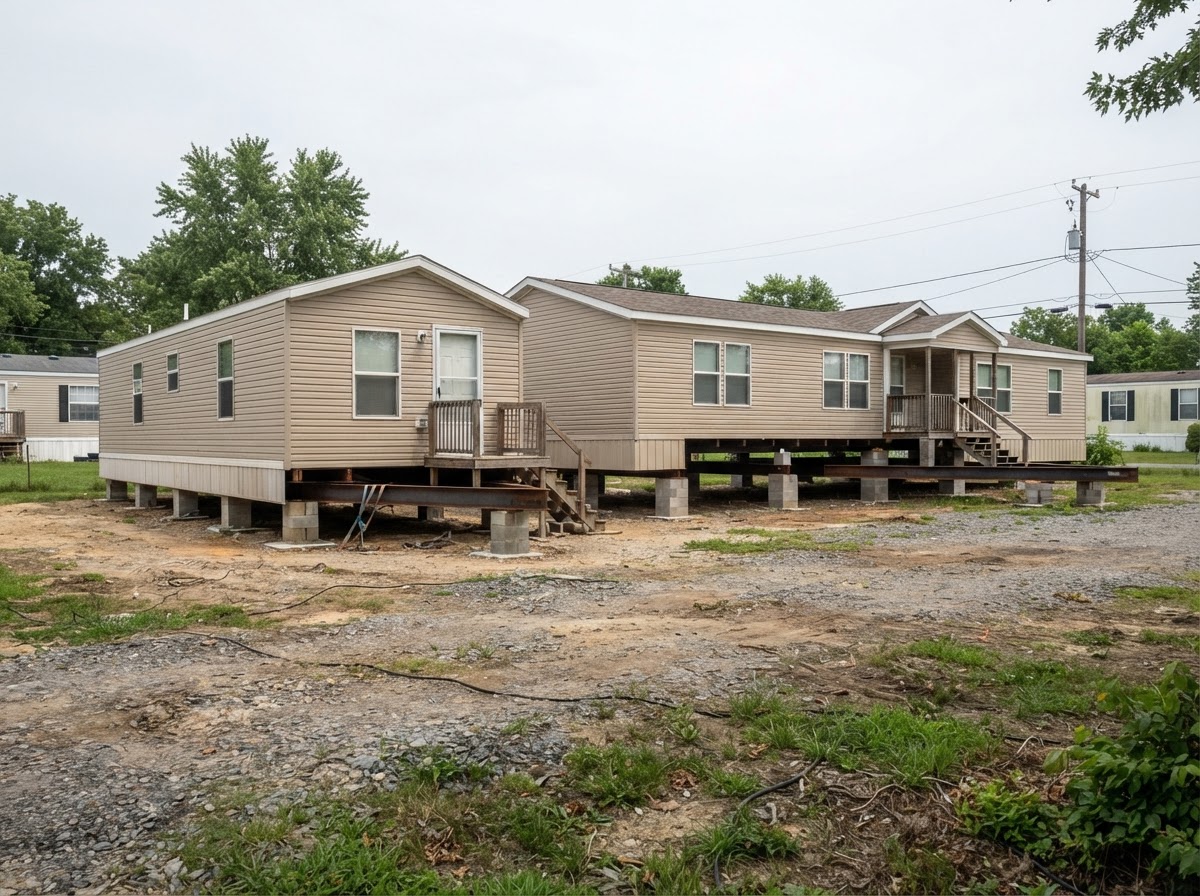
A double-wide is two manufactured structural sections joined together along a center marriage line. Each section has its own frame and support relationship, and the two halves must also be evaluated together so the marriage-line transition stays consistent.
Two Structural Sections
A double-wide is two separate manufactured sections, each with its own steel chassis/frame, joined at the marriage line.
Two Support Relationships
Each half sits on its own set of piers, pads, and shims, so one section can settle or be leveled independently of the other in some cases.
Marriage-Line Alignment
Because the two sections are joined, the center transition must stay consistent — a change at the seam is often the first visible sign of differential movement.
Additional Symptoms
One half lower than the other, center floor transition changes, trim separation, door alignment near the marriage line, and ceiling or wall seam movement.
How Single-Wide & Double-Wide Leveling Is Evaluated
A professional evaluation follows a logical sequence to determine whether the home needs leveling, repair, or both. This is a conceptual overview of what is evaluated and why — not a do-it-yourself procedure.
- 1
1. Identify symptoms
Review the homeowner's reported symptoms — floor slope, sticking doors, marriage-line changes, rocking, or visible support movement.
- 2
2. Check elevation
Assess the home's relative elevation to identify low areas, high areas, and side-to-side or end-to-end differences.
- 3
3. Inspect support components
Examine accessible piers, blocks, pads, footings, shims, and frame or I-beam support points.
- 4
4. Identify low and high areas
Map where the frame sits high or low and compare those areas to the support condition beneath them.
- 5
5. For double-wides, compare both sections and the marriage line
Evaluate each section's elevation, then the section-to-section relationship and the marriage-line transition, since one section can settle differently from the other.
- 6
6. Determine whether leveling alone or repair is required
Decide whether a level correction is appropriate or whether pier, pad, shim, reblocking, or stabilization work is needed first or alongside it.
- 7
7. Recheck level after correction
After any correction, recheck elevation, support contact, and the section relationship to confirm the work.
Common Single-Wide Leveling Problems
Because a single-wide is one section, most leveling problems trace back to one frame and its support points. Common issues include:
- •One side low — supports along one side have changed elevation
- •One end low — settlement toward one end of the frame
- •Isolated pier settlement — a single pier has dropped, often with a loose shim above it
- •Loose or missing shim — a visible symptom that may point to movement below
- •Pad or footing settlement — a bearing surface has moved beneath a pier
- •Reblocking problems — a shifted or inconsistent block-support arrangement
For the causes behind these symptoms, see What Causes a Mobile Home to Become Unlevel?
1.One Section Lower Than the Other
One half of a double-wide can change elevation differently from the other, so one side of the home sits lower. This is differential movement between sections, and it often shows up at the marriage-line transition first. Not every double-wide problem is a marriage-line problem — each section's supports should be evaluated individually and then together.
2.Marriage-Line Alignment & Differential Settlement
When one section settles relative to the other, the center transition can shift, producing a floor height change, trim separation, or wall and ceiling seam symptoms along the marriage line. The fix depends on which supports have moved and whether the movement is isolated or recurring.
3.Different Support Movement Between Halves
Because each section has its own piers, pads, and shims, the two halves can move at different rates. One section may be sound while the other has a settled pier or pad, which is why both sections are evaluated rather than treating the home as a single frame.
4.Multiple Pier & Pad Problems Across Both Sections
A double-wide has more support points overall, so multiple piers or pads can be affected across both halves. Not every double-wide problem is a marriage-line problem; several independent support failures can coexist and need to be scoped separately.
What Is Different About a Single-Wide?
A single-wide is one primary structural section built on one main chassis and steel I-beam frame. The leveling relationship runs side to side and end to end across that one section. Support points — piers, blocks, pads, footings, and shims — sit beneath that single frame, and the evaluation is generally more straightforward because there is one frame relationship to check.
- •One primary structural section on one chassis and frame system
- •Support points sit beneath that single section
- •Side-to-side and end-to-end level relationships across one frame
- •No marriage line — there is no second section to align
- •Common symptoms: one side low, one end low, floor slope, sticking doors, loose shims, pier settlement
Single-Wide vs. Double-Wide at a Glance
The basic support principle is shared, but the structural relationships differ. This table compares the factors that change between a single-wide and a double-wide leveling job:
| Condition | Typical Scope |
|---|---|
| Structural sections | Single-wide: one primary section. Double-wide: two joined sections. |
| Frame relationship | Single-wide: one chassis/frame. Double-wide: two frames/sections. |
| Marriage line | Single-wide: no. Double-wide: yes — the center seam where the two sections meet. |
| Support layout | Single-wide: generally simpler. Double-wide: more support points and coordinated sections. |
| Leveling complexity | Single-wide: often more straightforward. Double-wide: can require section-to-section alignment. |
| Common symptoms | Single-wide: side/end slope, pier settlement. Double-wide: same plus center-seam and marriage-line changes. |
| Inspection focus | Single-wide: frame, piers, pads, shims. Double-wide: same plus the relationship between sections. |
A double-wide is not automatically twice the work or twice the price — complexity depends on condition, the number of affected supports, and whether repair is needed beyond the level correction.
What About Multi-Section & Triple-Wide Homes?
Homes built in three or more sections introduce additional section-to-section relationships beyond the single marriage line of a double-wide:
More Sections, More Seams
Each added section introduces another joined edge to evaluate for elevation and alignment.
Coordinated Support
Each section's supports are checked individually and in relation to the sections beside them.
Same Principles
The leveling principle is the same — correct elevation and check support condition — but the number of section relationships increases.
When Foundation Repair Is Needed Instead of Just Leveling
Leveling corrects elevation. When a support component has actually failed, leveling alone will not hold. Foundation repair may be needed when the home shows:
- A sinking pier — the support has dropped, often with a loose shim above it
- A broken or shifted block — the pier itself has failed
- A settled pad — the bearing surface beneath a pier has moved
- Loose or missing shims that keep returning after adjustment
- Recurring settlement — the same area repeatedly goes out of level
- Washout — water has removed supporting material from around a support
- A reblocking need — the broader block-support arrangement has shifted
Why the Marriage Line Matters
The marriage line is the connection where the two manufactured-home sections meet. Section-to-section elevation matters because the two halves share a center transition: a floor height difference, a shifting wall or ceiling seam, or a door that no longer latches near the center can all point to differential movement between the two sections. Not every visible seam is structural — cosmetic movement can exist without foundation failure — but the marriage line is where differential settlement between the two halves tends to show up first. Evaluating a double-wide means checking each section individually and then checking the relationship between them.
Foundation Components Are Similar
Although the section count differs, both single-wides and double-wides may use the same types of support components beneath the frame. The components are shared; what changes is how many sections must be coordinated and whether a marriage line is involved.
Does a Double-Wide Cost More to Level?
Double-wides can involve more support points and additional alignment complexity, but actual price depends on the condition of the home, not the number of sections alone. A double-wide with sound supports and a small elevation correction is not automatically more expensive than a single-wide with a settled pier and a washed-out pad. Scope is set by what has failed.
- ?Number of affected supports, not number of sections, drives most of the work
- ?Settlement severity and whether the movement is isolated or recurring
- ?Pad and shim condition beneath the affected supports
- ?Whether reblocking is needed across a broader support arrangement
- ?Access beneath the home and crawlspace conditions
- ?Whether foundation repair is needed alongside the level correction
For cost context, see our guides on Mobile Home Leveling Cost Delaware and Mobile Home Foundation Repair Cost Sussex County. There is no fixed 'double-wide multiplier.'
Is Re-Leveling the Same for Both?
The objective is similar — restore a consistent level condition across the frame — but the structural relationships are different. A single-wide involves one section to evaluate. A double-wide must be evaluated section by section and then as a whole, because each half has its own frame and support relationship and the marriage line ties them together. The same support components (piers, pads, blocks, shims) appear in both, but the coordination between sections is what makes a double-wide distinct. Throughout Millsboro, Long Neck, Dagsboro, Georgetown, Frankford, and Harbeson, the terminology matters less than diagnosing the actual support condition beneath the home.
Frequently Asked Questions: Single-Wide vs. Double-Wide Leveling
Is a double-wide harder to level than a single-wide?
A double-wide adds complexity because both sections and the marriage line must be evaluated together. That does not make every double-wide harder in an absolute sense — a double-wide with sound supports can be more straightforward than a single-wide with multiple failed piers. Complexity depends on condition, not just home type.
Does a double-wide have more piers?
A double-wide generally has more support points overall because it covers more area, but there is no universal count. The number and layout of supports depends on the home's design and manufacturer instructions.
What is the marriage line on a double-wide?
The marriage line is the connection where the two manufactured-home sections meet. Section-to-section elevation matters there because both halves share a center transition, and differential movement between them tends to show up at that seam first.
Can one half of a double-wide settle without the other?
Yes. Each section has its own frame and support relationship, so one half can change elevation differently from the other. That is why both sections are evaluated individually and then together.
Can a single-wide sink on only one side?
Yes. If the supports along one side of the frame change elevation — from pier settlement, pad movement, or erosion — one side of the home can sit lower than the other.
Do both single-wides and double-wides use shims?
Often, depending on the support system. Shims sit between the pier cap and the beam to maintain bearing contact in both single-wide and double-wide installations.
Can both single-wides and double-wides need reblocking?
Yes. Reblocking corrects a broader block-support arrangement and may be needed in either type of home when the layout of supports has shifted or was set inconsistently.
Is double-wide leveling automatically twice the price?
No. A double-wide is not a 2x multiplier. Price depends on the number of affected supports, settlement severity, pad and shim condition, access, and whether repair is needed beyond the level correction.
Does a center seam gap always mean the double-wide is unlevel?
No. Some seam movement is cosmetic and can exist without foundation failure. But a changing floor transition or seam that returns after correction warrants evaluation of both sections and the supports beneath them.
Can a double-wide need foundation repair and leveling together?
Yes. If a support component has failed, the home may need repair first or alongside the level correction so the elevation adjustment holds. See our guide on Mobile Home Leveling vs. Foundation Repair for the distinction.
Who levels single-wide and double-wide homes near Millsboro?
Millsboro Mobile Home Leveling performs leveling and support evaluation for single-wide, double-wide, and multi-section homes throughout Millsboro and Sussex County, DE. Call 302-449-7221 or request service online to schedule an evaluation.
Schedule a Leveling Evaluation Near Millsboro
If you are not sure whether your single-wide or double-wide manufactured home needs leveling, foundation repair, or anchoring service, Millsboro Mobile Home Leveling can evaluate the visible support system and help determine the appropriate next step.
Request Mobile Home Foundation Service
Serving Millsboro and all surrounding Sussex County communities.