Mobile Home Foundation & Anchoring Maintenance Guide for Coastal Delaware
Mobile home foundation and anchoring maintenance is primarily about watching for changes in the support and anchoring systems before small conditions become larger repair issues. Homeowners should monitor floor level, piers, pads, shims, visible erosion, tie-down straps, ground anchors, and connections, especially after noticeable site changes or significant weather. There is no single universal maintenance interval for every manufactured home, so inspection frequency should reflect the home's age, repair history, support condition, exposure, and any recurring movement.
Request Mobile Home Foundation Service
Serving Millsboro and all surrounding Sussex County communities.
In This Guide
- 1.Foundation & Anchoring Maintenance Are Different
- 2.Homeowner Routine Awareness
- 3.Level & Floor Symptoms
- 4.Pier & Block Support Maintenance
- 5.Pad & Footing Maintenance
- 6.Shim & Bearing Contact Maintenance
- 7.Drainage, Erosion & Washout Awareness
- 8.Tie-Down Strap Maintenance
- 9.Ground Anchor Maintenance
- 10.After Heavy Rain
- 11.After a Significant Storm
- 12.Corrosion & Coastal Exposure
- 13.How Often Should a Foundation Be Professionally Checked?
- 14.Preventive Maintenance vs. Repair
- 15.Annual Maintenance Checklist
- 16.When to Call for Professional Evaluation
- 17.Coastal Delaware Service-Area Context
- 18.Frequently Asked Questions
Level & Floor Symptoms
Changes in level are often the first sign that something beneath the home has moved. Monitor for:
- A new floor slope that was not there before
- One side of the home feels lower
- A floor transition that has changed, especially at a double-wide marriage line
- Symptoms that return after a prior leveling
- Furniture that begins rocking or rolling where it did not before
Recurring level symptoms point to an underlying cause. See Signs Your Mobile or Manufactured Home Is Out of Level and What Causes a Mobile Home to Become Unlevel?
After a Significant Storm
After a significant storm, visible checks from safe, accessible areas are appropriate. Look for a new floor slope, a new marriage-line change in a double-wide, visible strap damage, loose straps, a disturbed anchor, erosion, or support movement. Do not crawl beneath a home that may be damaged or unstable, or where flooding, electrical, or animal hazards make entry unsafe. Where storm-related symptoms appear, evaluation is the right next step.
Reasons a professional check may make sense:
- A new floor slope or low side
- A new marriage-line change on a double-wide
- Visible strap damage or looseness
- A disturbed or shifted anchor
- Erosion or washout near supports
- Visible support movement
How Often Should a Foundation Be Professionally Checked?
There is no fixed universal interval. A professional evaluation may be appropriate when any of the following apply:
Symptoms Develop
New floor slope, sticking doors, or movement that was not there before.
Previous Settlement Recurs
The same area repeatedly goes out of level after prior leveling.
Recent Purchase or Unknown History
The home was recently purchased or its foundation history is unknown.
Major Rain or Washout
Significant rainfall, flooding, or visible washout has affected the support area.
Visible Changes
Supports, shims, straps, or anchors show visible change.
Preparing to Sell
The home is being prepared for sale and the foundation condition is unknown.
For frequency guidance grounded in condition rather than a calendar, see How Often Should a Mobile Home Be Re-Leveled? Delaware Guide and Mobile Home Foundation Preventive Maintenance & Adjustment.
Tie-Down Strap Maintenance
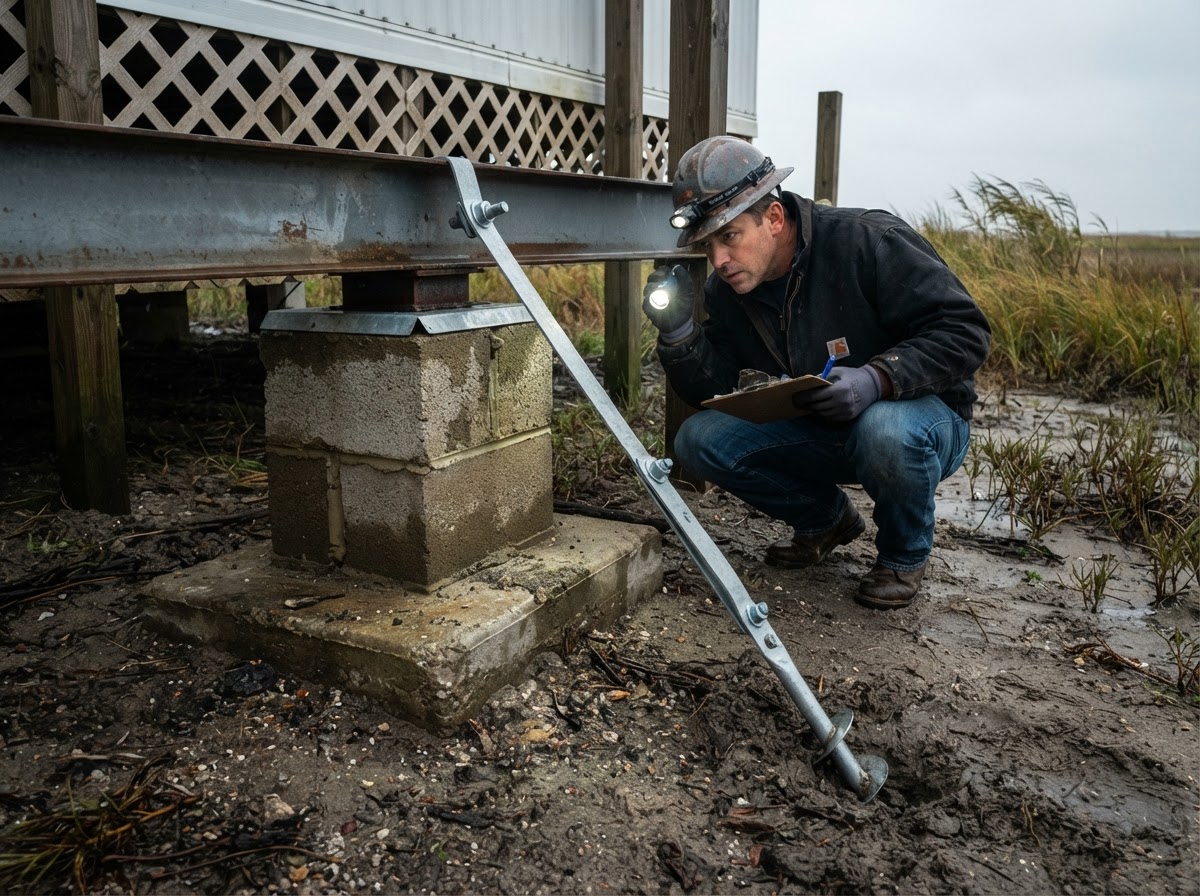
Tie-down straps are the link between the home's frame and the ground anchors. Visible concerns to watch for include heavy rust, flaking corrosion, a loose strap, a disconnected strap, a damaged connection, or a missing strap. This page does not provide tension values — strap condition and applicable requirements are what matter. Where a strap has visible deterioration, evaluation by a qualified professional is the right next step.
- •Heavy rust or flaking corrosion on a strap
- •A strap that has become loose
- •A strap that is disconnected from its anchor or frame connection
- •A damaged connection point
- •A strap that is missing entirely
For replacement context, see Rusted Mobile Home Tie-Down Strap Replacement and Loose Mobile Home Tie-Down Repair & Retensioning.
Manufactured Home Foundation & Anchoring Checklist
Homeowners can use this practical checklist periodically. It is not a legally required annual inspection — it is a homeowner awareness tool for catching changes early.
- Interior — has floor slope changed?
- Interior — are multiple doors or windows suddenly sticking?
- Interior — has the marriage-line transition changed on a double-wide?
- Foundation — visible pier movement or blocks that have shifted?
- Foundation — pad exposure or new gaps?
- Foundation — shim gaps or lost contact?
- Foundation — erosion or washout near supports?
- Anchoring — visible strap rust, looseness, or a missing strap?
- Anchoring — a damaged, missing, or displaced ground anchor?
- Anchoring — a disconnected connection?
- After weather — new washout, a new floor change, or new anchoring damage?
1.Pier & Block Support Maintenance
Visible concerns with piers and blocks include leaning, sinking, a cracked block, a shifted support, or inconsistent contact with the beam above. Structural correction of piers and blocks should be performed by a professional — homeowners should not attempt to rebuild loaded supports themselves. Where a pier has visibly moved, evaluation is the right next step rather than waiting.
2.Pad & Footing Maintenance
Concrete pads and footings can settle, displace, or crack with movement. Watch for visible settlement, displacement, cracks that show movement rather than harmless surface cracking, and exposure caused by erosion or washout around the bearing area. Homeowners should not attempt to repair concrete beneath a loaded support — that is professional work.
3.Shim & Bearing Contact Maintenance
Shims maintain the bearing contact between the pier cap and the beam. Watch for a loose shim, a missing shim, a displaced shim, or a gap above a support. A loose shim may not be the root cause — it can be a symptom of settlement below, where the pier has dropped and left the shim behind. Repeated shim changes at the same support are a sign to evaluate the support beneath it.
When to Call for Professional Evaluation
Professional evaluation is appropriate when any of the following appear:
- —A new floor slope develops
- —A pier visibly moves or shifts
- —A pad settles or cracks with movement
- —A shim repeatedly becomes loose at the same support
- —Several supports are affected at once
- —A marriage line changes on a double-wide
- —Visible washout affects supports
- —A tie-down strap shows major deterioration
- —A ground anchor is missing or damaged
- —Symptoms return after a prior leveling
When in doubt, an evaluation is more useful than waiting for the condition to worsen.
Homeowner Routine Awareness
This is casual awareness, not a legally required monthly inspection. The goal is to notice changes from safe, accessible areas — not to crawl beneath the home on a fixed schedule. Watch for:
- •New floor slope or a side that feels lower
- •Door or window changes that appeared recently
- •Movement or rocking felt while walking through the home
- •New visible washout or material loss near supports
- •Loose skirting that has exposed previously covered support areas
- •Visible strap deterioration or a strap that looks different than before
- •Unusual support gaps visible from a safe vantage point
Foundation & Anchoring Maintenance Are Different
These are two separate systems and they fail in different ways. A home can have a healthy foundation but anchoring problems, or vice versa, so maintenance should watch both independently:
| Condition | Typical Scope |
|---|---|
| Foundation / leveling system | Piers, blocks, pads, footings, shims, frame support, and level/elevation. Primary role: carry and support the home's vertical load. |
| Anchoring system | Tie-down straps or ties, ground anchors, and frame connections. Primary role: help resist applicable lateral and uplift forces. |
A level home can still have rusted or missing tie-downs, and an anchored home can still be out of level. Watch both.
Coastal Delaware Service-Area Context
Millsboro Mobile Home Leveling serves communities across coastal and inland Sussex County:
Inland Sussex County
Millsboro, Long Neck, Dagsboro, Georgetown, Frankford, Harbeson, Selbyville, and Millville.
Coastal Communities
Ocean View, Bethany Beach, South Bethany, Fenwick Island, Lewes, Rehoboth Beach, and Dewey Beach.
Conditions Vary
Site conditions are not identical across these communities. Drainage, exposure, and soil vary property to property, so maintenance should reflect the actual site.
Preventive Maintenance vs. Repair
Maintenance and repair are related but different. Maintenance watches for changes and evaluates condition; repair corrects known failure:
- Maintenance: watch for changes; evaluate level and support condition; check visible anchoring condition
- Repair: correct a known failure — repair a pier, pad, shim, or block, or replace a damaged anchoring component
- Maintenance can catch a developing issue before it becomes a repair, but it cannot guarantee prevention of future settlement
After Heavy Rain
After heavy rainfall, a homeowner's job is observation from safe areas, not automatic re-leveling. Watch for new erosion, a pad edge becoming exposed, support settlement, a floor change, a shim gap that appeared, or visible washout. Re-leveling should not be automatic — if new symptoms appear after wet weather, the supports beneath the affected area should be evaluated first so any elevation correction addresses the actual cause rather than covering it up.
Drainage, Erosion & Washout Awareness
Water movement can change the bearing beneath supports over time. Homeowners should watch for new channels cut through the crawlspace, material loss around supports, exposed pads, recurring water flow beneath the home, and support movement noticed after wet weather. If water continues to channel beneath the home or wash out supporting areas, foundation repair alone may not address the source of the water movement — a separate qualified drainage or site professional may be needed for the water-management side of the problem.
Ground Anchor Maintenance
Ground anchors provide the connection to the ground at the bottom of the anchoring path. Watch for:
- ?A missing anchor where one was present before
- ?A damaged or bent anchor
- ?Visible displacement — an anchor that has shifted
- ?Corrosion on an anchor or connection
- ?A broken connection between anchor and strap
- ?Strap looseness caused by anchor movement
This page does not provide installation instructions. Where an anchor is missing or damaged, see Missing or Damaged Mobile Home Ground Anchors and Mobile Home Ground Anchor Installation & Replacement.
Corrosion & Coastal Exposure
Coastal environments can expose metal components to moisture and weather. Actual corrosion depends on component age, material and coating, drainage, exposure, maintenance, and site conditions — not simply on proximity to the coast. No manufactured home in coastal Delaware corrodes on a fixed schedule. This page does not publish a fixed lifespan for straps or anchors, because there is no universal interval that applies to every component. Condition-based evaluation is more reliable than a calendar replacement rule.
Frequently Asked Questions: Foundation & Anchoring Maintenance
How often should a mobile home foundation be checked?
There is no fixed universal interval. Inspection frequency should reflect the home's age, repair history, support condition, exposure, and any recurring movement. A professional check may make sense when symptoms develop, when settlement recurs, after a major rain or washout, or when the home is being prepared for sale.
Does a mobile home need to be re-leveled every year?
No. Annual re-leveling is not a universal requirement. Leveling is appropriate when the home has actually changed elevation, not on a calendar schedule. Routine awareness of floor level is useful; automatic annual re-leveling is not.
How often should tie-down straps be replaced?
There is no fixed lifespan that applies to every strap. Replacement depends on condition — heavy corrosion, flaking, looseness, or disconnection — and on applicable requirements. This page does not invent a replacement interval. A qualified professional can evaluate strap condition and recommend replacement where warranted.
Should ground anchors be inspected?
Yes, when the anchoring system's condition is being evaluated or when visible issues exist — a missing, damaged, displaced, or corroded anchor. Inspection is appropriate; installation or repair is professional work.
Is surface rust on a tie-down strap automatically a failure?
No. Surface rust alone is not automatically a failure. Heavy corrosion, flaking, looseness, or disconnection are more concerning. Severity and condition matter, and a qualified professional can judge whether replacement is warranted.
What should I check after heavy rain?
From safe, accessible areas, watch for new erosion, an exposed pad edge, support settlement, a floor change, a shim gap, or washout. If new symptoms appear after wet weather, the supports beneath the affected area should be evaluated rather than automatically re-leveling.
What should I check after a storm?
Watch for a new floor slope, a new marriage-line change on a double-wide, visible strap damage, loose straps, a disturbed anchor, erosion, or support movement — all from safe areas. Do not crawl beneath a home that may be damaged or unstable. Where symptoms appear, schedule an evaluation.
Can erosion around a pad become a foundation problem?
Yes, if the erosion changes the bearing or support conditions beneath a pad. Erosion and washout remove supporting material, which can allow a pad or pier to settle. The drainage source and the support it affected may both need attention.
Can a loose shim be preventive maintenance, or does it mean repair?
It depends on why the shim became loose. A loose shim can be a routine bearing-contact correction, or it can be a symptom of settlement below the pier. Repeated shim changes at the same support point to an underlying cause that should be evaluated.
Does preventive maintenance stop all settlement?
No. Maintenance helps catch changes early, but it cannot guarantee that future settlement will not occur. The goal is to identify developing conditions before they become larger repairs, not to prevent all movement.
Should buyers inspect foundation and anchoring systems?
Yes. A pre-purchase foundation and anchoring evaluation helps a buyer understand the condition of the supports, pads, shims, and tie-down system before committing. See our Manufactured Home Foundation Inspection Checklist for Home Buyers.
Who provides foundation and anchoring evaluations near Millsboro?
Millsboro Mobile Home Leveling performs foundation and anchoring evaluations throughout Millsboro and coastal and inland Sussex County, DE. Call 302-449-7221 or request service online to schedule an evaluation.
Schedule a Foundation & Anchoring Evaluation Near Millsboro
If you are unsure about the level, foundation supports, or anchoring system beneath a manufactured home near Millsboro, Millsboro Mobile Home Leveling can evaluate the visible system and help determine the appropriate next step.
Request Mobile Home Foundation Service
Serving Millsboro and all surrounding Sussex County communities.