Mobile Home Pier & Beam Foundation Repair Millsboro
In a manufactured or mobile home, the steel frame and main I-beams transfer the weight of the home outward to a system of piers that carry the load down to pads, footings, or other approved bearing surfaces. Mobile home pier and beam foundation repair addresses problems in that relationship, where a pier, bearing surface, shim, or related support condition has failed or moved and the frame has lost proper support. Symptoms can include floor slope, visible pier movement, gaps between the frame and its supports, loose shims, repeated loss of level, sinking support areas, movement underfoot, or uneven sections. Millsboro Mobile Home Leveling performs this repair work for homeowners near Millsboro and throughout Sussex County, DE. The page stays specific to manufactured homes, where the beam is a steel chassis I-beam rather than the wood girder of a traditional crawlspace house.
Request Mobile Home Foundation Service
Serving Millsboro and all surrounding Sussex County communities.
Pier & Beam Foundation Repair Near Millsboro
Under a manufactured home, pier-and-beam support generally refers to the relationship between the steel frame, or main I-beams, and the pier systems that transfer structural loads down to pads, footings, or other approved bearing surfaces. The main frame members carry the home; the piers support those frame members; the pads and footings spread the load below the piers; and shims provide the final bearing contact between a pier cap and the steel. Movement in any one of those components can change the elevation and stability of the frame above it.
Steel Chassis & I-Beams
The main frame members on a manufactured home are longitudinal steel I-beams that run the length of the home and carry the floor, walls, and roof. These beams are the structural element the piers support, and their elevation is what the interior symptoms ultimately reflect.
Pier Supports
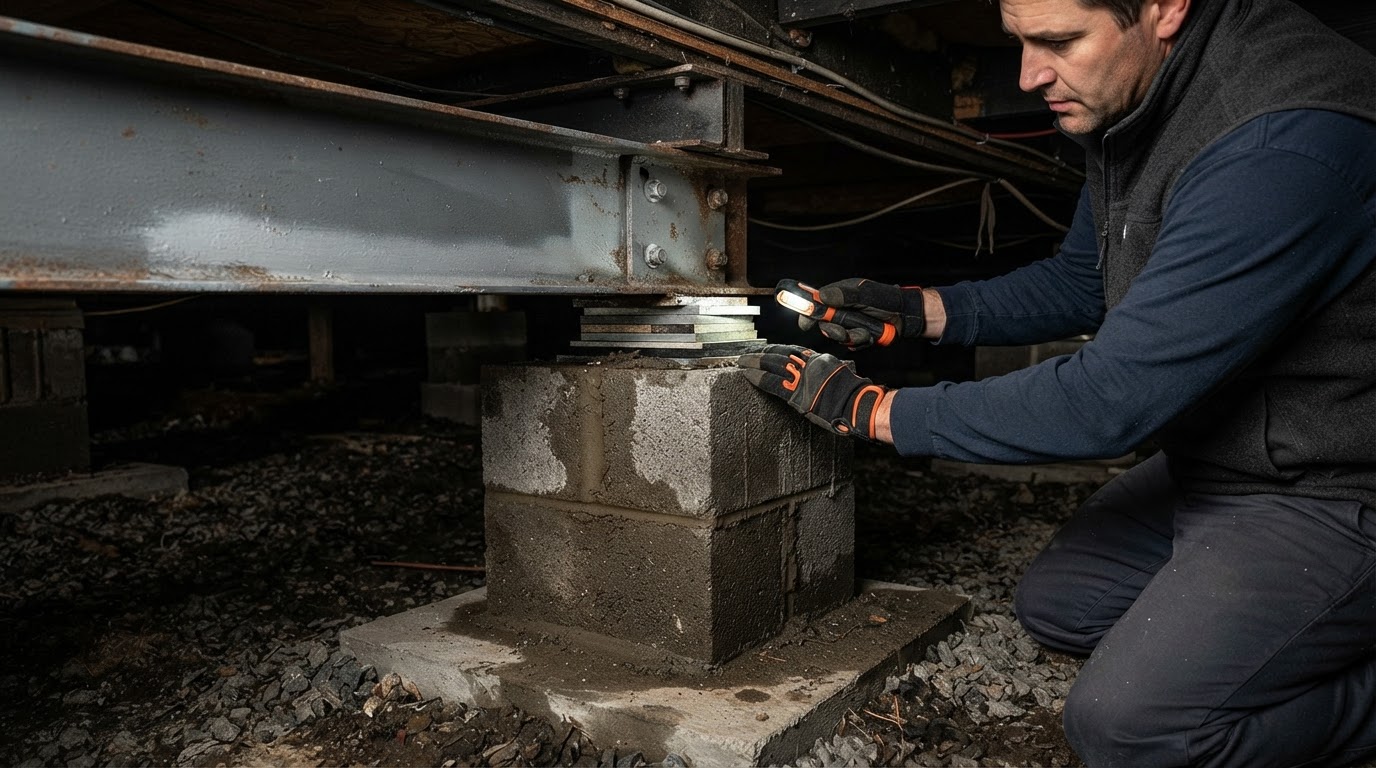
Piers, commonly stacked concrete masonry blocks, sit beneath the I-beams and transfer the frame's weight down to the bearing surface. Their height, spacing, and condition set the elevation of the chassis above them and are a primary focus of pier-and-beam repair.
Pads & Footings
The pad or footing beneath each pier spreads the load over the soil. A pad that cracks, sinks, or tilts can let the pier above it drop, which then changes the support the pier gives the I-beam.
Shims & Bearing Contact
Shims fill the small gap between the top of a pier and the steel I-beam to create controlled, full bearing. Loose, crushed, or missing shims reduce that contact and let the frame drop the thickness of the gap.
How Settlement Changes Frame Support
When a pier settles, shifts, or loses a block, the support it gives the I-beam above it changes. Because the frame is one connected steel structure, movement at one support point often shows up as slope, dip, or movement elsewhere along the beam.
This is the manufactured-home version of pier and beam, not a traditional site-built crawlspace. The beam is a steel chassis I-beam, the piers are typically block stacks over pads, and the repair is specific to how those components work together under a mobile home.
How Mobile Home Pier & Beam Problems Are Evaluated
Pier-and-beam repair begins by reading the relationship between the I-beams and the piers beneath them. The goal is to understand which support points are actually failing before changing any of them, because not every apparent pier problem requires replacing the entire support system.
Review symptoms and movement history
Discuss what you have noticed, when it began, and whether the home has a history of repeated leveling or movement under the frame.
Evaluate level and frame-support conditions
Check how the I-beams sit across the home and assess the overall condition of the pier-and-beam support system beneath it.
Inspect accessible I-beams and supporting piers
Examine the main frame members and the piers that support them where they can be safely reached beneath the home.
Check blocks, pads, shims, and bearing
Look at the pads and footings, the block stacks, the shims, and the visible bearing contact between each pier cap and the steel I-beam.
Determine the correct repair scope
Decide whether the issue needs pier repair, reblocking, shimming, leveling, stabilization, or a broader foundation repair, based on what is actually failing.
Complete repairs and recheck frame support
Perform the agreed work and recheck how the I-beams bear on the piers to confirm the frame is supported consistently across the system.
Not every apparent pier problem requires replacing the entire support system. Some conditions are corrected with re-shimming or reblocking; others involve a damaged pier or pad. An inspection determines the appropriate scope. Specific structural load calculations and DIY repair steps are not provided here.
Pier & Frame Support Problems Under Mobile Homes
Because the I-beams and piers work as one support system, a problem at any point in the load path can show up as movement in the frame above. Understanding each common failure helps explain why pier-and-beam repair targets the failed component rather than only the elevation on top of it.
Sinking Piers
A pier that has dropped lowers the I-beam above it with it, creating slope or a dip in the floor. The repair usually involves the bearing surface beneath the pier, not just the height on top of it.
Leaning or Shifted Piers
A pier that has tilted or shifted laterally is no longer transferring the I-beam's load straight down. Misalignment reduces proper bearing and is a component condition rather than just a height problem.
Damaged Blocks
A block stack that has cracked, spalled, separated, or deteriorated is a deteriorated support component. Repairing it usually means rebuilding or replacing the damaged blocks rather than shimming over them.
Failed Pads / Footings
The pad or footing beneath a pier spreads the load over the soil. A cracked, broken, or sunken pad can let the pier above it drop or tilt, and the base may need repair or replacement before the pier can hold.
Loose or Missing Shims
Shims provide the final bearing contact between a pier cap and the I-beam. Loose, crushed, or missing shims reduce that contact and let the frame drop by the size of the gap, which is a component failure rather than a simple elevation adjustment.
Frame Support Gaps
A visible gap between the I-beam and the pier beneath it means the frame is not bearing on that support the way it should. Gaps warrant evaluation of the support point rather than ignoring them.
Reblocking
When piers are poorly spaced, improperly stacked, or missing, the support arrangement itself is the problem. Reblocking rebuilds or corrects the layout so the I-beams are supported in a way that will hold.
Mobile Home Pier & Beam Repair in Millsboro & Sussex County
Pier-and-beam repair near Millsboro and across Sussex County depends on the actual conditions under each home rather than a generic fix. Service regularly extends to communities such as Long Neck, Dagsboro, Georgetown, and Frankford. The repair scope depends on the home type, the frame layout, the pier spacing and configuration, the existing support materials, previous repairs, crawlspace accessibility, the settlement history, and the condition of the pads and shims. No claim is made about local building-code requirements; an inspection determines what the actual support system needs.
Related Foundation Services
- Mobile Home Foundation RepairThe broad foundation repair page covering the full range of support component failures.
- Manufactured Home Foundation StabilizationWhen the goal is to stop continued movement rather than only repair the component.
- Mobile Home Pier Repair & ReplacementWhen an individual pier is the component that needs repair or replacement.
- Mobile Home Foundation & Leveling InspectionA full evaluation of frame level and support condition before any pier-and-beam repair.
- Mobile Home Shimming & ReshimmingRestoring bearing when the shims between pier and I-beam have failed.
- Manufactured Home I-Beam & Frame Support RepairFocused repair of the steel I-beam and frame support points themselves.
Mobile Home Pier & Beam Foundation Repair FAQs
What does pier and beam mean on a mobile home?
On a manufactured or mobile home, pier and beam refers to the relationship between the steel frame, or main I-beams, and the pier systems that transfer the frame's load down to pads, footings, or other approved bearing surfaces. It is not the same as a traditional site-built crawlspace, where the beam is a wood girder; here the beam is a steel chassis I-beam supported by block piers.
Are manufactured home I-beams supported by piers?
Yes. The longitudinal steel I-beams that make up the manufactured-home chassis rest on piers, commonly stacked concrete masonry blocks, which carry the frame's weight down to pads or footings. The I-beams, piers, pads, and shims work as one support system, and a failure at any point can change how the frame is supported.
What happens if one pier begins sinking?
When a pier drops, the section of I-beam above it drops with it, creating slope or a dip in the floor. The repair usually involves the bearing surface beneath the pier, because resetting the height above a support that is still sinking will not hold.
Can a leaning pier affect the home above it?
Yes. A pier that has tilted or shifted laterally is no longer transferring the I-beam's load straight down, which reduces proper bearing and can change the elevation of the frame above it. Misalignment is a component condition that repair or reblocking addresses rather than a simple height adjustment.
Can loose shims create gaps between the pier and frame?
Yes. Shims provide the final bearing contact between a pier cap and the steel I-beam. When shims are loose, crushed, or missing, that contact is reduced and the frame can drop by the size of the gap. Re-shimming restores bearing, but only after confirming the support beneath the shim is stable.
Is pier and beam repair the same as leveling?
No. Leveling corrects the elevation and bearing relationship between an otherwise sound frame and its supports. Pier-and-beam repair addresses a damaged or failed support component, such as a sinking pier, a broken block, a failed pad, or missing shims. Leveling a frame over a failed support will not hold until the support is repaired.
Can damaged pads affect pier support?
Yes. The pad or footing beneath a pier spreads the load over the soil. A cracked, broken, or sunken pad can let the pier above it drop or tilt, which then changes the support the pier gives the I-beam. A failed pad often has to be repaired or replaced before the pier above it can hold.
Does every pier problem require replacement?
No. Some conditions are corrected with re-shimming, reblocking, or stabilizing the bearing surface; others involve a damaged pier that needs repair or replacement. An inspection determines the appropriate scope rather than assuming every apparent pier problem means replacing the support.
Can double-wide homes have pier and beam support issues?
Yes. A double-wide has two chassis, each with its own I-beams and piers, joined along a central marriage line. Movement or failure in the supports beneath either section can affect the frame above it and the relationship between the two sections along the seam.
Do you provide mobile home pier and beam repair near Millsboro?
Yes. Millsboro Mobile Home Leveling provides pier-and-beam foundation repair for homeowners in Millsboro and across Sussex County, DE, including Long Neck, Dagsboro, Georgetown, and Frankford. Call 302-449-7221 to schedule an inspection.
Request Pier & Beam Foundation Repair Near Millsboro
If the supports beneath your manufactured home's steel I-beams have shifted, settled, or failed, contact Millsboro Mobile Home Leveling at 302-449-7221 to arrange a pier-and-beam inspection in Millsboro or the surrounding Sussex County area.
Request Mobile Home Foundation Service
Serving Millsboro and all surrounding Sussex County communities.