Double-Wide Manufactured Home Leveling Millsboro
Double-wide manufactured home leveling addresses homes built from two structural sections joined together on site. Because a double-wide is two chassis rather than one, proper leveling has to account for each section's individual elevation and the relationship between them along the central marriage line. Settlement, support movement, or shim loss beneath either section can show up as one section sitting lower than the other, floor slope, interior trim separation, doors that stop aligning, visible gaps along joined areas, or uneven transitions between rooms. Millsboro Mobile Home Leveling performs this work for double-wide owners near Millsboro and throughout Sussex County, DE. Not every crack or gap means the home is structurally failing, but they are a reasonable reason to have both sections and the marriage line inspected.
Request Mobile Home Foundation Service
Serving Millsboro and all surrounding Sussex County communities.
Double-Wide Mobile Home Leveling Near Millsboro
A double-wide requires coordinated evaluation of both home sections because one side or section can settle differently from the other. Each section has its own steel frame, and the two frames are pulled together along a central marriage line. When the supports beneath one section move, the elevation of that half changes relative to the other, and the relationship along the seam changes with it. Leveling a double-wide means considering the entire home rather than only the visibly low area.
One Section Feels Lower Than the Other
Differential settlement is common in double-wides. When the supports beneath one section settle or shift while the other stays stable, one half of the home sits lower, and the floor and ceiling can reflect that difference across the marriage line.
Uneven Floors Across the Marriage Line
Section-to-section elevation differences often become most noticeable at the joined area, where a transition between rooms can feel like a step or a slope. The seam is where the two chassis meet, so it is also where misalignment between them shows up first.
Doors or Openings Stop Aligning Properly
When either section shifts, interior openings can rack with its frame. Doors that once latched cleanly may begin to rub or fail to latch. Frame alignment is one possible cause, though settling trim, humidity, and hardware wear can produce similar symptoms.
Trim or Finish Separation
Cosmetic separation at trim, baseboards, or the marriage line can sometimes accompany frame movement, but separation by itself is not a diagnosis. It is a reason to inspect what the supports beneath each section are actually doing.
Pier or Shim Movement Beneath One Section
Because the two sections have separate support layouts, movement in the piers, blocks, pads, or shims beneath one half can change how that section sits relative to the other. The correction has to follow where the movement actually is.
Marriage-line alignment is a related but separate service. When the seam itself has separated, stepped, or shifted, that work is covered in detail on the double-wide marriage line alignment and leveling page.
How Double-Wide Manufactured Home Leveling Is Evaluated
Double-wide correction is approached as a two-section system, not as two single-wides. The goal is to understand how each section sits and how the two relate before changing either one.
- 1
Discuss visible symptoms and location
Review what you have noticed, where it occurs in the home, and whether any previous leveling or repair work has been performed on either section.
- 2
Evaluate elevation across both sections
Check how the frame and floor sit across both halves of the home to map where elevations differ from where they should be.
- 3
Compare the two sections and the marriage line
Read the relationship between the two chassis along the central seam to see whether one section has moved relative to the other.
- 4
Inspect accessible supports beneath both halves
Examine the piers, blocks, pads, shims, and frame support points that can be safely reached beneath each section.
- 5
Determine the correct scope
Decide whether the condition needs leveling, support repair, marriage-line alignment, or a combination, rather than adjusting one section in isolation.
- 6
Make coordinated corrections and recheck
Apply corrections that account for both sections so that fixing one half does not move the other out of position, then recheck the home as a whole.
This is a professional service page, not a do-it-yourself lifting guide. Specific jack placement, lift heights, and load handling are not described here because uncoordinated lifting of one section of a double-wide can damage the frame, the floor system, the marriage line, or the supports themselves.
Support Systems That Affect Double-Wide Leveling
A double-wide is supported by two separate frame-and-pier systems that have to stay in relationship with each other. Understanding the components beneath each section helps explain why double-wide leveling is coordinated rather than piecemeal.
Separate Structural Frames
Each half of a double-wide has its own steel I-beam chassis and its own support layout. Leveling one frame without considering the other can move the marriage line out of alignment, which is why the two are evaluated together.
Piers & Blocks
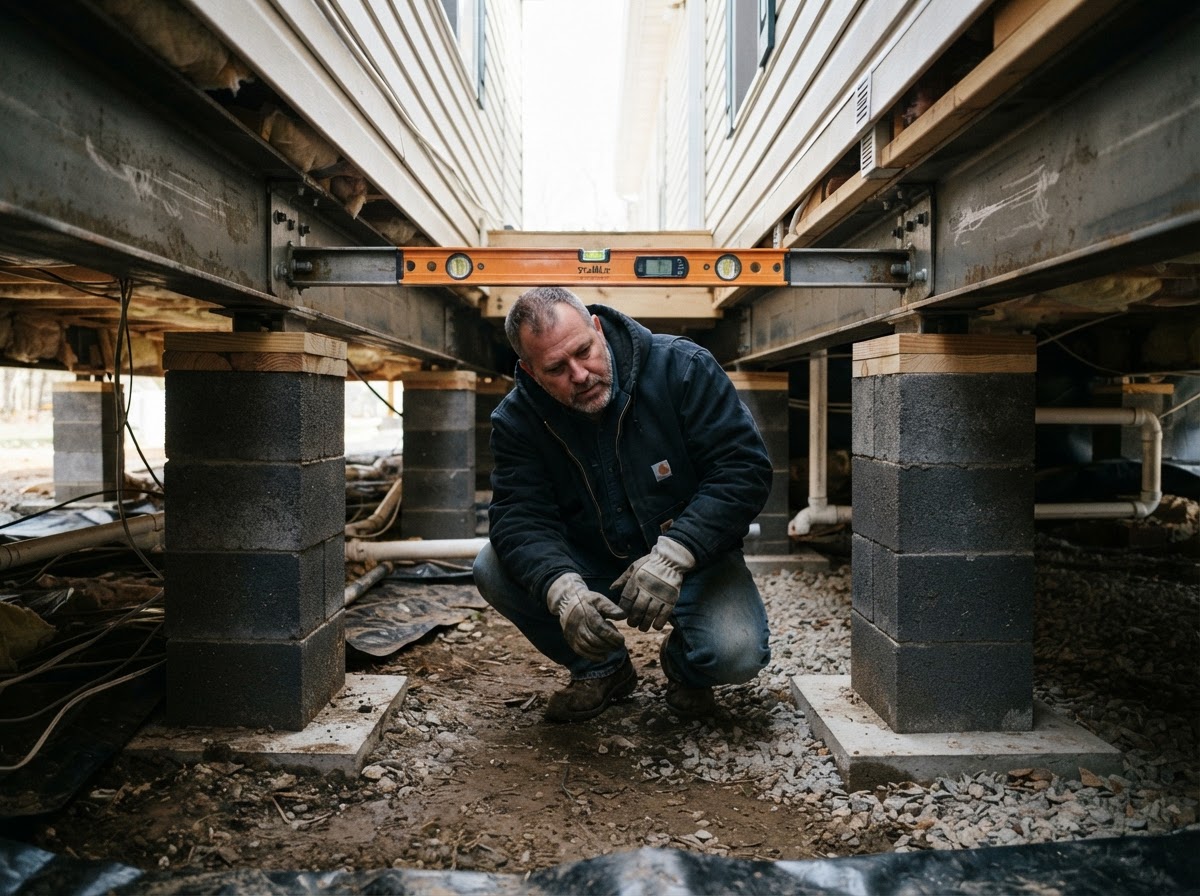
Each section rests on its own set of piers, commonly stacked concrete masonry blocks. Because the two support layouts are independent, individual support points can settle differently and create a height difference between the two halves.
Pads / Footings
The pad or footing beneath each pier spreads the load over the soil. A pad that cracks, sinks, or tilts under one section can let the pier above it drop, changing that section's elevation relative to the other.
Shims
Shims provide the final bearing contact between each pier cap and the steel frame. Loose, crushed, or missing shims under one section can let that half settle while the other stays put.
Marriage Line
The marriage line is where the two sections join. Level and alignment between the two halves along that seam is what keeps floor transitions, walls, and roof connections consistent across the home.
Reblocking & Support Repair
When piers are poorly spaced, improperly stacked, or deteriorated, the issue is the support arrangement, not just the elevation above it. In those cases reblocking or a broader support repair is needed rather than a simple leveling adjustment.
Double-Wide Leveling in Millsboro & Across Sussex County
Double-wide homes near Millsboro and across Sussex County vary widely in how they need to be leveled. The correction depends on the foundation and support layout, the condition of each section, previous leveling, the settlement pattern, crawlspace accessibility, the pier configuration, and any existing repairs. Service regularly extends to communities such as Long Neck, Dagsboro, Georgetown, and Frankford. Each double-wide is evaluated against its actual support conditions rather than against a generic assumption. No claim is made about specific local soils, because the bearing conditions beneath any given home are property-specific and have to be inspected.
Related Leveling & Foundation Services
- Mobile & Manufactured Home LevelingThe broad leveling page covering the full category of manufactured-home leveling.
- Mobile Home Re-LevelingWhen a double-wide that was previously level has shifted or settled.
- Double-Wide Marriage Line Alignment & LevelingFocused correction of separation or misalignment at the central seam.
- Mobile Home Foundation & Leveling InspectionA full evaluation of both sections before any double-wide correction.
- Mobile Home Foundation RepairWhen the issue is a damaged support component rather than an adjustment.
- Mobile Home Shimming & ReshimmingRestoring bearing when shims under one or both sections have failed.
- Mobile Home Floor Sloping or DippingWhen a slope or dip near the marriage line points to section alignment.
- Mobile Home Doors & Windows Sticking From Foundation SettlementWhen section movement has shifted openings enough to make doors or windows stick.
- Double-Wide Marriage Line Separation & Alignment ProblemsWhen the two sections no longer meet evenly along the marriage line.
Double-Wide Manufactured Home Leveling FAQs
How do I know if my double-wide is out of level?
Common signs include one section sitting lower than the other, floor slope, uneven transitions across the marriage line, doors that rub or will not latch, trim separation, and movement underfoot. A check of the frame elevation across both sections and the supports beneath them confirms whether the double-wide has actually shifted.
Can one half of a double-wide settle more than the other?
Yes. Because a double-wide is two separate chassis with separate support layouts, the supports beneath one section can settle or shift while the other stays stable. That differential movement is what makes the two halves sit at different elevations.
What is the marriage line in a double-wide?
The marriage line is the central seam where the two sections of a double-wide are joined together on site. The level and alignment of the two frames along that seam is what keeps floor transitions, walls, and roof connections consistent across the home.
Can an uneven marriage line cause floor transitions to feel different?
Yes. When one section settles relative to the other, the joined area can develop a step or a slope, and the floor transition across the marriage line can feel uneven. Whether the fix is leveling or a focused marriage-line alignment depends on what the inspection finds.
Is double-wide leveling different from single-wide leveling?
Yes. A single-wide is one continuous chassis, so leveling is about that single frame and its supports. A double-wide joins two chassis along a marriage line, which adds the relationship between the two sections as a separate consideration during correction.
Can shifted piers affect only one section of a double-wide?
Yes. Each section has its own piers, blocks, pads, and shims, so movement in the supports beneath one half can change how that section sits relative to the other without affecting the opposite side.
Does every marriage-line gap mean the home needs re-leveling?
No. Gaps along the marriage line can have several causes, including trim movement, finish shrinkage, or actual frame misalignment. A visible gap is a reason to inspect the supports beneath both sections, not an automatic diagnosis that the whole home needs re-leveling.
Can a double-wide need foundation repair instead of simple leveling?
Yes. If a pier, block, or pad beneath one section is damaged, deteriorated, or missing, the component itself needs repair or replacement. Leveling the frame above a failed support will not hold until the support beneath it is addressed.
Do you level double-wide manufactured homes near Millsboro?
Yes. Millsboro Mobile Home Leveling levels double-wide manufactured homes for owners in Millsboro and across Sussex County, DE, including Long Neck, Dagsboro, Georgetown, and Frankford. Call 302-449-7221 to schedule an inspection.
Schedule Double-Wide Home Leveling Near Millsboro
Contact Millsboro Mobile Home Leveling at 302-449-7221 to arrange a double-wide leveling inspection that evaluates both sections and the marriage line for your manufactured home in Millsboro or the surrounding Sussex County area.
Request Mobile Home Foundation Service
Serving Millsboro and all surrounding Sussex County communities.