How Often Should a Mobile Home Be Re-Leveled? Delaware Guide
There is no universal schedule that requires every mobile home to be re-leveled at a fixed interval. A manufactured home should be evaluated when new symptoms appear, after meaningful support movement, or when previous settlement begins recurring. Homes with a history of foundation movement may benefit from periodic checks even when major symptoms are not obvious.
Request Mobile Home Foundation Service
Serving Millsboro and all surrounding Sussex County communities.
In This Guide
- 1.Quick Answer: How Often Should a Mobile Home Be Re-Leveled?
- 2.Re-Leveling Is Condition-Based, Not Calendar-Based
- 3.What Causes a Mobile Home to Lose Level?
- 4.Signs It May Be Time to Check the Level
- 5.How Often Should the Foundation Be Checked?
- 6.Does Delaware Weather Change the Equation?
- 7.Single-Wide vs. Double-Wide Re-Leveling
- 8.What Happens During a Leveling Check?
- 9.When Re-Leveling Alone Is Not Enough
- 10.Frequently Asked Questions
Quick Answer: How Often Should a Mobile Home Be Re-Leveled?
There is no one-size-fits-all interval. Re-leveling is condition-based: it is appropriate when the support system has actually changed, not because a certain number of months have passed. A home can be checked without necessarily needing leveling, and unnecessary repeated adjustment is not the goal.
Consider an inspection when:
- Floors begin sloping
- Doors or windows begin sticking
- One side feels lower
- The marriage line changes in a double-wide
- Shims loosen or go missing
- Piers settle or shift
- Foundation movement appears after heavy rain
- The home repeatedly loses level after correction
- Previous foundation repairs have changed or failed
Re-Leveling Is Condition-Based, Not Calendar-Based
Routine monitoring and actual re-leveling are two different things. A homeowner can watch for changes between professional evaluations without scheduling a leveling every year. The goal is to catch support movement early and correct the cause — not to repeatedly adjust a home that is holding its elevation. A home that has stayed level for many years on stable supports does not need to be re-leveled simply because time has passed. A home that keeps going out of level after each correction has a cause beneath the support that needs to be found before more leveling is done. Re-leveling over a settling pier or an eroded pad moves the symptom without fixing the problem, which is why frequency alone is not the right question — the right question is whether the supports have moved and whether the cause has been addressed.
What Causes a Mobile Home to Lose Level?
Level loss almost always traces back to something that changed beneath the frame — a support, a bearing surface, or the material supporting it. The categories below cover most of what is found under manufactured homes in Delaware.
Pier Settlement
A pier that drops downward usually points to a bearing problem beneath it — a settled pad, lost bearing material, or washout. The pier is the visible component, but the bearing beneath it is what moved.
Concrete Pad / Footing Movement
A pad that cracks, settles, or shifts changes the elevation of the pier above it. A broken or settled pad can let the pier drop even when the pier itself is intact.
Loose or Missing Shims
Shims that loosen, compress, or fall out open a gap between the pier and the frame. A shim gap is often a symptom of movement beneath the shim rather than the shim itself failing.
Reblocking / Setup Movement
An inconsistent or incomplete support setup can shift once the bearing beneath it is disturbed, which changes the level above it.
Erosion or Washout
Water moving through the crawlspace can remove bearing material from around or beneath supports, letting piers and pads settle.
Heavy Rain & Drainage Changes
Significant rainfall can saturate or erode bearing material, or simply reveal a pre-existing weakness that was already developing.
Multi-Section Alignment Changes
On a double-wide, one section can move relative to the other, which changes the marriage-line alignment rather than the whole-home level.
Broader Foundation Settlement
Settlement at one support can be part of a broader foundation movement affecting several supports, which is why the level is read across the whole home.
Signs It May Be Time to Check the Level
The checklist below covers the symptoms most often reported before a leveling evaluation. None of them proves the home needs leveling by itself, but several appearing together is a stronger signal than one.
- Floor slope in one direction
- One side or end of the home feels lower
- Furniture no longer sits level or rocks
- Multiple doors rub, stick, or stop latching
- Windows suddenly bind or become hard to open
- The marriage-line floor transition changes in a double-wide
- New wall or ceiling seam changes appear
- The home shakes or rocks more than before
- Visible pier movement — a pier that has settled, leaned, or shifted
- New shim gaps appear above a support
- The same settlement keeps returning after correction
For a fuller symptom guide, see Signs Your Mobile or Manufactured Home Is Out of Level, which walks through each indicator and the non-foundation causes that can mimic them.
How Often Should the Foundation Be Checked?
Checking the foundation is different from re-leveling the home. A homeowner can monitor for changes between professional evaluations, and a professional check makes sense in several situations even when no major symptom is obvious yet. There is no mandatory maintenance schedule that applies to every home, but the situations below are common reasons a check is worthwhile.
Reasons a professional check may make sense:
- The leveling history is unknown
- The home was recently purchased used
- There is a history of recurring settlement
- The home was recently reblocked or had supports reset
- A major rain or washout event affected the area
- A visible support change was noticed
- The home is being prepared to sell
- The support components are older and have not been inspected in years
Does Delaware Weather Change the Equation?
Coastal Delaware, including Millsboro and the surrounding Sussex County communities, can experience significant rainfall and storm events. Water moving around or beneath foundation supports can erode, wash away, or disturb bearing material, which can let a pier or pad settle. That does not mean every Delaware manufactured home settles more quickly, and there is no statewide re-leveling rule that applies to every property. What changes the equation is not the state line — it is whether water has affected the bearing beneath the supports, whether the site drains, and whether the supports have a history of movement. After a major rain or storm event, a check is reasonable when new symptoms appear; without new symptoms, there is no automatic reason to level the home.
Single-Wide vs. Double-Wide Re-Leveling
Home configuration changes how leveling is approached, which affects how often a check is worthwhile and what symptoms to watch for.
Single-Wide
A single-wide is one primary structural section, so level loss usually shows up as a broad slope or a localized dip rather than a section-to-section mismatch.
Double-Wide
A double-wide is two joined sections with a marriage-line relationship. One section can move relative to the other, which changes the marriage-line alignment rather than the whole-home level — a different correction from whole-home re-leveling.
Multi-Section / Triple-Wide
Multi-section homes have more complex section-to-section support relationships, and alignment between sections has to be read alongside the overall level.
What Happens During a Leveling Check?
A leveling check is an evaluation, not an automatic adjustment. The steps below describe the process conceptually — no homeowner jacking or DIY leveling is involved.
- 1
Review homeowner symptoms
Listen to what changed, where, and when — especially after rain, storms, or prior repairs.
- 2
Evaluate level and elevation
Read the frame elevation across the home to see whether movement is isolated, broad, or section-to-section.
- 3
Inspect the supports
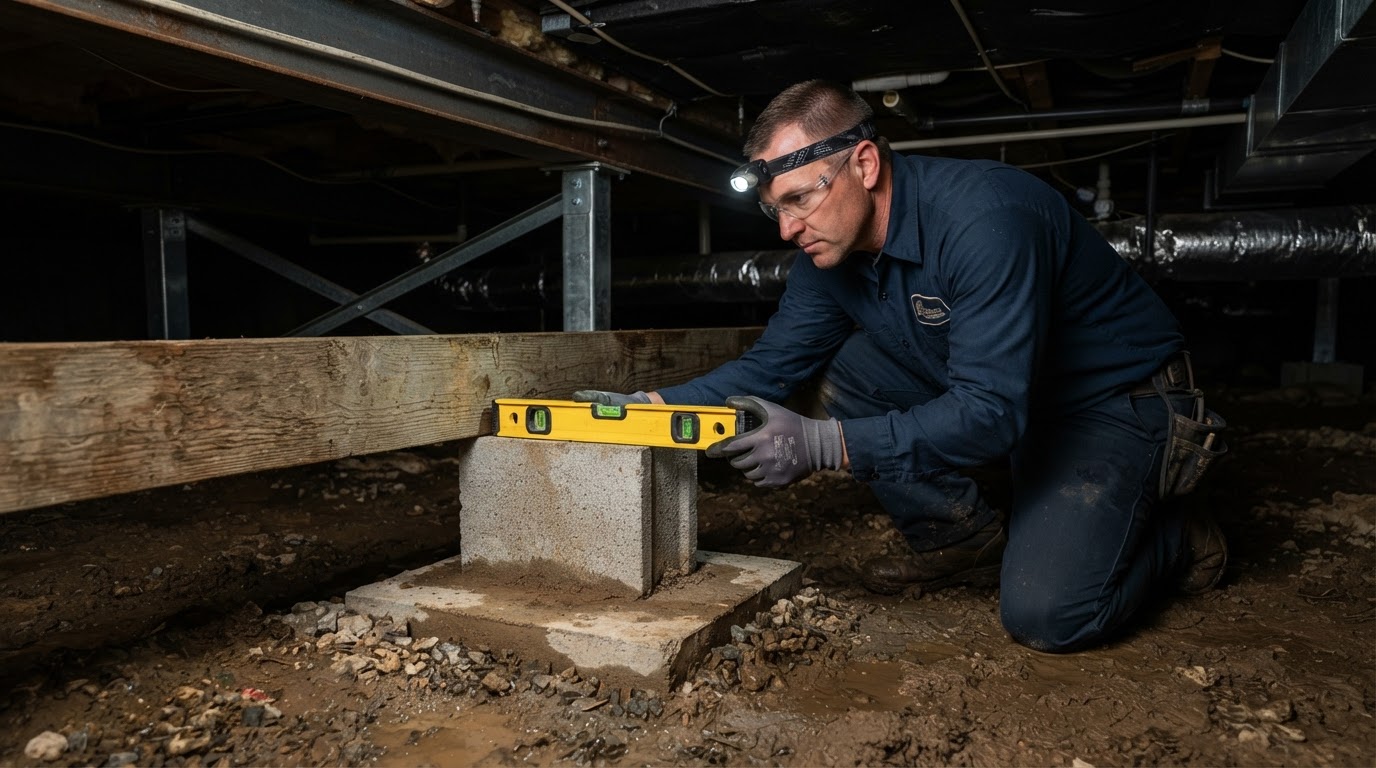
Read the accessible piers, pads, blocks, shims, and frame contact for settlement, movement, or missing contact.
- 4
Check piers, pads, shims, and frame contact
Look for the specific support where the elevation change originates.
- 5
Identify underlying causes
Determine whether the cause is at the support, beneath the pad, or in the bearing material below.
- 6
Determine whether re-leveling or another repair is needed
Decide whether leveling alone is appropriate or whether pier, pad, or stabilization work is needed first or alongside leveling.
When Re-Leveling Alone Is Not Enough
Re-leveling corrects elevation. It does not repair a failed support. When the cause is beneath the support, leveling alone will not hold. The distinction matters because a homeowner asking how often to re-level may actually have a repair question, not a frequency question.
- •A sinking pier needs pier repair, not just leveling above it
- •A failed or cracked pad needs pad or footing repair
- •Repeated shim movement means the support beneath the shim is still moving
- •A leaning pier is a lateral movement problem, different from vertical settlement
- •Washout beneath a support means bearing has to be restored before leveling holds
- •Broader recurring settlement may call for stabilization rather than continued leveling
- •An inconsistent support setup may need reblocking rather than adjustment
Re-leveling corrects elevation. Foundation repair corrects failed components. Stabilization addresses continued or recurring movement. Knowing which one applies comes from evaluating the supports, not from a calendar.
Frequently Asked Questions
Does every mobile home need regular re-leveling?
No. A manufactured home that is holding its elevation on stable supports does not need to be re-leveled simply because time has passed. Re-leveling is appropriate when the support system has actually changed, not on a fixed schedule.
Is there a set number of years between re-leveling?
No universal interval applies to every home. Some homes stay level for many years; others develop recurring settlement because of a cause beneath the supports. Frequency depends on the support and site conditions, not a fixed number of years.
What is the first sign a mobile home is out of level?
The most common first sign is a floor that begins to slope, often noticed as furniture that no longer sits level or a room that feels different when walking through it. Doors and windows that begin sticking are another early indicator, especially when several stick together.
Can heavy rain cause a mobile home to need re-leveling?
Yes, conditionally. Heavy rain can erode or disturb bearing material beneath a support, which can let a pier or pad settle. But rain can also simply reveal a pre-existing weakness, so the cause is evaluated at the affected support rather than assumed from the weather.
Can a double-wide become uneven between the two sections?
Yes. On a double-wide, one section can move relative to the other, which changes the marriage-line alignment rather than the whole-home level. That calls for section alignment, which can be different from whole-home re-leveling.
Does re-leveling fix a sinking pier?
No. Re-leveling corrects the elevation above the pier, but if the pier is still settling because of a bearing problem beneath it, the level will return. The pier — and the bearing beneath it — has to be corrected first or alongside leveling.
Should a newly purchased used mobile home be checked for level?
It is reasonable to have a newly purchased used home checked, especially when the leveling history is unknown. A check is an evaluation — it does not mean the home needs leveling, only that the support and level condition are read before assuming everything is sound.
What happens if I ignore an out-of-level condition?
An unlevel home can develop worsening symptoms over time — more sticking doors, larger floor slope, wider marriage-line gaps, and added stress on supports and finishes. Ignoring it does not guarantee a catastrophe, but it usually makes the eventual correction larger and can let a repairable cause progress.
Can a mobile home stay level for many years?
Yes. Depending on the foundation and support conditions, the site drainage, and the home configuration, a manufactured home can hold its level for many years without needing re-leveling. Stable bearing and sound supports are what keep a home level, not a fixed maintenance schedule.
Who provides mobile home leveling near Millsboro?
Millsboro Mobile Home Leveling provides leveling and re-leveling evaluations for homeowners in Millsboro and across Sussex County, DE. Call 302-449-7221 to schedule an inspection.
Schedule a Mobile Home Level Evaluation Near Millsboro
If your manufactured home is showing new leveling or foundation symptoms, Millsboro Mobile Home Leveling can evaluate the support system and help determine the appropriate next step. Call 302-449-7221 or request service to schedule an evaluation in Millsboro or the surrounding Sussex County area.
Request Mobile Home Foundation Service
Serving Millsboro and all surrounding Sussex County communities.