Mobile Home Block Pier Repair & Replacement Millsboro
Block-pier systems support the frame of many manufactured and mobile homes, stacking concrete masonry units into a vertical support that transfers the steel frame's load down to a pad or footing. Mobile home block pier repair and replacement is appropriate when those blocks crack, shift, lean, deteriorate, or no longer provide stable, plumb support. Signs include a visibly leaning pier, cracked or broken blocks, blocks shifted out of alignment, a pier that appears unstable, a gap between the pier, shim, and frame, a pier that has settled, floor slope above the support area, or a repeated need for leveling at the same spot. Millsboro Mobile Home Leveling performs this work for homeowners near Millsboro and throughout Sussex County, DE. Not every cosmetic block crack means the entire pier must be rebuilt; an inspection determines whether the assembly can be corrected or needs rebuilding or replacement.
Request Mobile Home Foundation Service
Serving Millsboro and all surrounding Sussex County communities.
Mobile Home Block Pier Repair Near Millsboro
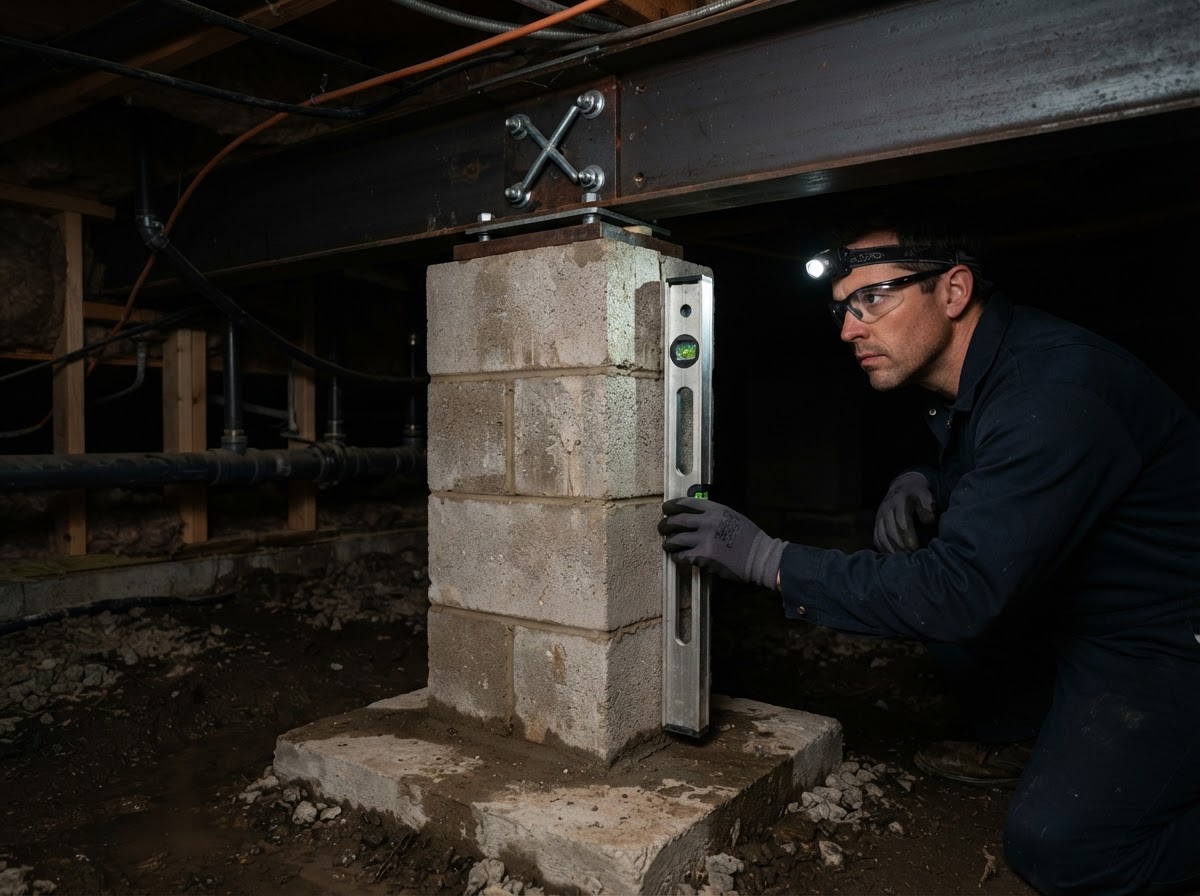
A block pier is a vertical support assembly beneath a manufactured-home frame, built from stacked concrete blocks that transfer the frame's load down to a pad or footing. Repair may be needed when that assembly is damaged, displaced, deteriorated, or no longer aligned to provide proper support. Because a block pier is a stack, a problem at any level — a cracked block, a shifted course, or a settled base — can change how the whole assembly bears on the frame above it.
Leaning Block Piers
A block pier that has tilted off vertical is no longer transferring the frame's load straight down. Alignment matters because a leaning stack reduces proper bearing and can worsen over time, and a lean is a structural condition rather than just a height problem.
Cracked or Broken Blocks
Visible cracks, spalls, or breaks in the blocks are structural damage to the support material. Damaged blocks should be evaluated in context — a single hairline crack in an otherwise plumb, well-bearing pier is different from a broken course that has split the stack — but broken structural components usually need replacement rather than shimming over the break.
Shifted Blocks
Blocks that have moved laterally out of alignment change where the stack bears on its base and on the frame above it. Displacement can come from impact, settlement, or movement of the pad beneath the pier, and the cause determines whether re-seating is enough or rebuilding is required.
Settled Block Piers
A block pier can move when the supporting base below it settles. When the pad or footing under a pier drops, the stack above it drops with it, which is why a settled pier often points back to a pad or footing condition rather than the blocks themselves.
Gaps at the Top of a Pier
A gap between the top of a block pier, the shim, and the frame means the pier is no longer making the bearing contact it should. Shims complete that final contact, and a gap can come from a displaced shim, a settled pad, or a shifted course — each pointing to a different correction.
Repeated Movement
When the same block pier keeps moving after repair, the cause is usually beneath it or in the broader support arrangement rather than in the blocks alone. Recurring movement may indicate a stabilization or base-support issue that deserves evaluation instead of another rebuild of the visible stack.
Plumb, properly stacked, and bearing correctly on the pad and frame.
Tilted off vertical; no longer transferring the frame load straight down.
Moved laterally out of alignment, changing how the stack bears on its base.
Blocks cracked, spalled, or broken; the structural material itself has failed.
Dropped with its base; the pad beneath the stack has often settled with it.
These condition cards are a visual reference, not a diagnosis. An inspection determines the actual condition of a block pier and whether repair, rebuilding, or reblocking is appropriate.
How Mobile Home Block Pier Problems Are Evaluated
Block pier repair starts by reading the stack, the pad beneath it, and the frame it supports together. The goal is to find where the movement originated — in the pier, in the base below it, or in another support component — before rebuilding anything, because rebuilding a block pier over a failed pad or ongoing settlement will not solve the root problem.
Identify the affected area and symptoms
Discuss what you have noticed, where in the home it shows up, and which support area may be involved.
Inspect accessible block-pier assemblies
Examine the block stack in question along with the piers around it, since movement at one support can be related to conditions next to it.
Check alignment, blocks, shims, pads, and frame contact
Look at pier plumb, visible block condition, the shims at the top, the pad or footing at the base, and how the frame bears on the pier.
Determine where the movement originated
Decide whether the problem started in the pier itself, in the base below it, or in another support component that affected the pier.
Decide on repair, rebuilding, replacement, or reblocking
Determine whether the pier can be corrected in place, needs rebuilding or replacement, or whether the broader support arrangement needs reblocking or stabilization.
Complete the scope and recheck support contact
Perform the agreed work and recheck how the corrected pier bears on its pad and how the frame sits above it.
Rebuilding a block pier without addressing a failed pad or settlement beneath it may not solve the root problem. Step-by-step block stacking, temporary support, and lifting instructions are not provided here; incorrect load handling around a failed block pier can damage the frame, floor, or adjacent supports.
Repairing vs. Replacing Mobile Home Block Piers
Distinguishing a repairable block pier from one that needs rebuilding, replacement, or broader reblocking is what keeps this page focused on the block-pier assembly itself. The condition found during inspection determines which is appropriate, and the line between them depends on whether the blocks, the alignment, or the base beneath the stack is the real problem.
Pier Alignment Correction
A block pier that is otherwise sound but has shifted slightly out of plumb may be corrected by re-seating or reblocking it once the cause is addressed. Positional correction is appropriate when the blocks are intact and the movement came from outside the stack rather than from failed material.
Damaged Block Replacement
When individual blocks are cracked, spalled, or broken, the damaged units can sometimes be replaced within an otherwise stable stack. Visibly damaged structural components are evaluated in context, and replacement targets the failed units rather than rebuilding the whole pier if the rest is sound.
Pier Rebuilding
A severely shifted, leaning, or damaged pier may need full reconstruction. Rebuilding is used when the stack can no longer be corrected in place — when multiple courses have failed, the pier has tilted past practical correction, or the blocks have deteriorated broadly.
Reblocking
Reblocking is broader than repairing one isolated block pier. It corrects the layout and condition of the support arrangement beneath the frame — poorly spaced, improperly stacked, or missing piers — and may involve correcting several support points together rather than one.
Pad / Footing Problems
The base beneath a block pier affects the repair. A rebuilt pier over a failed or settled pad will not hold, so the pad or footing has to be evaluated and, if needed, repaired before the stack above it can be corrected.
Shimming
Shims complete the final bearing contact at the top of a block pier. After a pier is repaired or rebuilt, the shim contact is rechecked so the frame bears on the corrected stack properly.
Pier repair corrects an individual support. Reblocking addresses a broader support arrangement. Pad repair addresses the bearing surface beneath the pier. Knowing which layer has failed is what determines whether the block-pier correction will hold.
Mobile Home Block Pier Repair in Millsboro & Sussex County
Block pier repair near Millsboro and across Sussex County depends on the actual conditions under each home rather than a single method. Service regularly extends to communities such as Long Neck, Dagsboro, Georgetown, Frankford, and Harbeson. Repair decisions depend on the pier configuration, block condition, pad and footing condition, settlement, shims, home size, frame layout, crawlspace accessibility, and any prior repairs. No unsupported code claims or exact block-pier specifications are published here; an inspection determines what the block-pier assembly and the base beneath it actually need.
Related Foundation Services
- Mobile Home Foundation RepairThe broad foundation repair page covering damaged supports of every kind.
- Mobile Home Pier & Beam Foundation RepairRepair of the I-beam-to-pier relationship across the whole support system.
- Mobile Home Pier Repair & ReplacementThe broader individual-pier page covering piers of every type.
- Mobile Home Concrete Footing & Pad RepairWhen the base beneath the block pier is the failed component.
- Mobile Home Foundation & Leveling InspectionA full evaluation of block-pier, pad, and frame condition before any repair.
- Mobile Home Re-LevelingRe-checking elevation after a block-pier correction has been completed.
- Mobile Home Setup Correction & ReblockingWhen several block piers are shifted or inconsistent rather than one being damaged.
Mobile Home Block Pier Repair FAQs
What is a block pier under a mobile home?
A block pier is a vertical support assembly beneath a manufactured-home frame, built from stacked concrete masonry blocks that transfer the steel frame's load down to a pad or footing. Because it is a stack, a problem at any level — a cracked block, a shifted course, or a settled base — can change how the whole assembly bears on the frame.
Is a leaning block pier a problem?
Yes, a lean is a structural condition rather than just a height problem. A block pier that has tilted off vertical is no longer transferring the frame's load straight down, which reduces proper bearing and can worsen over time. Whether it can be re-seated or needs rebuilding depends on why it leaned and the condition of the blocks.
Can cracked blocks be replaced?
Often, yes. When individual blocks are cracked, spalled, or broken but the rest of the stack is sound and plumb, the damaged units can sometimes be replaced within the existing pier. When multiple courses have failed or the pier has tilted past practical correction, rebuilding the stack is usually more appropriate.
What causes a block pier to shift?
A block pier can shift from impact, from settlement of the pad or footing beneath it, from movement of the frame above it, or from poor original stacking. The cause determines whether re-seating the stack is enough or whether the base or broader support arrangement also needs correction.
Can a sinking pad make the block pier lean?
Yes. The pad or footing supports the block pier from below, so when the base drops or tilts, the stack above it leans or shifts with it. In that case the pad has to be evaluated and, if needed, repaired before the block pier can be corrected and hold.
Is block pier repair the same as reblocking?
No. Block pier repair or replacement addresses an individual support. Reblocking corrects the layout and condition of the whole support arrangement beneath the frame — poorly spaced, improperly stacked, or missing piers — and may involve correcting several support points together. Reblocking is broader and is used when the arrangement itself is the problem.
What happens if the shim above a block pier becomes loose?
The shim provides the final bearing contact between the top of the block pier and the frame. A loose or missing shim creates a gap, so the pier is no longer supporting the frame the way it should, which can show up as movement or slope above that support. Re-shimming restores contact, but only after confirming the pier and pad beneath it are stable.
Does every damaged block pier require full replacement?
No. A pier with a few damaged blocks in an otherwise sound, plumb stack may need only block replacement. Full rebuilding or replacement is reserved for piers that have tilted past practical correction, have multiple failed courses, or have deteriorated broadly. An inspection determines which is appropriate.
Can a bad block pier cause an uneven floor?
Yes. Because the steel frame is one connected structure, a block pier that drops, shifts, or loses bearing can change the elevation of the I-beam above it, which shows up as slope, dip, or movement in the floor over that area. The repair usually targets both the pier and the bearing condition beneath it.
Do you repair block piers near Millsboro?
Yes. Millsboro Mobile Home Leveling repairs and replaces mobile home block piers for homeowners in Millsboro and across Sussex County, DE, including Long Neck, Dagsboro, Georgetown, Frankford, and Harbeson. Call 302-449-7221 to schedule an inspection.
Schedule Block Pier Repair Near Millsboro
If a block pier beneath your manufactured home is leaning, cracked, shifted, or no longer providing stable support, contact Millsboro Mobile Home Leveling at 302-449-7221 to arrange a block-pier inspection in Millsboro or the surrounding Sussex County area.
Request Mobile Home Foundation Service
Serving Millsboro and all surrounding Sussex County communities.