Signs Your Mobile or Manufactured Home Is Out of Level
Common signs a manufactured home may be out of level include new floor slope, one side sitting lower, multiple sticking doors or windows, marriage-line changes in a double-wide, loose or missing shims, visible pier movement, and recurring support gaps. None of these signs proves the home needs leveling by itself, so the support system should be evaluated before deciding on a repair.
Request Mobile Home Foundation Service
Serving Millsboro and all surrounding Sussex County communities.
Quick Checklist: Signs a Mobile Home May Be Out of Level
The checklist below covers the symptoms most often reported before a leveling evaluation. Several appearing together is a stronger signal than one in isolation.
- Floor slopes in one direction
- One room feels lower than the rest
- One side of the home appears lower
- Furniture rocks or leans
- Doors rub or stop latching
- Windows become difficult to open
- The floor transition changes at the marriage line
- Ceiling or wall seams change in a double-wide
- The home shakes or rocks more than before
- A visible gap appears above a pier
- A shim is loose, displaced, or missing
- A pier settles, leans, or shifts
- A concrete pad settles or cracks with displacement
- Skirting clearance appears different from one side to the other
- Previous leveling symptoms return after correction
Decorative skirting differences alone do not prove settlement — skirting can shift or settle independently of the frame. Read the supports, not just the skirting.
1.Uneven, Sloping or Dipping Floors
Floor changes are usually the first thing a homeowner notices, and they come in three patterns. A broad slope across a section of the home often points to a support or settlement issue beneath that area. A localized dip in one spot can come from a single support that dropped or from a floor-system condition above the support. One-sided settlement — where the whole home tilts toward one side — often involves pier or pad movement beneath that side. Localized floor damage, soft spots, or floor-system bounce can mimic leveling problems, which is why the supports beneath the affected area are read alongside the floor itself.
2.Doors & Windows Start Sticking
When the chassis frame shifts out of alignment, door and window openings can twist out of square, causing doors to rub or refuse to latch and windows to bind. Several openings sticking together is a much stronger sign of frame or foundation movement than a single sticking door. A single door can stick from humidity, hinge wear, or settling of the door itself, none of which means the home is out of level. Multiple openings changing at the same time is what points toward the frame and supports.
3.Double-Wide Marriage Line Changes
On a double-wide, the two structural sections are joined along the marriage line. When one section moves relative to the other, the center seam can become uneven, the floor transition can change, trim can separate, and wall or ceiling seams can open. Doors near the center can begin rubbing. These symptoms point to section-to-section alignment rather than whole-home level — a different correction from leveling the entire home. Some seam separation is cosmetic and not foundation-related, which is why the level condition is read alongside the visible finish.
4.Home Shakes or Rocks When Walking
Movement felt while walking through a manufactured home can come from the support system beneath it — loose shims, pier movement, or a leveling change — or from a localized floor-system condition. Support-related movement tends to feel like the whole home responds to a step; floor-system bounce tends to feel localized to one area. The supports are read before assuming the cause, because tightening a floor that is bouncing over a loose pier will not fix the pier.
5.Visible Pier or Block Movement
A pier that has sunk downward, leaned sideways, shifted off-center, or had a block break or move is a direct support symptom. Different elevations between neighboring supports show up as a step in the frame above them. A sinking pier is a vertical bearing problem; a leaning or shifted pier is a lateral movement problem — the two call for different corrections, which is why the direction of movement is identified before any repair.
6.Loose, Missing or Displaced Shims
A shim that has loosened, compressed, fallen out, or been pushed partly out of a support point is a lost bearing-contact point. It is often a symptom of pier or pad settlement beneath it rather than the shim alone failing. A shim gap that keeps reopening after being filled is a strong sign that the support beneath the shim is still moving and that the cause has not been addressed.
7.Concrete Pad / Footing Movement
A concrete pad or footing that settles, cracks with displacement, becomes exposed at the edge, or shifts changes the elevation of the pier above it. Hairline cracks without movement may be cosmetic; a broken or settled pad can let the pier above it drop. An exposed pad edge can also be a sign that bearing material around or beneath it has eroded.
8.Symptoms After Rain or Storms
New slope, a shifted pier, a shim gap, or erosion appearing after heavy rain or a storm can mean water eroded or disturbed bearing material — or that the weather revealed a pre-existing weakness. Washout channels, exposed pad edges, and water routinely flowing through part of the crawlspace are support concerns even before the home is obviously out of level. Post-storm changes warrant an inspection, but not every storm requires re-leveling.
Signs That Do NOT Automatically Mean the Home Is Out of Level
Not every symptom points to the supports. The conditions below can mimic leveling problems without involving the foundation, which is why multiple symptoms and an actual level and support evaluation matter before deciding on a repair.
- —A single sticking door (humidity, hinge wear, or the door itself)
- —A single cracked drywall seam (settlement of the finish, not the frame)
- —A single squeaky floor (a floor-system noise, not a support problem)
- —Localized floor softness (subfloor or floor-system damage, not leveling)
- —Cosmetic skirting issues (skirting can shift independently of the frame)
- —Window hardware failure (a hardware problem, not frame movement)
One symptom in isolation is weak evidence. Several symptoms appearing together, especially after rain or a storm, is much stronger — and even then the level and supports are evaluated before any repair is recommended.
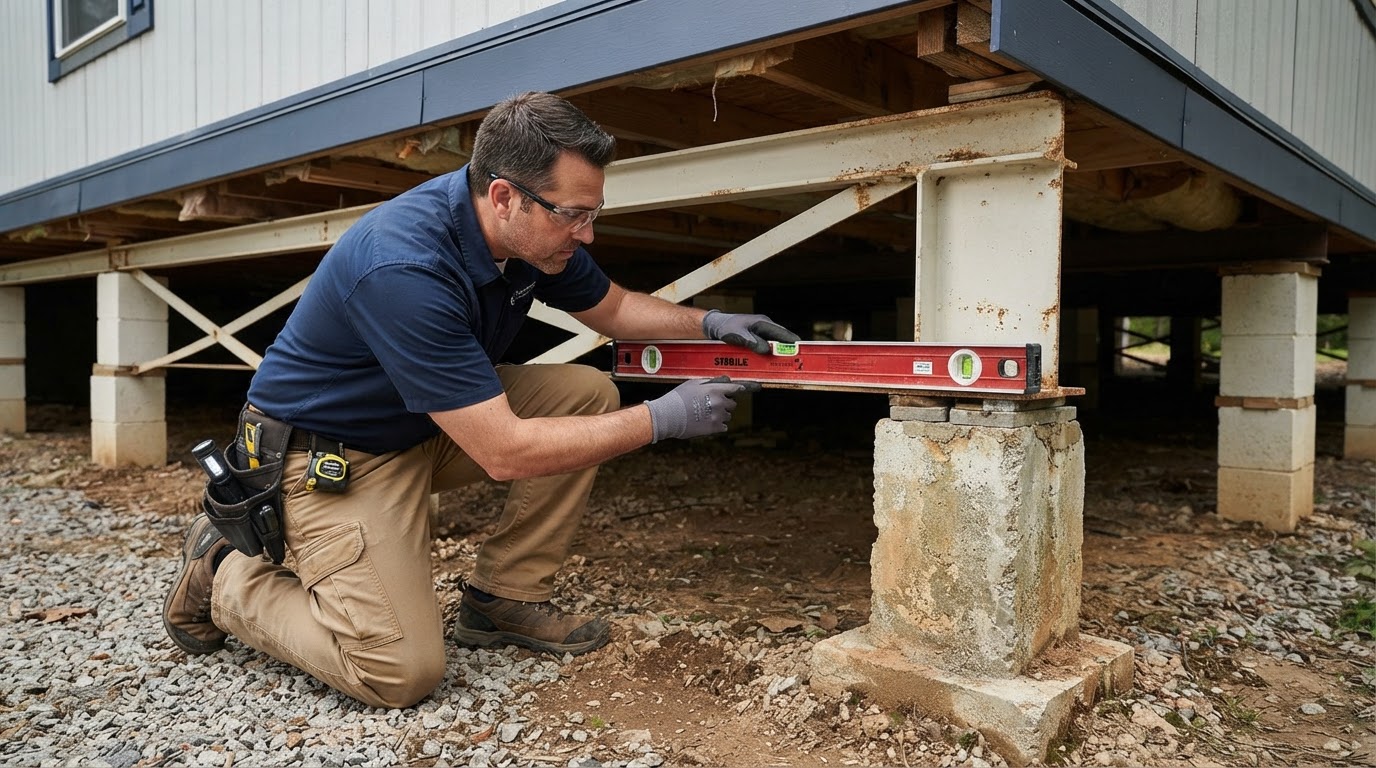
How Professionals Check Whether a Mobile Home Is Out of Level
A professional check is an evaluation, not an automatic adjustment. The steps below describe the process conceptually — no homeowner jacking or DIY leveling is involved.
- 1
Review symptoms
Listen to what changed, where, and when — including any connection to rain, storms, or prior repairs.
- 2
Evaluate elevation
Read the frame elevation across the home to see whether movement is isolated, broad, or section-to-section.
- 3
Compare different areas of the frame and home
Map where the level changes so the affected supports can be located.
- 4
Inspect the supports
Read the accessible piers, pads, blocks, shims, and frame contact for settlement, movement, or missing contact.
- 5
Identify failed components
Find the specific support or bearing condition where the elevation change originates.
- 6
Determine whether leveling or another repair is appropriate
Decide whether leveling alone is correct or whether pier, pad, or stabilization work is needed first or alongside leveling.
What Happens If the Home Is Out of Level?
The correction depends on what the evaluation finds. Leveling is only one of several possible service paths.
Frequently Asked Questions
What is the easiest sign that a mobile home is out of level?
A floor that begins to slope is usually the easiest sign to notice — often felt as furniture that no longer sits level or a room that feels different when walking through it. Doors and windows that begin sticking are another early indicator, especially when several stick at the same time.
Can sticking doors mean a mobile home needs leveling?
They can, but a single sticking door is weak evidence — it can be humidity, hinge wear, or the door itself. Multiple doors and windows sticking together is a much stronger sign of frame or foundation movement and is what points toward a leveling evaluation.
Can one room be low while the rest of the home is level?
Yes. A localized dip can come from a single support that dropped beneath that room, which can leave the rest of the home largely level. The support beneath the low area is read to find where the elevation change originates.
Can a double-wide be level on one side but not the other?
Yes. One section of a double-wide can move relative to the other, which changes the marriage-line alignment rather than the whole-home level. That calls for section alignment, which can be different from whole-home re-leveling.
Can loose shims mean the home has settled?
Yes. A shim that has loosened, compressed, or fallen out is often a symptom of pier or pad settlement beneath it rather than the shim alone failing. A shim gap that keeps reopening is a strong sign the support beneath it is still moving.
Can a mobile home be out of level without obvious symptoms?
Sometimes. A slow settlement can develop before the floor slope, sticking doors, or shim gaps become obvious. This is one reason a check can make sense when the leveling history is unknown, such as after buying a used home.
Will an out-of-level mobile home always have foundation damage?
No. A home can be out of level because a support shifted or a shim loosened without the foundation being damaged. The evaluation determines whether the cause is a simple level correction or a failed component that needs repair.
Can heavy rain cause new leveling symptoms?
Yes, conditionally. Heavy rain can erode or disturb bearing material beneath a support, which can let a pier or pad settle. Rain can also reveal a pre-existing weakness, so the cause is evaluated at the affected support rather than assumed from the weather.
Is floor bounce the same as being out of level?
No. Floor bounce is usually a floor-system condition — a localized flex in the floor — while being out of level is an elevation change in the frame and supports. The two can feel similar but call for different corrections, which is why the supports are read alongside the floor.
How can I get a mobile home checked near Millsboro?
Millsboro Mobile Home Leveling checks level and support conditions for homeowners in Millsboro and across Sussex County, DE. Call 302-449-7221 to schedule an evaluation.
Schedule a Level and Support Evaluation Near Millsboro
If your manufactured home is showing signs it may be out of level, Millsboro Mobile Home Leveling can read the level and supports and help determine the appropriate next step. Call 302-449-7221 or request service to schedule an evaluation in Millsboro or the surrounding Sussex County area.
Request Mobile Home Foundation Service
Serving Millsboro and all surrounding Sussex County communities.