Manufactured Home Foundation Stabilization Millsboro
Manufactured home foundation stabilization focuses on support conditions that are allowing the home to keep moving, settling, or losing proper support. It is most often relevant when a home repeatedly becomes unlevel, when piers keep settling, when shims repeatedly loosen, or when one section keeps moving again after a prior adjustment. Signs that can point toward stabilization rather than a simple re-leveling include repeated loss of level, piers continuing to settle, shims that loosen repeatedly, recurring floor slope, visible support movement, or persistent symptoms after previous leveling. Millsboro Mobile Home Leveling performs this stabilization work for homeowners near Millsboro and throughout Sussex County, DE. Not every recurring symptom requires stabilization, but recurring movement is a reasonable reason to have the support system evaluated rather than re-adjusted again.
Request Mobile Home Foundation Service
Serving Millsboro and all surrounding Sussex County communities.
Manufactured Home Foundation Stabilization Near Millsboro
Manufactured home foundation stabilization addresses the support conditions that are contributing to continued or recurring movement beneath the home. The distinction from re-leveling matters: re-leveling corrects the elevation the frame is sitting at; stabilization addresses why the support system may keep moving or losing support in the first place. Re-leveling a frame over a support that is still settling resets the elevation but does not stop the movement beneath it. Stabilization is the work that targets the condition causing the movement so the correction can hold.
Repeated Settlement
When the same area of the home keeps going out of level, the cause is usually beneath the support rather than at the top of it. Repeated settlement is a signal that a bearing condition or support arrangement is allowing continued movement, which an adjustment alone will not stop.
Sinking or Moving Piers
A pier that continues to drop or shift changes the support it gives the frame over time. Individual support points that keep moving affect the elevation above them and can create recurring slope in the same part of the home.
Loose or Repeatedly Displaced Shims
Shims that keep loosening or falling out of the same spot usually do so because the support beneath is still moving. Re-shimming without finding why the movement keeps happening rarely lasts, which is why recurring shim loss is treated as a support condition rather than a shim problem.
Support Movement After Previous Leveling
A home that becomes unlevel again after a prior leveling is showing that the underlying support condition was not addressed. That pattern points toward stabilization rather than another adjustment that will not hold.
Erosion or Washout Around Supports
Loss of bearing material from erosion or washout changes the ground the piers and pads rest on. Stabilizing the elevation requires addressing the material loss and the drainage condition, not just resetting the frame height above it.
No unsupported claim is made about specific Millsboro soils. The bearing conditions beneath any given home are property-specific, and stabilization scope is determined by what is actually found during inspection, not by a community-wide assumption.
How Manufactured Home Foundation Stabilization Is Evaluated
Stabilization is based on the actual cause of the movement rather than repeatedly adding shims until the floor looks flat. The process reads the history of the movement first, then identifies which support conditions are allowing it to continue.
- 1
Review movement history
Discuss when the recurring symptoms began, how often the home has been leveled or adjusted, and where the movement keeps showing up.
- 2
Evaluate current level and support condition
Check how the frame sits now and assess the overall condition of the support system beneath the home.
- 3
Inspect accessible supports and surroundings
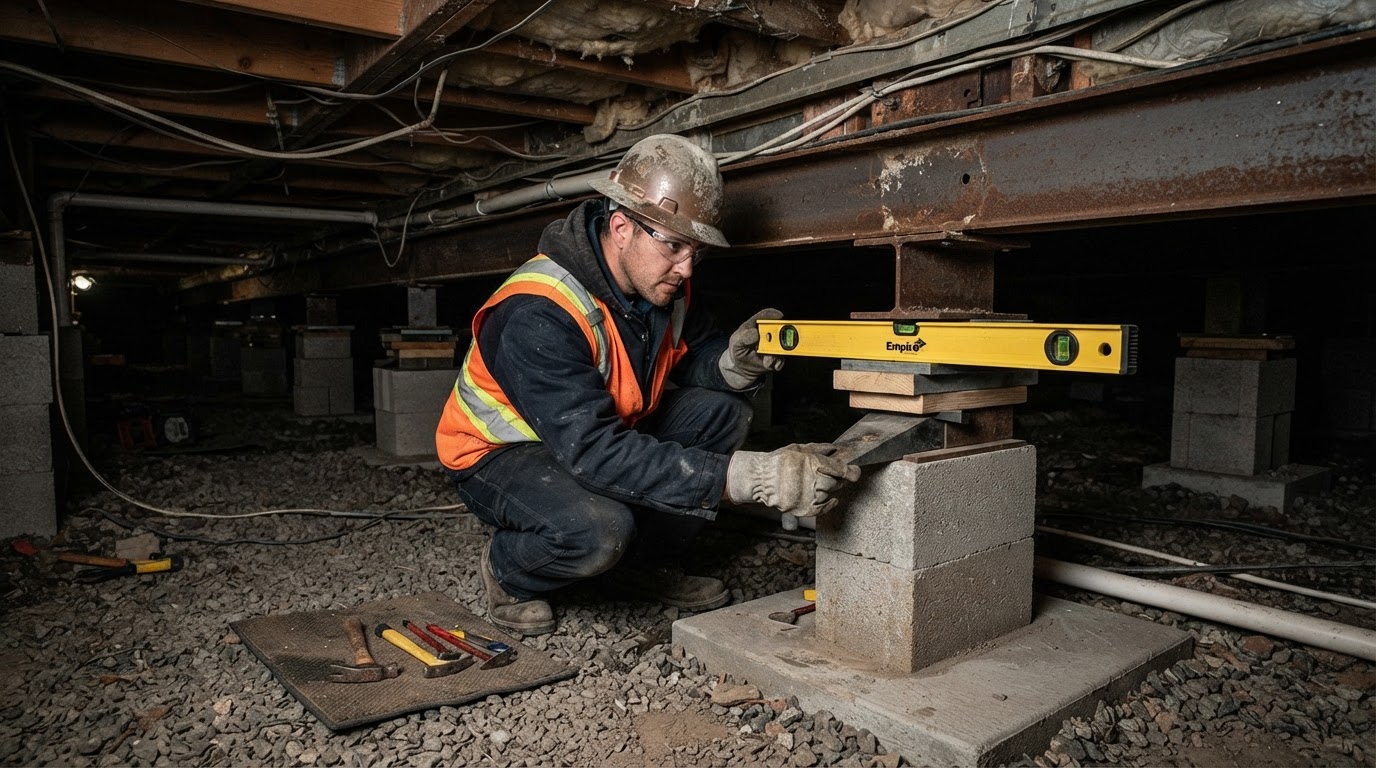
Examine the piers, blocks, pads, shims, frame support points, and surrounding crawlspace conditions that can be safely reached.
- 4
Identify points showing continued movement
Locate the support points that are settling, losing bearing, displaced, deteriorated, or otherwise allowing the frame to keep moving.
- 5
Determine the appropriate scope
Decide whether the correction requires stabilization, repair, reblocking, leveling, or a combination, based on what is actually causing the movement.
- 6
Complete the scope and recheck
Perform the agreed work and recheck the support conditions to confirm the movement has been addressed rather than only the elevation reset.
Stabilization should be based on the actual cause of the movement, not on repeatedly shimming the same area. Specific jack capacities, placement, and lift heights are not described here because incorrect load handling can damage the frame, floor, or supports.
Foundation Support Problems That Can Cause Continued Movement
Stabilization targets the conditions that let the support system keep moving. Understanding each contributor helps explain why stabilization addresses the cause of the movement rather than the elevation on top of it.
Pier Settlement
A pier that is settling drops the frame above it over time. Stabilization addresses the bearing condition beneath the pier so it stops sinking, rather than only resetting the height above it.
Damaged or Unstable Pads
A pad or footing that is cracked, broken, or sinking no longer distributes the load the way it should. The pad beneath a settling pier often has to be addressed before the support above it can hold.
Shifted Block Piers
A block pier that has tilted or shifted laterally is no longer transferring the load straight down. Stabilization may involve reblocking or correcting the geometry of the support so it bears properly again.
Repeated Shim Loss
When shims keep loosening or falling out of the same support, the cause is usually that the support beneath is still moving. Stabilization finds and addresses that underlying condition rather than re-shimming it again.
Reblocking Needs
When piers are poorly spaced, improperly stacked, or missing, the support arrangement itself is the problem. Reblocking reconstructs or corrects the layout so the frame is supported in a way that will hold.
Frame Support Concerns
The steel chassis and I-beams are what the supports hold up. The relationship between the frame and its supports is part of what determines whether the correction is leveling, support repair, stabilization, or a combination.
Leveling vs. Stabilization
Leveling corrects the elevation the frame is sitting at. Stabilization addresses the conditions that are contributing to continued movement so the elevation can hold. Foundation repair corrects damaged or failed support components. These are related but distinct objectives, and the right one is determined by what the inspection finds.
Manufactured Home Stabilization in Millsboro & Sussex County
Stabilization decisions for homes near Millsboro and across Sussex County depend on the actual site and support conditions rather than a generic assumption. Service regularly extends to communities such as Long Neck, Dagsboro, Georgetown, Frankford, and Harbeson. The scope depends on the foundation configuration, pier arrangement, previous repairs, drainage conditions, crawlspace accessibility, the settlement pattern, the size of the home, and the condition of the support components. No claim is made about community-specific soils, because the bearing conditions beneath any given home are property-specific and have to be inspected.
Related Foundation Services
- Mobile Home Foundation RepairWhen a support component is damaged or failed rather than simply still moving.
- Mobile Home Foundation & Leveling InspectionA full evaluation of frame level and support condition before stabilization begins.
- Mobile Home Re-LevelingWhen the supports are sound and only the elevation needs correcting.
- Mobile Home Pier Repair & ReplacementWhen a pier that keeps moving needs to be repaired or replaced.
- Mobile Home Setup Correction & ReblockingWhen the support arrangement beneath the home needs correcting.
- Mobile Home Foundation Preventive Maintenance & AdjustmentPeriodic checks that catch movement before it becomes a recurring stabilization issue.
- Mobile Home Underpinning & Foundation SupportWhen a low or weak area needs added support rather than only stabilization.
- Manufactured Home Foundation RetrofitWhen an older support system needs coordinated modernization rather than one repair.
- Mobile Home Pier Sinking & Settlement RepairWhen recurring settlement at the same pier needs to be stopped.
- Mobile Home Foundation Movement After Heavy RainWhen recurring settlement appears after heavy rainfall.
- Mobile Home Foundation Repair After Flooding or WashoutWhen washout or erosion has undermined the supports being stabilized.
- What Causes a Mobile Home to Become Unlevel?Educational guide to the support-path causes behind recurring settlement and elevation loss.
- Can Heavy Rain & Flooding Damage a Mobile Home Foundation?How erosion, washout, and water movement affect supports — without assuming every storm causes damage.
Manufactured Home Foundation Stabilization FAQs
What does manufactured home foundation stabilization mean?
Foundation stabilization addresses the support conditions that are allowing a manufactured home to keep moving, settling, or losing proper support. Where re-leveling resets the elevation the frame is sitting at, stabilization targets why the support system keeps moving so the correction can hold rather than repeat.
How is stabilization different from re-leveling?
Re-leveling corrects the elevation of an otherwise sound frame over sound supports. Stabilization addresses the condition that is causing continued movement, such as a settling pier, a failed pad, or recurring shim loss. Resetting the height over a support that is still moving will not last, which is why stabilization targets the cause.
Why would a mobile home keep becoming unlevel?
Repeated loss of level usually means the cause is beneath the support rather than at the top of it. Gradual settlement, a pier that keeps sinking, compressed or displaced shims, drainage changes, or a prior adjustment that did not address the underlying condition can all let a home keep moving. Recurring movement points toward a support condition that deserves evaluation.
Can sinking piers cause repeated movement?
Yes. A pier that continues to drop changes the support it gives the frame over time and can create recurring slope in the same part of the home. Stabilization addresses the bearing condition beneath the settling pier so it stops sinking, rather than only resetting the height above it.
Can loose shims be a sign of a larger support problem?
They can be. Shims that keep loosening or falling out of the same spot usually do so because the support beneath is still moving. Re-shimming without finding why the movement keeps happening rarely lasts, which is why recurring shim loss is treated as a support condition rather than a shim problem.
Does foundation stabilization always require pier replacement?
No. The repair depends on the actual condition. Some movement is corrected by stabilizing the bearing surface or reblocking the support arrangement; other cases involve a damaged pier that needs repair or replacement. An inspection determines which applies rather than assuming every recurring issue requires replacing the piers.
Can erosion or washout affect foundation stability?
Yes. Loss of bearing material from erosion or washout changes the ground the piers and pads rest on, and the supports above it can drop or shift with it. Stabilizing the elevation requires addressing the material loss and the drainage condition, not just resetting the frame height.
Can a double-wide need stabilization?
Yes. A double-wide joins two chassis along a central marriage line, and movement in the supports beneath either section can recur just as it can under a single-wide. Stabilization for a double-wide accounts for both sections and the relationship between them along the seam.
Should a home that has been leveled multiple times be inspected?
Yes. Multiple levelings in the same area are a strong signal that the underlying support condition was not addressed. An inspection can determine whether the movement points toward stabilization, a specific repair, or a support arrangement that needs reblocking.
Do you provide manufactured home foundation stabilization near Millsboro?
Yes. Millsboro Mobile Home Leveling provides foundation stabilization for homeowners in Millsboro and across Sussex County, DE, including Long Neck, Dagsboro, Georgetown, Frankford, and Harbeson. Call 302-449-7221 to schedule an evaluation.
Schedule Foundation Stabilization Near Millsboro
If your manufactured home keeps settling or going out of level in the same area, contact Millsboro Mobile Home Leveling at 302-449-7221 to arrange a stabilization evaluation in Millsboro or the surrounding Sussex County area.
Request Mobile Home Foundation Service
Serving Millsboro and all surrounding Sussex County communities.