Sussex County Flood-Zone Manufactured Home Footing, Pier & Tie-Down Inspection Guide
Manufactured homes placed or replaced in Sussex County Special Flood Hazard Areas (SFHAs) are subject to specialized county permitting and inspection stages beyond standard installations. Sussex County currently requires staged pier inspections — evaluating footing preparation, pier rebar or core-fill development, completed elevated pier construction, and tie-down anchoring — to verify that elevated foundations can resist hydrostatic, hydrodynamic, wind, and flotation forces. Always confirm current, parcel-specific flood zone designations and inspection schedules directly with Sussex County Planning & Zoning.
Request Mobile Home Foundation Service
Serving Millsboro and all surrounding Sussex County communities.
In This Guide
- 1.Are Extra Inspections Required in Flood Zones?
- 2.Standard Sussex County Inspection Sequence
- 3.Additional Staged Pier Inspections in Flood Zones
- 4.Determining Parcel-Specific Flood Hazard Status
- 5.Flood-Zone Installation Rules vs. Flood Damage Repair
- 6.Why Flood Conditions Demand Stronger Foundation Design
- 7.Frequently Asked Questions & Official Sources
Additional Pier Inspection Stages for Applicable Flood-Zone Installations
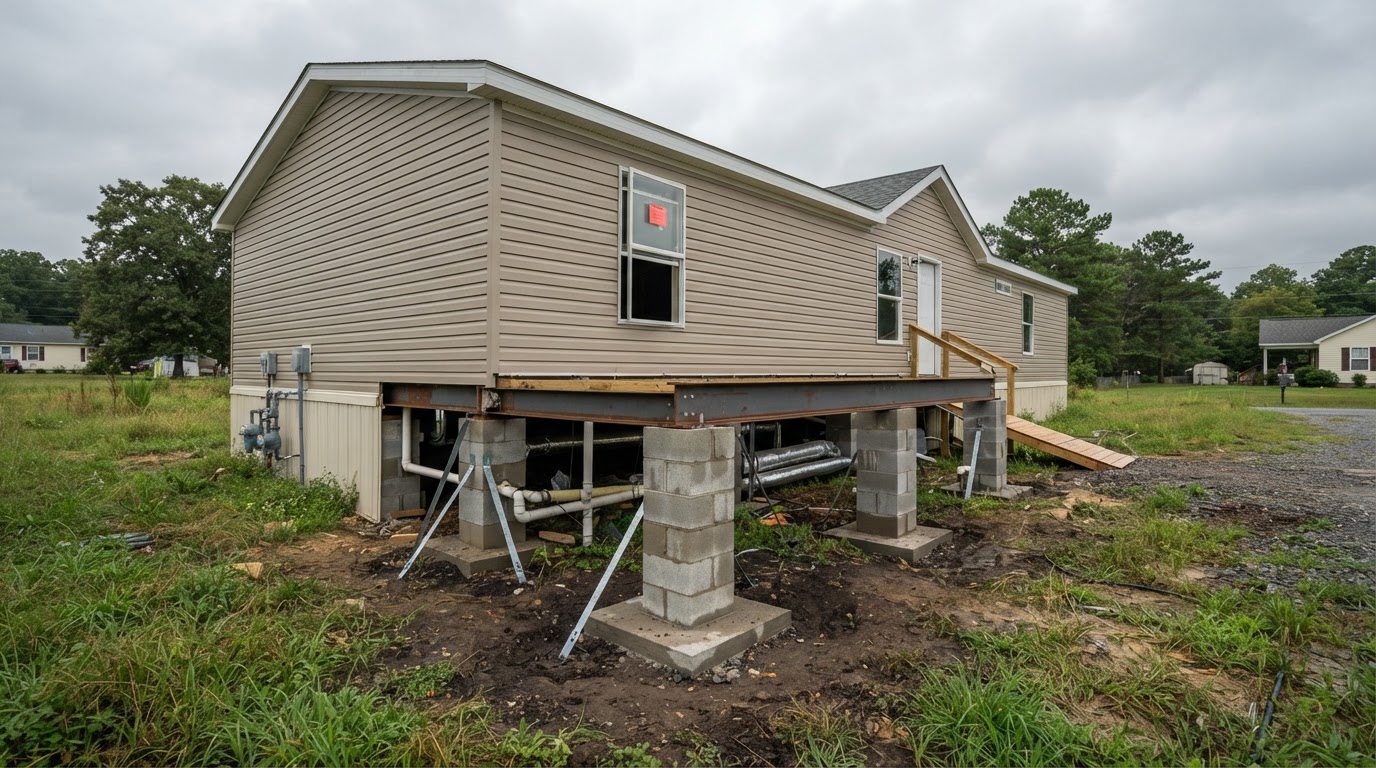
Because elevated piers in flood hazard zones carry higher structural loads, Sussex County requires intermediate field verifications during pier construction:
Reinforcement & Rebar Inspection
Verifies vertical steel rebar placement, grout cells, and footing dowel connections within hollow concrete masonry unit (CMU) pier cores before grouting.
Filled Pier Core / Grouting Inspection
Confirms that CMU pier cells are completely filled with structural concrete grout to create solid, high-capacity support columns.
Completed Pier & Elevation Check
Verifies final pier height, cap block placement, and top-of-pier chassis elevation against the official Flood Elevation Certificate.
These staged pier inspections ensure that elevated piers do not shear or collapse under hydrodynamic water flow. Do not attempt to construct or modify flood-zone structural piers without licensed installation oversight and county inspection approval.
Why Flood Conditions Demand Stronger Foundation Design
Floodwaters subject manufactured home foundations to four distinct physical forces that standard inland pier setups are not designed to resist alone:
- Hydrostatic Pressure: Standing floodwater pressing sideways against foundation walls or pushing upward beneath concrete floor pads.
- Hydrodynamic Forces: Moving water currents pushing against piers, creating overturning moments and lateral shear forces.
- Buoyancy (Flotation): Water displacement creating upward lifting force that can float an unanchored manufactured home off its piers.
- Scour & Erosion: Fast-moving floodwater washing away soil around concrete footings, undermining pier bearing capacity.
For anchoring upgrade details, see Mobile Home Wind-Resistant Anchoring Upgrades and Storm & High-Wind Tie-Down Retrofitting.
Are Additional Inspections Required for Manufactured Homes in Sussex County Flood Zones?
Yes. Sussex County enforces enhanced building permit and inspection protocols for manufactured home installations located within FEMA-designated Special Flood Hazard Areas (SFHAs):
- •Sussex County identifies mandatory additional pier inspection stages between the initial footing inspection and final tie-down sign-off for applicable flood-zone installations.
- •Homes in flood hazard zones must be elevated so the lowest structural member (or chassis I-beam) sits at or above the Base Flood Elevation (BFE) plus local freeboard requirements.
- •Foundation piers in flood zones must be engineered to withstand lateral water velocity, wave action, debris impact, and buoyant uplift forces.
- •Enclosed foundation skirts or walls in flood zones require engineered hydrostatic flood vents to equalize water pressure during flooding.
- •Anchoring systems in flood hazard zones must secure the home against combined high-wind and water currents.
- •Flood-zone status is parcel-specific — residing in a coastal municipality does not automatically place every parcel in a flood hazard zone.
Standard Manufactured Home Inspection Sequence in Sussex County
For standard inland installations outside Special Flood Hazard Areas, Sussex County typically administers a three-stage inspection sequence:
| Condition | Typical Scope |
|---|---|
| Stage 1: Footing Inspection | Verifies excavation depth, soil bearing capacity, and concrete pad/footing placement before foundation piers are constructed. |
| Stage 2: Tie-Down Inspection | Inspects ground anchor depth, auger placement, frame brackets, and tie-down strap tensioning before skirting or perimeter walls are installed. |
| Stage 3: Final Inspection | Confirms completed pier stacking, shimming, utility connections, crawlspace ventilation, and site drainage before issuing occupancy approval. |
In Special Flood Hazard Areas, Sussex County adds mandatory intermediate pier inspection stages between Stage 1 and Stage 2.
How to Confirm Whether a Sussex County Property Is in a Flood Zone
Flood hazard designations are determined parcel by parcel using official FEMA Flood Insurance Rate Maps (FIRMs):
Special Flood Hazard Areas (SFHA)
High-risk flood zones designated as Zone A, AE, AH, or VE on FEMA flood maps, where flood regulations apply.
Base Flood Elevation (BFE)
The computed elevation to which floodwater is anticipated to rise during a 100-year flood event.
FEMA Flood Map Service Center
Property owners can look up exact parcel coordinates on the FEMA Map Service Center (msc.fema.gov).
Sussex County GIS Mapping
Sussex County provides online interactive mapping displaying local flood zones, tax parcels, and municipal boundaries.
Flood-Zone Installation Rules vs. Flood Damage Repair
It is vital to distinguish new flood-zone installation permitting from physical foundation repair after a storm or flood event:
- Flood-Zone Installation Permitting: Regulates the initial placement or replacement of a manufactured home, establishing required pier elevation and anchor engineering.
- Flood Damage Foundation Repair: Physical restoration required when storm surge or heavy rain washes out soil, shifts piers, or damages pads beneath an existing home.
- Repairing Existing Supports: Replacing damaged piers or re-leveling an existing home restores stability; major structural rebuilds may trigger county review.
- For physical repair details after water exposure, see Foundation Repair After Flooding or Washout and Crawlspace Erosion & Washout.
Official Sources & Regulatory Disclaimer
Primary references for Sussex County flood-zone manufactured home requirements include: 1) Sussex County Planning & Zoning / Building Code Department (sussexcountyde.gov); 2) FEMA Floodplain Management Requirements for Manufactured Homes (fema.gov); 3) HUD Model Manufactured Home Installation Standards, 24 CFR Part 3285, Subpart D — Drainage & Flood Hazard (hud.gov); and 4) Delaware Department of Natural Resources and Environmental Control (DNREC) Floodplain Management (dnrec.delaware.gov). DISCLAIMER: This guide is educational context only. Flood plain regulations vary by parcel and municipality. Always verify parcel-specific flood requirements directly with Sussex County Planning & Zoning.
Frequently Asked Questions: Sussex County Flood-Zone Inspections
Does every Sussex County manufactured home require flood-zone pier inspections?
No. Staged flood-zone pier inspections apply specifically to parcels located within FEMA Special Flood Hazard Areas (SFHAs). Parcels outside flood zones follow standard county inspection protocols.
Does living near the coast automatically mean my property is in a flood zone?
Not necessarily. Flood hazard designations are parcel-specific based on elevation and soil contours. Some inland properties near streams sit in flood zones while certain coastal elevated parcels do not.
What is an Elevation Certificate and why is it needed?
An Elevation Certificate is an official document prepared by a licensed surveyor confirming the elevation of the home's lowest structural member relative to the Base Flood Elevation.
Are flood vents required in manufactured home skirting in flood zones?
Yes. If an elevated home has a solid perimeter enclosure (such as concrete block skirting), engineered flood vents must be installed to allow floodwaters to enter and exit automatically, equalizing hydrostatic pressure.
Does Sussex County inspect tie-downs in flood zones?
Yes. Tie-down and ground anchor inspections are mandatory to ensure the anchoring system can withstand combined wind and water uplift forces.
Does Millsboro Mobile Home Leveling issue county flood permits?
No. Permits and official inspections are administered exclusively by Sussex County Planning & Zoning. Millsboro Mobile Home Leveling performs physical foundation repair, re-leveling, pier rebuilding, and anchoring services.
What should I do if floodwaters washed soil away from my pier footings?
If soil erosion has exposed or undermined your concrete pads, schedule a foundation evaluation immediately. Do not attempt to re-level the home until the bearing soil is stabilized.
Need Foundation or Pier Repairs in Coastal Sussex County?
If your manufactured home foundation in Sussex County DE requires physical pier repair, reblocking, pad stabilization, or tie-down replacement, call Millsboro Mobile Home Leveling at 302-449-7221 or request service online.
Request Mobile Home Foundation Service
Serving Millsboro and all surrounding Sussex County communities.