Manufactured Home Community Preventive Foundation Inspections & Maintenance Millsboro
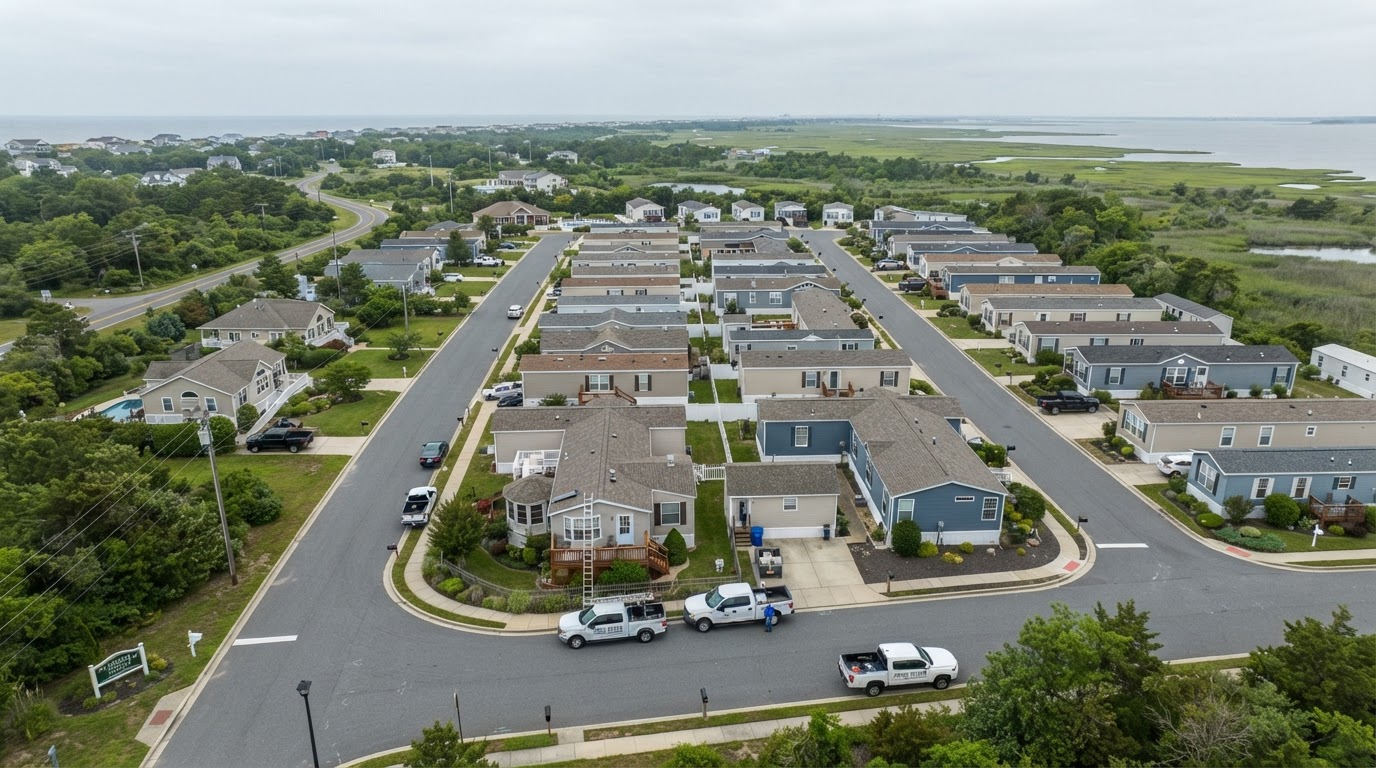
Preventive foundation service for a manufactured-home community is different from waiting until every home develops a visible problem. Community operators can use condition-based inspections to identify homes showing level changes, support movement, loose shims, reblocking concerns, or anchoring deterioration before deciding which units actually need service. Millsboro Mobile Home Leveling organizes community-wide preventive inspection around that condition-driven approach rather than an arbitrary same-schedule re-level for every lot.
Request Mobile Home Foundation Service
Serving Millsboro and all surrounding Sussex County communities.
Preventive Foundation Service for Manufactured Home Communities Near Millsboro
Preventive community service is for the operator responsible for more than one home who wants to catch support conditions before they become complaints. It is not a claim that every home needs annual leveling or a fixed universal inspection interval; re-leveling should be condition-driven, not automatically scheduled for every home on the same timetable.
Community Owners
Owners responsible for a manufactured-home community who want a condition-based read on which homes need work before resident reports accumulate.
Park Managers
Managers running a park day to day who need recurring maintenance requests organized into a prioritized evaluation.
Property Managers
Managers handling a community or portfolio on behalf of an owner, where preventive inspection keeps small support issues from compounding across several lots.
Park-Owned Rental Inventory
Community-owned rental units where preventive inspection of visible support condition helps catch movement before a tenant notices.
Multi-Home Portfolios
Owners of several homes within or across communities who want a repeatable way to prioritize which units need service and which can wait.
Communities with Recurring Resident Requests
Communities where the same homes generate repeated maintenance reports, pointing to a recurring support condition worth evaluating as a whole.
No claim is made that every home in a community needs annual re-leveling or a fixed inspection interval. Preventive service here is condition-based: inspect to identify which homes need work, then service those homes.
What Community Foundation Inspections Can Evaluate
A community-wide preventive inspection reads each home's visible support condition and sorts the inventory into homes that need correction and homes that can be monitored. The categories below are the systems a preventive check can evaluate.
Level & Elevation Concerns
A new slope, a recurring level change on a home that has been leveled before, or section-to-section alignment differences on a double-wide or multi-section home. Each is a reason to flag a home for evaluation rather than a diagnosis.
Piers, Blocks, Pads & Shims
The visible condition and support relationship of each home's piers, block stacks, pads or footings, and shims. A leaning pier, a displaced block, a cracked pad, or a loose shim changes how the frame bears above it.
Reblocking & Recurring Movement
Homes showing repeated correction needs, where the support arrangement is inconsistent or where the same slope returns after leveling. Recurring movement can point toward a stabilization conversation rather than another simple re-level.
Anchoring & Tie-Down Components
The visible condition and completeness of tie-down straps, ground anchors, and frame connections where accessible. Visible corrosion, loose or missing straps, and deteriorated anchors reduce a system's wind-resistance and are separate from the vertical supports.
Water & Erosion Indicators
Visible washout, exposed supports, drainage changes, or erosion around bearing areas. These are site-condition observations that can affect the support system and are a reason to evaluate rather than an automatic conclusion that a foundation is damaged.
This is a visible-condition preventive inspection, not a do-it-yourself crawl-under inspection instruction. No one should crawl beneath an unstable home to assess it.
Prioritizing Preventive Foundation Work Across a Community
The useful part of a community-wide preventive inspection is the sorting it produces: which homes need no work now, which should be evaluated, and which clearly need a repair scope. The categories below keep the language condition-based and avoid classifying any condition as a life-safety emergency.
Monitor / Document
- No significant symptom observed on the home
- A prior foundation history worth noting for future comparison
- A minor cosmetic concern without other support symptoms
Evaluate
- A repeated slope complaint on the same home
- A loose-looking support component noticed during walk-around
- New rocking or shaking reported by a resident
- Visible anchoring deterioration on a tie-down component
Repair Scope Needed
- A shifted support or leaning pier beneath a home
- A damaged pier or block requiring component repair
- A support pad concern affecting bearing
- An obvious anchoring component failure or missing tie-down
No condition here is classified as a life-safety emergency. Each category is a planning label for organizing community maintenance, and each home still requires its own evaluation before any correction is made.
When a Manufactured Home Community May Request Foundation Evaluation
The triggers below are the moments a community operator tends to request preventive foundation evaluation. Each is a reason to inspect; none is an automatic conclusion that a foundation is damaged.
Resident reports of uneven floors
A recurring or first-time resident report of a slope, dip, or change in how a home feels underfoot is a common entry point into a preventive evaluation.
Repeated requests on the same home
Where the same lot generates repeated leveling or maintenance requests, a preventive inspection can determine whether the issue is recurring movement that needs stabilization.
Turnover
A vacant unit between residents is a practical moment to inspect visible foundation and level condition before the next occupant arrives.
Pre-sale preparation
A park-owned home being readied for sale benefits from a visible-condition check so a support concern is addressed before a buyer's inspection.
After significant rain or storm events
Heavy rain or storm conditions can shift supports or expose erosion around pads and anchors, making a post-storm visible check a reasonable preventive step.
Visible erosion or drainage change
Washout, exposed supports, or a change in drainage around bearing areas is a site-condition observation worth evaluating before it affects the support system.
Prior reblocking or pier repair history
Homes with known prior reblocking or pier repair can be re-checked to confirm the prior work is holding and the condition is not recurring.
Unknown foundation history
A home acquired without foundation history benefits from a baseline visible-condition inspection so the community has a reference for future comparisons.
No claim is made that weather automatically damages foundations. Rain and storms are reasons to inspect, not a conclusion that damage has occurred.
Preventive Foundation Inspection & Maintenance Process
The process for a community-wide preventive inspection follows the same evaluation-first approach used across the site, organized so each lot is read on its own terms.
Identify the homes included in the request
Determine which lots are part of the preventive inspection, whether a full community or a flagged subset.
Gather reported symptoms and history
Record resident reports, prior leveling or repair history, and any turnover or sale timing.
Evaluate each home individually
Inspect the accessible support system and level condition of each home rather than grouping lots by assumption.
Note level, support, and anchoring concerns
Flag visible slope, pier or block movement, pad condition, shim loosening, and anchoring deterioration where accessible.
Separate homes needing no immediate work
Distinguish homes that can be monitored or documented from those that need correction.
Prioritize repairs by observed condition
Order the homes needing work by the severity of the observed condition, not by a fixed schedule.
Complete approved service
Carry out the corrections authorized for the homes flagged for repair.
Re-check relevant support areas
Where appropriate, re-check corrected areas after the work is complete.
This is a conceptual preventive process, not a formal recurring maintenance contract or a database or asset-management software system. No annual inspection program or maintenance contract is promised unless separately verified.
Related Community Foundation & Maintenance Services
The commercial silo also covers community-wide repair work, managed and park-owned homes, portfolio-scale service, dealer setup correction, and investor or flipper foundation service. The core preventive-maintenance and inspection pages support community work directly.
Manufactured Home Community Preventive Foundation FAQs
Should every mobile home in a community be re-leveled on the same schedule?
No. Re-leveling should be condition-driven rather than automatically scheduled for every home on the same timetable. A preventive inspection identifies which homes actually need re-leveling and which can wait, so the work follows observed condition rather than a fixed interval.
Can preventive inspections identify which homes actually need work?
Yes. A condition-based evaluation of each home's visible support system sorts the inventory into homes that need correction, homes that should be evaluated further, and homes that can be monitored, so the community operator can prioritize the homes that actually require service.
Can an inspection include visible tie-down and anchor concerns?
Yes. Where accessible, a preventive inspection can note visible tie-down corrosion, loose or missing straps, and ground-anchor condition as a separate scope from the vertical support work, since anchoring is a distinct system.
Can community-owned and resident-owned homes require different service coordination?
Yes. A community-owned home can be authorized directly by the operator, while a resident-owned home may involve coordination with the resident for access. The evaluation approach is the same, but access and authorization can differ.
Is preventive maintenance the same as foundation repair?
No. Preventive maintenance and inspection identify which homes need work and address adjustments before conditions worsen. Foundation repair corrects a damaged or failed support component. The two are related but distinct scopes.
What if the same home repeatedly goes out of level?
Recurring movement may indicate an underlying support or site condition that a simple re-level does not address. A home that shifts more than once is a candidate for stabilization or root-cause evaluation rather than repeated re-leveling.
Can homes be inspected after major rain or storms?
Yes. After significant rain or storm events, a visible-condition inspection can check for shifted supports or exposed erosion without claiming that weather automatically damages foundations. Rain and storms are a reason to inspect, not a conclusion of damage.
Can inspections be performed during turnover?
Yes. A vacant unit between residents is a practical moment to inspect visible foundation and level condition before the next occupant arrives, with fewer access constraints than an occupied home.
Do you provide formal engineering certifications?
No. Millsboro Mobile Home Leveling focuses on foundation, leveling, support, and anchoring services. Engineering or lender certifications may require an appropriately licensed professional depending on the purpose and jurisdiction.
Can preventive inspection help prioritize a multi-home repair project?
Yes. By sorting the community into homes needing no work, homes to evaluate, and homes needing repair, a preventive inspection gives an operator a practical order for a multi-home project based on observed condition rather than assumption.
Plan Preventive Foundation Service for a Manufactured Home Community
Contact Millsboro Mobile Home Leveling at 302-449-7221 to discuss condition-based preventive foundation inspection, leveling, reblocking, or anchoring service across a manufactured-home community near Millsboro or the surrounding Sussex County area.
Request Mobile Home Foundation Service
Serving Millsboro and all surrounding Sussex County communities.