Can Heavy Rain & Flooding Damage a Mobile Home Foundation?
Yes, heavy rain or flooding can damage a mobile home foundation when water erodes or disturbs supporting material, affects the bearing beneath pads or footings, or causes piers and other supports to settle or shift. Rainfall alone does not mean the foundation is damaged; the concern is whether water movement changed the support conditions beneath the home. Standing water indicates a drainage condition, but it does not by itself prove that supports have failed.
Request Mobile Home Foundation Service
Serving Millsboro and all surrounding Sussex County communities.
In This Guide
- 1.How Water Can Affect Foundation Support
- 2.Erosion Around Pads & Footings
- 3.Washout Beneath Supports
- 4.Pier Settlement After Heavy Rain
- 5.Pad / Footing Movement
- 6.Loose or Missing Shims After Foundation Movement
- 7.One-Sided Settlement After Water Movement
- 8.Double-Wide Alignment Changes
- 9.Rain vs. Flooding vs. Washout
- 10.Signs Water May Have Affected the Foundation
- 11.What Should Be Checked After Rain or Flooding
- 12.Re-Leveling vs. Foundation Repair After Water Damage
- 13.When Drainage or Site Work May Also Be Needed
- 14.Coastal Delaware / Sussex County Context
- 15.Is Foundation Damage After Flooding Covered by Insurance?
- 16.Frequently Asked Questions
Signs Water May Have Affected the Foundation
These signs can suggest water has changed the support conditions beneath the home. No single symptom proves flood damage, but several appearing together after wet weather warrant an inspection.
- New floor slope after rain or flooding
- One side of the home becomes low
- A pier appears lower than before
- A pad edge is newly exposed
- Visible washout or a new channel under the home
- A loose shim where there was none before
- A pier has shifted position
- A marriage-line change in a double-wide
- The home begins rocking or shaking
- The same area repeatedly settles after wet weather
If several of these appear after significant rain or flooding, the supports beneath the affected area should be inspected.
What Should Be Checked After Significant Rain or Flooding?
After significant rain or flooding, the support system should be evaluated where accessible — not just the floor above. A foundation and leveling inspection looks at the supports that carry the home, and where water may have reached anchoring components, the anchoring system can be checked as well.
Reasons a professional check may make sense:
- Level and elevation across the home
- Piers and block supports for settlement or shifting
- Pads and footings for movement or cracking
- Shims for new gaps or loss of contact
- Support bearing for erosion or washout
- Anchoring components where visibly affected by water
Re-Leveling vs. Foundation Repair After Water Damage
After water-related movement, the right service depends on what actually failed beneath the home. Re-leveling corrects elevation. Foundation repair corrects support components or bearing problems. Stabilization may be relevant for recurring movement, and underpinning may be relevant where additional support is required. Choosing the wrong scope — for example, re-leveling over a washed-out pad — is a common reason the problem returns.
- •Re-leveling corrects the elevation of the frame above the supports
- •Foundation repair corrects damaged or failed support components such as piers, pads, or blocks
- •Stabilization addresses recurring or ongoing movement so a level correction can hold
- •Underpinning adds or improves structural support where bearing is inadequate
For a fuller explanation of how these services differ, see Mobile Home Leveling vs. Foundation Repair.
1.Erosion Around Pads & Footings
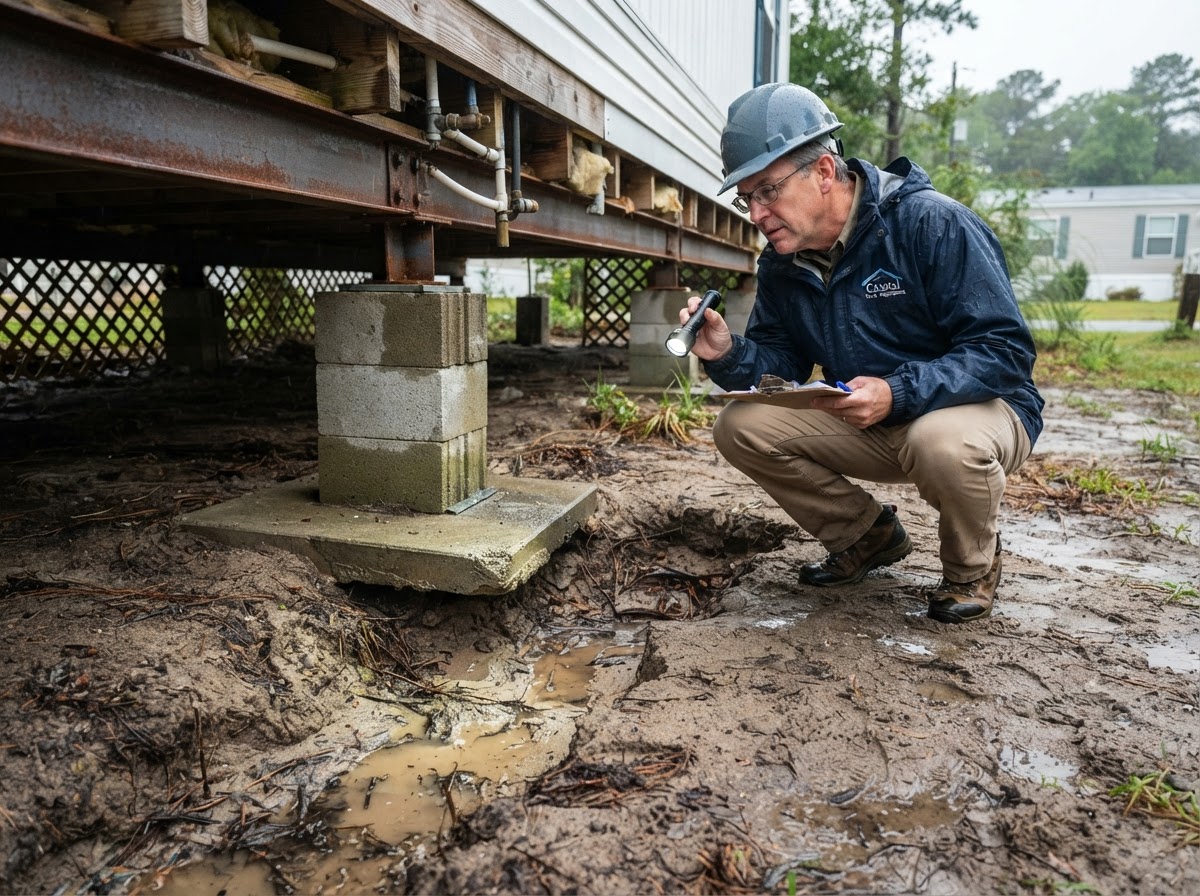
Water movement may remove material from around the base of a support. Signs can include an exposed pad edge, a new channel cut through the crawlspace, visible material loss near a footing, or a support area that simply looks different after rain. Erosion around a pad does not instantly mean the home is damaged, but it does mean the bearing area has changed and should be evaluated.
2.Washout Beneath Supports
Washout goes a step further than surface erosion: water removes material from beneath a pad or footing, reducing the bearing that supports the pier above. Effects can include pad settlement, pier settlement, support movement, or a new floor slope. When washout is visible beneath a support, the bearing condition — not just the elevation — needs to be addressed.
3.Pier Settlement After Heavy Rain
A pier may appear to sink after wet weather, but rainfall should not be automatically blamed for every sinking pier. What often happens is that rain reveals or worsens a support problem that already existed — a pad with poor bearing, an eroded footing, or a soft support zone. The rain is the trigger that makes an existing weakness visible, which is why the support beneath the pier should be evaluated rather than assuming the pier only needs lifting.
4.Pad / Footing Movement
A concrete pad or footing can settle, displace, or crack with movement after water affects the bearing beneath it. Signs include a pad that has dropped, a crack that shows displacement rather than a harmless surface crack, or a loss of bearing under one edge. Pad movement can carry the pier above it, which then changes the floor elevation inside the home.
5.Loose or Missing Shims After Foundation Movement
When a support settles, a gap can open between the pier cap and the beam, leaving a shim loose or missing. The loose shim is the visible symptom, not the original problem. The cause is usually the movement below — the pad, footing, or pier that dropped and left the shim behind. Replacing the shim without evaluating the support beneath is a common reason the gap returns.
6.One-Sided Settlement After Water Movement
If water consistently moves through one side or one end of the crawlspace, several support points along that area could be affected together. The result can look like the home is sinking on one side. This is not common after every storm — it depends on where water flows and which supports sit in its path. When one side drops after wet weather, the supports along that side and the water path should both be evaluated.
7.Double-Wide Alignment Changes
In a double-wide, water-related settlement can affect one section differently from the other. Symptoms can include a marriage-line elevation change, a center floor transition that shifts, or wall and ceiling seam symptoms along the center. Because the two sections are joined, differential movement between them shows up along the marriage line first.
How Water Can Affect Foundation Support
A manufactured home sits on a support path: the frame rests on shims and bearing contact, which sit on piers or blocks, which sit on pads or footings, which rest on the supporting material below. Water-related issues matter when they affect the lower portions of this load path — the pads, footings, and bearing surface — because that is where moving water can remove material or change how weight is carried.
- •Frame → shims → piers → pads / footings → supporting material
- •Water matters most when it reaches the bearing zone beneath pads and footings
- •Erosion removes supporting material; washout creates voids beneath supports
- •A pier can settle if the bearing below it changes — not because the pier itself got wet
- •Standing water signals a drainage condition, not automatic support failure
What Is the Difference Between Rain, Flooding & Washout?
These terms describe different water conditions, and they matter differently for foundation evaluation. The distinction helps avoid assuming damage that has not occurred — or missing damage that has.
| Condition | Typical Scope |
|---|---|
| Heavy rain | May change drainage and moisture conditions. Inspect if new symptoms appear, but rain alone does not prove support failure. |
| Standing water | Indicates a drainage or water-accumulation condition. It does not by itself prove that supports have failed or moved. |
| Flooding | Water may reach or move through support areas. Inspect for changes to bearing, pads, and piers after floodwater recedes. |
| Washout | Visible material loss or erosion around or beneath supports. This is a direct concern for bearing and should be evaluated. |
| Erosion | Supporting material has been moved or removed over time or during water flow. The bearing area has changed and should be checked. |
The condition of the supports — not the amount of water alone — determines whether foundation damage has occurred.
When Drainage or Site Work May Also Be Needed
If water continues to channel beneath the home, wash out supporting areas, or accumulate around supports, foundation repair alone may not address the source of the water movement. Correcting the supports without addressing where the water comes from can lead to the same damage returning. A separate qualified drainage or site professional may be needed for the water-management side of the problem. Millsboro Mobile Home Leveling evaluates the support and anchoring system; confirm with the appropriate professional whether drainage or site work is also required for your property.
Is Foundation Damage After Flooding Covered by Insurance?
This page does not provide policy-specific insurance advice. Whether foundation damage after flooding is covered depends on the policy, the cause of loss, whether flood coverage is in place, policy exclusions, and the documentation available. Standard homeowners insurance typically does not cover flood damage, but coverage varies widely by policy. Homeowners should contact their insurer or agent for policy-specific guidance rather than relying on general information, and should document the condition of the supports with photos and an inspection where appropriate.
Coastal Delaware & Sussex County Context
Coastal and inland Sussex County communities — including Millsboro, Long Neck, Dagsboro, Selbyville, Millville, Ocean View, Bethany Beach, Lewes, and Rehoboth Beach — experience periodic heavy rainfall, coastal storms, and nor'easters that can move water through crawlspaces and around support areas. This does not mean every property in these communities is flood-prone or that every home is in a flood zone. Flood-zone status is property-specific and should be confirmed through the applicable official flood mapping and jurisdiction, not assumed from a town name. What matters for foundation evaluation is whether water has actually reached and changed the bearing beneath the supports — not simply whether the property is near the coast.
Frequently Asked Questions About Rain, Flooding & Foundations
Can heavy rain make a mobile home pier sink?
It can, but not automatically. Rain can reveal or worsen a support problem that already existed — such as a pad with poor bearing or an eroded footing. The concern is whether water changed the bearing beneath the pier, which is why the support below should be evaluated rather than assuming the pier only needs lifting.
Can flooding wash out foundation support?
Yes, where water removes supporting material from around or beneath pads and footings. Washout reduces the bearing that supports the piers above, which can cause settlement or movement. The bearing condition — not just the elevation — needs to be addressed.
Does standing water automatically mean foundation damage?
No. Standing water indicates a drainage or water-accumulation condition. It does not by itself prove that supports have failed or moved. The supports should be inspected, but standing water alone is not evidence of foundation damage.
Can a concrete pad settle after flooding?
Potentially. If floodwater erodes or disturbs the bearing beneath a pad, the pad can settle or displace, which can carry the pier above it and change the floor elevation inside the home.
Can washout cause the home to become unlevel?
Yes, if washout changes the bearing beneath one or more supports. When the support elevation or bearing changes, the floor above can slope. The washout and the support it affected both need to be evaluated.
Should the home be re-leveled immediately after flooding?
Not automatically. The underlying supports should be inspected first. Re-leveling over a washed-out pad, a settled pier, or eroded bearing will usually fail. The cause of the movement should be identified before any elevation correction is made.
Can loose shims appear after foundation settlement?
Yes. When a support settles, a gap can open between the pier cap and the beam, leaving a shim loose or missing. The loose shim is the visible symptom; the movement below is usually the cause.
Can a double-wide marriage line change after water-related settlement?
Potentially. If water affects one section's supports differently from the other, the marriage-line elevation can change, producing a shifting floor transition or seam symptoms along the center.
Does foundation repair fix drainage problems?
Not necessarily. Foundation repair corrects support components, but if water continues to channel beneath the home or wash out supporting areas, the source of the water movement may need separate drainage or site work by a qualified professional.
Is every coastal Delaware mobile home at flood risk?
No. Flood-zone status is property-specific and varies within the same town. It should be confirmed through official flood mapping and the applicable jurisdiction, not assumed from a community's coastal location.
Who inspects mobile home foundation movement after heavy rain near Millsboro?
Millsboro Mobile Home Leveling evaluates foundation and support movement after heavy rain or flooding throughout Millsboro and Sussex County, DE. Call 302-449-7221 or request service online to schedule an inspection.
Inspect Your Foundation After Heavy Rain or Flooding
If your manufactured home has new floor slope, visible washout, or support movement after heavy rain or flooding, Millsboro Mobile Home Leveling can evaluate the support system and help determine whether leveling, foundation repair, or another correction is appropriate.
Request Mobile Home Foundation Service
Serving Millsboro and all surrounding Sussex County communities.