Mobile Home Re-Leveling Millsboro
Manufactured and mobile homes can change elevation after installation as the support conditions beneath them change over time. Mobile home re-leveling evaluates the current frame elevation and support system and makes appropriate corrections when the home is no longer sitting as intended. Triggers often include a new floor slope, doors that previously worked but now rub, windows becoming harder to operate, a home that feels different when walking, visible shim displacement, pier movement, or settlement after previous work. Millsboro Mobile Home Leveling performs this re-leveling work for homeowners near Millsboro and throughout Sussex County, DE.
Request Mobile Home Foundation Service
Serving Millsboro and all surrounding Sussex County communities.
Why a Mobile Home May Need Re-Leveling Near Millsboro
A manufactured home may need re-leveling when changes in its support system or the ground beneath it cause portions of the frame to sit at different elevations than intended. The distinction from initial leveling is timing: re-leveling addresses a home that has moved after it was already set up or after a previous leveling. The contributors below are common, though no unsupported claim is made about any specific Millsboro soil.
Gradual Settlement
Over time, the bearing surface beneath piers and pads can compact or shift slightly, allowing individual supports to drop. Gradual settlement often shows up first as a slow-developing slope rather than a sudden change.
Pier or Block Movement
A pier that has tilted, shifted laterally, or lost a block changes the support it gives the frame. Even a small movement at a single pier can produce a noticeable effect in the floor above.
Shim Compression or Displacement
Shims that have compressed, split, or slid out of bearing reduce contact between the pier and the frame. When a shim loses its fit, the frame above can drop the thickness of that gap.
Changes After Heavy Rain
Saturated crawlspace soil can lose bearing capacity, and runoff or poor drainage can move material beneath pads. Homes that were level before a wet season sometimes develop slope afterward.
Previous Leveling That No Longer Holds
When a prior leveling adjustment does not hold, it usually means the underlying support condition was not addressed. Re-leveling that repeatedly fails is a signal that something more than an adjustment may be needed.
Recurring movement matters. If a home keeps going out of level in the same area, the cause is often beneath the support rather than at the top of it, and that points toward a support or foundation condition rather than a simple re-leveling.
What Happens During Mobile Home Re-Leveling
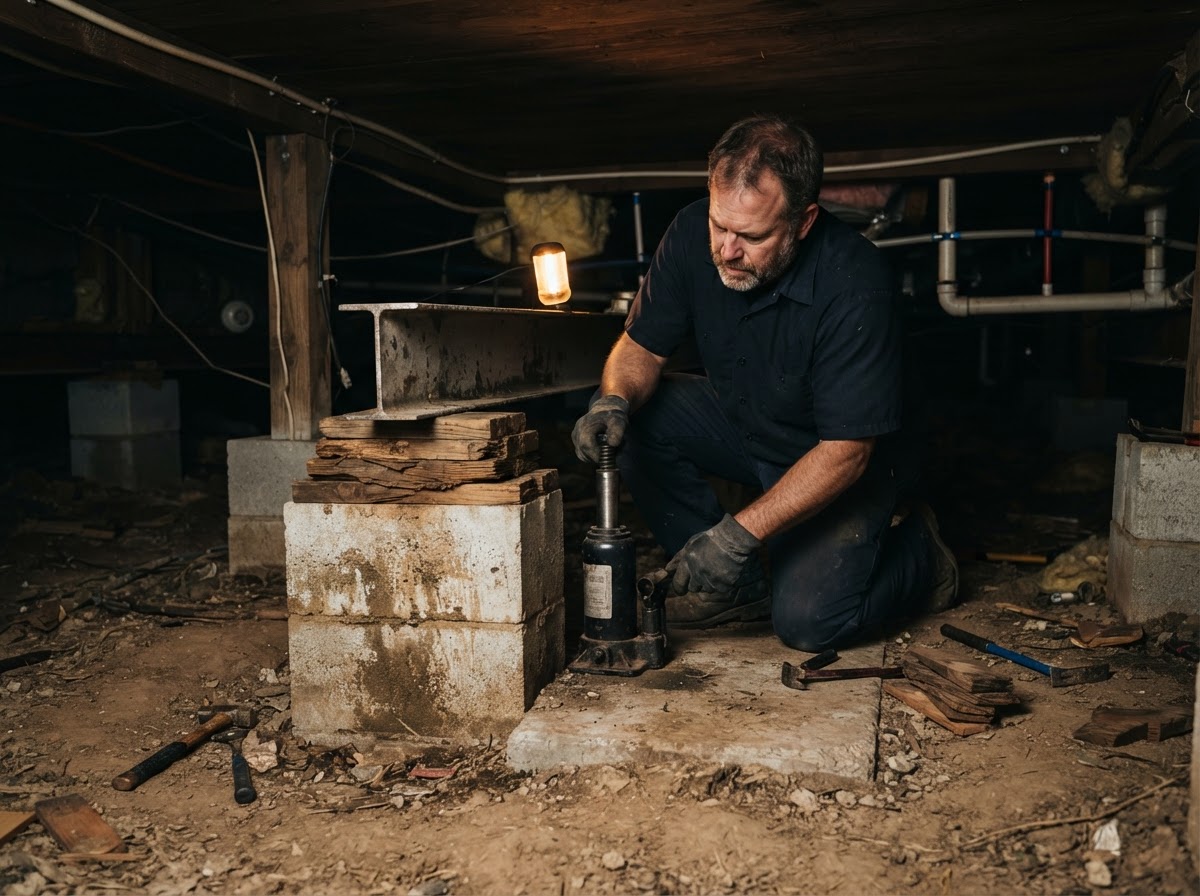
Re-leveling is not the same as randomly adding shims until the floor looks flat. The process is built around understanding why the home moved before correcting it, and it avoids abrupt movement of the frame.
- 1
Review symptom history
Discuss when the symptoms began and whether previous leveling or repair work was performed, and where.
- 2
Check current elevation
Measure how the frame sits now to map where elevations have changed since the home was last level.
- 3
Examine accessible supports
Inspect the piers, blocks, pads, shims, and frame support points that can be safely reached beneath the home.
- 4
Determine the scope of the issue
Decide whether the problem is a normal leveling correction or a broader support or foundation concern that needs more than an adjustment.
- 5
Make controlled corrections
Apply support and elevation corrections appropriate to the system, moving the frame in a controlled way rather than forcing it.
- 6
Recheck the home and supports
Verify the corrected areas and confirm the frame bears consistently on its supports before finishing.
Specific jack capacities, placement, and lift heights are not described here. Re-leveling a manufactured home involves controlled load handling, and incorrect lifting can damage the frame, floor, or supports.
When Re-Leveling May Require More Than an Adjustment
Re-leveling can reveal related issues that an adjustment alone will not solve. In those cases, correcting the elevation without addressing the underlying condition usually means the problem returns. The distinction between a leveling correction and a foundation or support repair is what keeps re-leveling from becoming a repeating cycle.
Sinking Pier or Support
If the support itself is sinking, adjusting the top elevation does not address what is happening beneath it. The bearing condition under the pier has to be evaluated, not just the height above it.
Damaged Block or Pad
A deteriorated block, a cracked pad, or a broken pier cap is a component failure, not an elevation problem. The component needs repair or replacement before the frame above it can hold its level.
Repeated Shim Movement
When shims keep loosening or falling out in the same spot, the cause is usually that the support beneath is still moving. Re-shimming without finding why it keeps happening rarely lasts.
Crawlspace Erosion or Washout
Loss of supporting material from erosion or washout changes the ground the piers rest on. Stabilizing the elevation requires addressing the material loss, not just the frame height.
Frame or Structural Support Problems
Some symptoms that look like a leveling issue actually involve the frame, crossmembers, or outriggers. In those cases the structural element, not just the support elevation, needs attention.
Mobile Home Re-Leveling in Millsboro & Across Sussex County
Mobile and manufactured homes throughout the area vary widely in age, support layout, number of sections, foundation configuration, prior repairs, access underneath, and anchoring setup. A home near Millsboro, in Long Neck, Dagsboro, Georgetown, or Frankford may have a completely different support history from one a few miles away. Re-leveling is therefore based on what is actually found beneath each home, not on a generic assumption about the community. No claim is made about community-specific soils; the bearing conditions under any given home are property-specific and have to be inspected.
Related Leveling & Foundation Services
- Mobile & Manufactured Home LevelingThe broad leveling service page for homes that have not necessarily been leveled before.
- Mobile Home Foundation & Leveling InspectionA full evaluation of frame level and support condition before re-leveling begins.
- Mobile Home Shimming & ReshimmingRestoring bearing when compressed or displaced shims are the cause of the movement.
- Mobile Home Pier Repair & ReplacementWhen a pier that keeps sinking needs to be repaired rather than re-adjusted again.
- Mobile Home Foundation Preventive Maintenance & AdjustmentPeriodic checks and small adjustments that catch settlement before it becomes a larger re-leveling.
- Mobile Home Sinking on One SideWhen one side of the home has settled and may need broader correction than re-leveling.
- Mobile Home Doors & Windows Sticking From Foundation SettlementWhen settlement has shifted door and window openings enough to make them stick.
- Mobile Home Re-Leveling After a StormWhen level or support symptoms appeared after a storm event.
- What Causes a Mobile Home to Become Unlevel?Educational guide to the support-path causes behind elevation loss — pier, pad, shim, erosion, and section movement.
- What Happens During a Mobile Home Re-Leveling?A conceptual walkthrough of the professional re-leveling process, from elevation check to final recheck.
Mobile Home Re-Leveling FAQs
What is mobile home re-leveling?
Re-leveling corrects a manufactured home that has moved out of level after its original installation or a previous leveling. It evaluates the current frame elevation and support system and makes controlled corrections to return the frame to its intended plane.
How is re-leveling different from initial mobile home setup?
Initial setup establishes the level and support arrangement when a home is first placed. Re-leveling addresses a home that was already set up or previously leveled and has since shifted, settled, or moved out of level.
Why would a mobile home become unlevel again?
Gradual settlement, pier or block movement, compressed or displaced shims, drainage changes, heavy rainfall, washout, or prior work that did not address the underlying support can all cause a home to go out of level again. Recurring movement usually points to a condition beneath the supports.
Can a home need re-leveling after heavy rain?
Yes. Saturated crawlspace soil can lose bearing capacity, and runoff can shift material beneath pads. A home that was level before a wet period can develop slope afterward, which is a common reason homeowners request a re-leveling evaluation.
Can loose or compressed shims cause the home to move out of level?
Yes. Shims that compress, split, or slide out of bearing reduce contact between the pier and the frame, and the frame can drop by the size of that gap. Replacing the failed shims restores full bearing.
What if one pier keeps sinking?
Repeated settlement at the same pier usually means the problem is beneath the support, not at the top of it. Adjusting the elevation will not last; the bearing condition under that pier has to be evaluated and likely repaired.
Can re-leveling fix sticking doors?
It can, when the cause is frame alignment. If the frame has shifted and the door openings have racked with it, returning the frame to level can restore alignment. Sticking doors can also have other causes, so an inspection confirms whether leveling is the right fix.
Does a double-wide require a different re-leveling approach?
Yes. A double-wide joins two chassis along a central marriage line, so re-leveling has to account for the relationship between the two sections as well as each section's own supports. That work is covered on the double-wide leveling page.
Do you provide mobile home re-leveling near Millsboro?
Yes. Millsboro Mobile Home Leveling provides re-leveling for homeowners in Millsboro and across Sussex County, DE, including Long Neck, Dagsboro, Georgetown, and Frankford. Call 302-449-7221 to schedule an evaluation.
Request Mobile Home Re-Leveling Near Millsboro
If your manufactured home has shifted or settled since it was last leveled, contact Millsboro Mobile Home Leveling at 302-449-7221 to schedule a re-leveling evaluation in Millsboro or the surrounding Sussex County area.
Request Mobile Home Foundation Service
Serving Millsboro and all surrounding Sussex County communities.