Mobile Home Foundation Pad Sinking or Tilting Millsboro
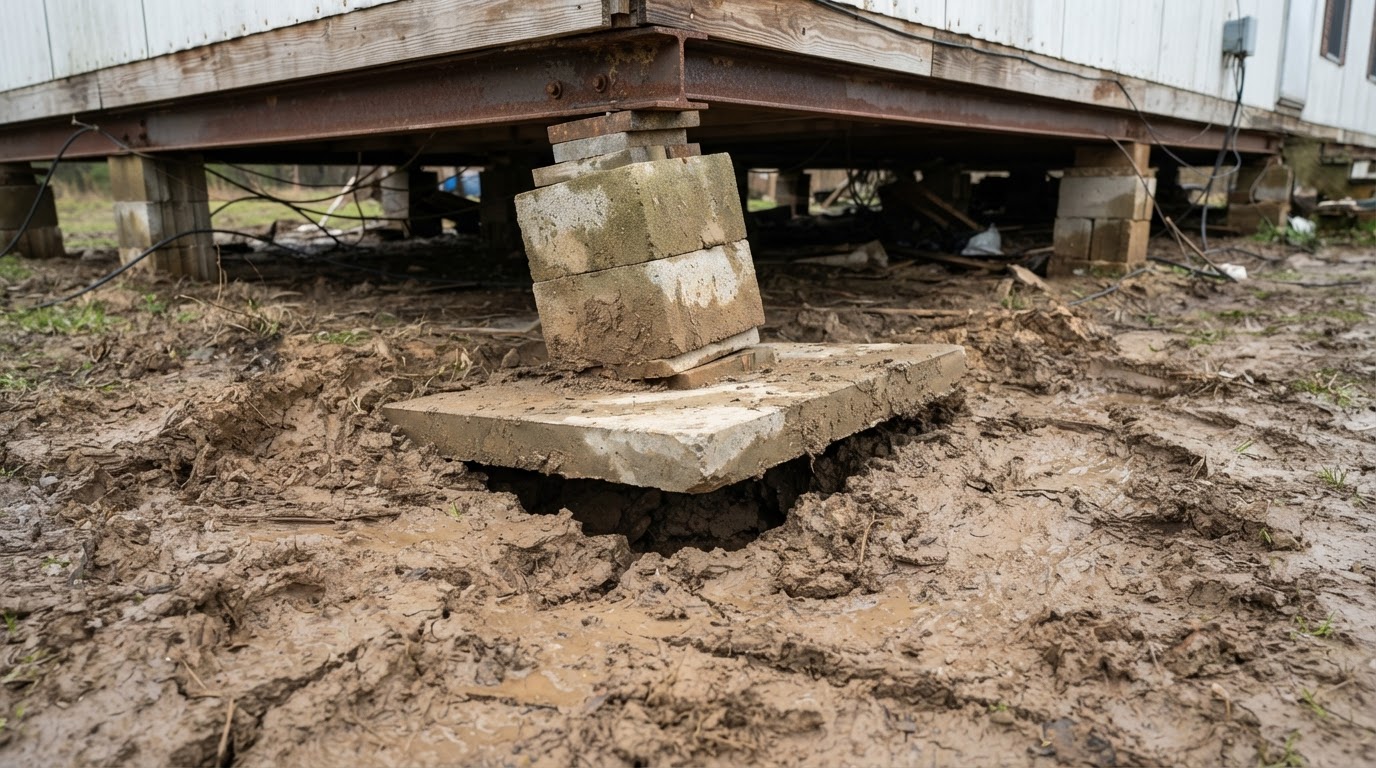
If the bearing pad beneath a mobile home pier settles or tilts, the pier above it can lose alignment or elevation even when the pier itself is not initially damaged. The pad is the surface the support rests on, so when the pad moves, everything above it — block stack, shim contact, frame elevation — can move with it. Homeowners in Millsboro and throughout Sussex County, DE often notice a sinking or tilting pad as a pier that is no longer plumb, one support sitting lower than the supports next to it, a gap between the pad and the soil, or a level that keeps changing at the same spot. A pad can sink without cracking, and a pad that has tilted may still be intact as a piece of concrete — the problem is the bearing relationship, not just the condition of the pad material. Millsboro Mobile Home Leveling evaluates the pad, the pier above it, and the level of the home together to determine whether pad repair, pier repair, re-leveling, reblocking, or stabilization is appropriate.
Request Mobile Home Foundation Service
Serving Millsboro and all surrounding Sussex County communities.
Signs a Mobile Home Foundation Pad May Have Moved
Pad movement is usually noticed through the effect it has on the pier and the level above it, rather than by the pad itself. The signs below describe what a sinking or tilting bearing pad can look like from the crawlspace and from inside the home.
Pier No Longer Vertical
A pier that has begun to lean often does so because the pad beneath it has tilted, letting the block stack tip off plumb.
One Support Lower Than Adjacent Supports
A pad that has sunk can drop the pier above it below the height of the neighboring supports, creating a low point in the level.
Pad Edge Visibly Tilted
A bearing pad that no longer sits level with the soil can show a tilted edge or a corner that has dropped below the rest of the pad.
Soil Separation Around the Pad
A gap between the pad and the surrounding soil can indicate that the pad or the bearing beneath it has shifted.
Pier Shifted Relative to the Pad
When the pier no longer sits centered on the pad, the pad may have moved beneath it or the pier may have shifted independently.
Repeated Shim Loss
Shims that keep loosening or falling out at the same support can point to a pad that is slowly settling beneath the pier.
Recurring Level Change
A home that keeps going out of level at the same location may have a bearing pad that has not stopped moving.
Homeowners should not crawl beneath an unstable or uneven crawlspace to inspect loaded supports themselves. Where pad movement may have made conditions uncertain, the area is evaluated from accessible points.
Foundation Pad Settlement vs Pier Settlement
Distinguishing pad settlement from pier settlement matters because the repair addresses a different layer of the support system. The two often appear together, which is why both are evaluated.
| Condition | Primary Area of Movement |
|---|---|
| Sinking pad | Bearing surface below the pier |
| Leaning pier | Pier / support assembly |
| Loose shim | Frame-to-support contact |
| Broken block | Pier component |
| Broken or cracked pad | Pad material itself |
| Floor slope | Interior symptom requiring diagnosis |
Why Mobile Home Support Pads Can Sink or Tilt
Pad movement usually comes from the bearing material beneath the pad rather than from the pad itself. The factors below describe conditions that can let a bearing pad settle or tilt, but the actual cause on any property has to be inspected.
Soil Movement
Bearing soil that shifts or consolidates beneath a pad can let the pad drop or tilt as the support below it changes.
Water or Erosion
Water directed beneath the home can soften or remove bearing material from under a pad, allowing the pad to settle into the void.
Poor Bearing Condition
A pad placed on poorly compacted or unsuitable bearing can settle over time as the material beneath it compresses.
Previous Settlement
A pad that has a history of movement can continue to settle, especially if the underlying bearing was never corrected.
Changing Load or Support Relationship
A change in how the home bears on the pad — from an addition, a repair, or a shifted support — can redistribute load and let the pad move.
Washout Beneath the Pad
Material washed out from under a pad leaves the pad bearing on less surface, which can let it tilt or sink at one edge.
Why Re-Leveling Alone May Not Fix a Sinking Pad
Re-leveling corrects the elevation of the home above the supports. If the pad beneath a pier is unstable or displaced, simply changing the elevation may not address the underlying bearing problem, and the same pad can let the support settle again.
- ▸A pad that has visibly sunk or tilted beneath a pier
- ▸A pier that leans because the pad beneath it has moved
- ▸Loose shims or a support gap at the affected location
- ▸The home repeatedly goes out of level at the same spot
- ▸Soil has separated from the pad edge or washed out beneath it
- ▸The bearing surface beneath the pad appears soft or disturbed
Where the pad has moved, repair may involve pad or footing repair, pier correction, reblocking, stabilization, or re-leveling as a combination. Homeowners should not crawl beneath a mobile home to install or adjust bearing pads under loaded supports themselves.
Related Services
- Mobile Home Concrete Footing & Pad RepairThe pad and footing repair service.
- Mobile Home Pier Repair & ReplacementWhen the pier above the pad has moved.
- Mobile Home Foundation RepairWhen the broader support system is involved.
- Manufactured Home Foundation StabilizationWhen the pad keeps settling and the movement needs to be stopped.
- Mobile Home Setup Correction & ReblockingWhen several supports need broader correction.
- Mobile Home Foundation & Leveling InspectionThe evaluation that reads pad, pier, and level together.
Foundation Pad Sinking or Tilting FAQs
Can a pad sink without cracking?
Yes. A bearing pad can settle or tilt as a whole piece without cracking, because the movement comes from the bearing material beneath it rather than from the pad material itself.
Can a sinking pad make a pier lean?
Yes. When the pad beneath a pier tilts, the block stack above it can tip off plumb, even though the pier and the pad are each intact as components.
Is pad settlement the same as soft-soil settlement?
Soft-soil settlement is one common cause of pad movement, but not every sinking pad is caused by soft soil. Water, erosion, poor bearing, or a prior settlement history can all let a pad move.
Can water cause pad movement?
Yes. Water that softens or removes bearing material from beneath a pad can let the pad settle or tilt into the resulting void.
Can re-leveling fix pad settlement?
Re-leveling corrects elevation, but if the pad beneath the support is unstable or displaced, simply changing the elevation may not address the bearing problem. The pad and the level are usually evaluated together.
Does a tilted pad always require replacement?
Not always. Whether a tilted pad needs replacement, resetting, stabilization, or only re-leveling above it depends on how far it has moved, whether it is still moving, and how the pier above it is affected.
Can one pad affect an entire mobile home?
One pad can affect the level at its support and, depending on the home configuration, contribute to a broader slope. The evaluation reads the pad, the adjacent supports, and the level together.
Should adjacent supports be evaluated too?
Yes, where one pad has moved. Bearing conditions are often consistent across a section of the crawlspace, and adjacent supports can be affected even when only one pad is obviously tilted.
Concerned a Mobile Home Support Pad Has Sunk or Tilted?
If a bearing pad beneath your manufactured home appears to have sunk or tilted, contact Millsboro Mobile Home Leveling at 302-449-7221 to schedule a pad, pier, and foundation evaluation in Millsboro or the surrounding Sussex County area.
Request Mobile Home Foundation Service
Serving Millsboro and all surrounding Sussex County communities.