Mobile Home Leveling, Anchoring & Foundation Repair Blades
A sloping floor or a loose shim tells you something changed beneath your manufactured home, but it does not tell you whether the problem is a simple level correction, a sinking pier, a moved pad, or broader foundation settlement. Millsboro Mobile Home Leveling serves manufactured and mobile homes near Blades and the surrounding Sussex County communities from our base in Millsboro, providing leveling, re-leveling, foundation support repair, shimming, reblocking, stabilization, underpinning, tie-down strap service, ground anchor installation and replacement, anchoring inspections, and foundation and leveling inspections. Foundation support and anchoring are two separate systems — piers and pads carry the vertical weight of the home, while straps and ground anchors help resist applicable lateral and uplift forces — so the appropriate first step is an inspection-driven evaluation rather than assuming a single adjustment will solve everything. We evaluate the visible support and anchoring condition and help determine whether the correct next step is leveling, component repair, stabilization, reblocking, anchoring work, or a combination. If you have noticed any of these changes near Blades, call 302-449-7221 or request service online.
Request Mobile Home Leveling or Foundation Service Near Blades
Serving Blades, DE and surrounding Sussex County communities.
Mobile Home Leveling Near Blades
The purpose of leveling is to restore consistent structural elevation. The cause of the level change should still be evaluated before adjustment. A single-wide is evaluated across one chassis and frame, while a double-wide is checked section to section so the marriage-line relationship between the two halves stays consistent — one section can settle differently from the other, so both are evaluated before any correction. Common symptoms near Blades include one side sitting low, a broad floor slope, a center transition that has changed on a double-wide, doors or windows that begin sticking, and recurring level loss after a prior leveling. Professional leveling uses controlled structural adjustment rather than abrupt lifting, and the frame, piers, pads, and shims are rechecked together after the elevation is addressed. Re-leveling corrects the current elevation; it does not by itself repair a damaged pier, a failed pad, a shifted block, or a recurring settlement problem, which is why the cause of the movement is evaluated before any adjustment. The objective is a more consistent level condition, not a guarantee of perfect cosmetic alignment, and no structural DIY instructions are provided.
Mobile Home Foundation Repair Near Blades
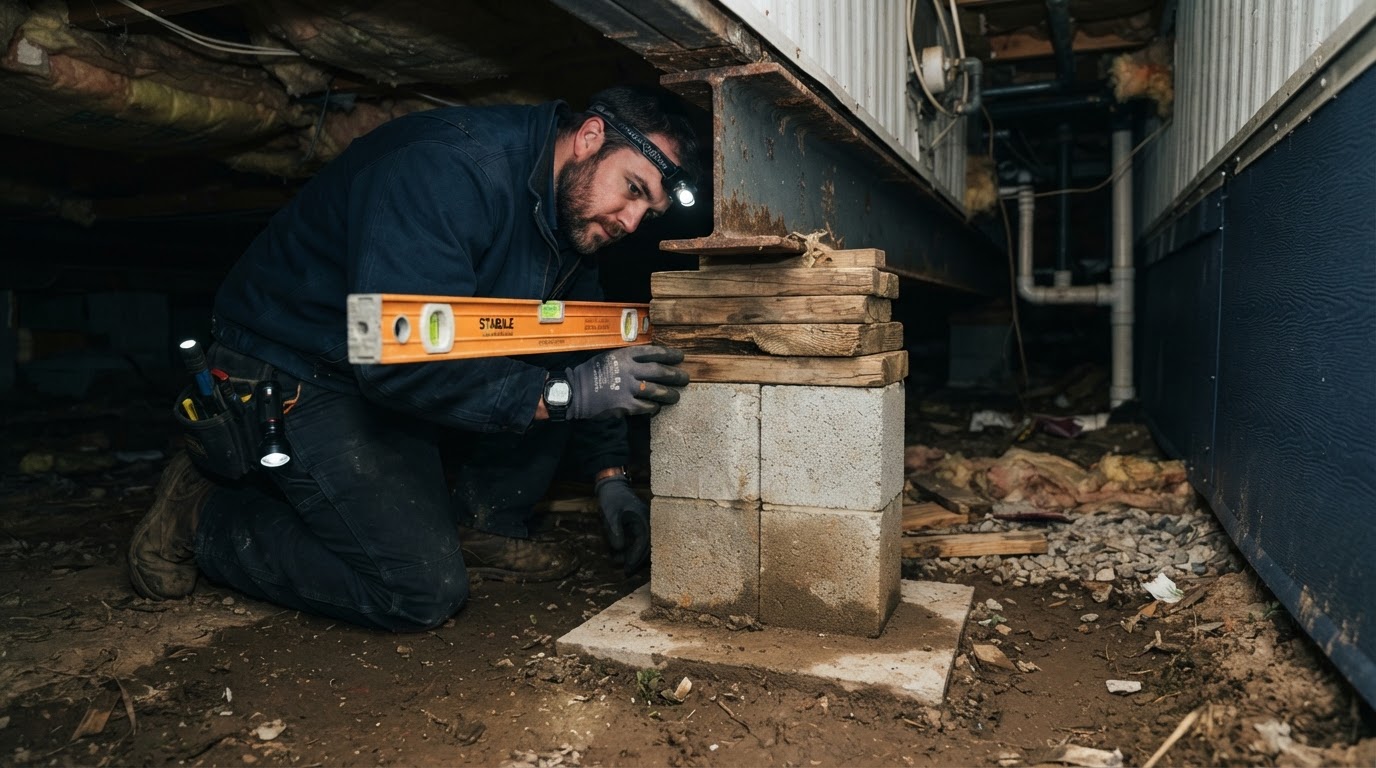
The support load path runs from the frame and I-beams through shims and bearing contact, into piers or block supports, and onto pads or footings that bear on the supporting surface — and a symptom higher in the load path can originate lower in the system. A shim gap, for example, may result from a settled pier or pad rather than a shim problem alone. Foundation repair near Blades can involve replacing or rebuilding piers that have sunk or leaned, correcting shifted block supports, repairing cracked or settled concrete pads and footings, reshimming where contact has been lost, reblocking a broader or inconsistent support arrangement, stabilizing a home that repeatedly loses level, and adding underpinning where additional support is required. The supports beneath the lowest visible sign are evaluated rather than treating that sign in isolation. The correct scope depends on what the inspection finds — a home may need leveling alone, foundation repair alone, or both together — and recurring level loss after prior leveling can justify investigating whether the support beneath the home is still moving rather than simply repeating the same adjustment.
Mobile Home Tie-Down & Anchor Services Near Blades
Tie-down repairs do not substitute for foundation repairs, and foundation leveling does not correct missing or deteriorated anchoring components. Piers and pads support vertical loads, while straps and ground anchors help resist applicable lateral and uplift forces — one system does not replace the other, and a home can be properly level and still have rusted straps or a missing anchor. Near Blades, anchoring services include visible-condition inspections of straps, anchors, and frame connections for corrosion, looseness, displacement, and missing components; replacement of rusted, corroded, broken, or missing straps; retensioning of loose ties; installation or replacement of missing and damaged ground anchors; and wind-resistant upgrades where an older or incomplete system could be improved. We do not publish invented anchor counts, spacing, depth, or torque values, and we do not represent any anchoring service as making a home hurricane-proof or storm-proof. When the anchoring condition is uncertain — especially on an older home or after a significant storm — a visible-condition inspection is the appropriate first step before any replacement or upgrade work.
Signs a Mobile Home Near Blades May Need Foundation Service
Most service requests near Blades start with a symptom the homeowner has noticed. The symptom confirms something has changed; the inspection determines whether the cause is elevation, a failed support component, recurring movement, an anchoring issue, or a combination. We do not claim these problems are uniquely common to Blades — they are the conditions homeowners most often describe when they call:
Mobile Home Foundation & Leveling Inspections Near Blades
Review visible & interior symptoms
We start with what has changed inside and around the home — slope, a low side, a shim gap, or anchoring concerns — so the evaluation targets the actual problem rather than a generic checklist.
Check relative elevation
Relative elevation is checked across the home to map low areas, high areas, side-to-side and end-to-end differences, and — on a double-wide — section-to-section differences at the marriage line.
Inspect piers, blocks & pads
Where accessible and safe, piers, blocks, and pads are evaluated for settlement, leaning, shifting, cracking, and inconsistent contact heights.
Review shim & frame contact
Shim contact between the I-beam frame and supports is reviewed for loose, missing, or displaced shims and gaps indicating settlement below the support.
Identify recurring movement
We determine whether the movement is a one-time elevation change or recurring settlement that may call for stabilization rather than another adjustment.
Match repair to the underlying cause
We explain whether leveling, repair, reblocking, stabilization, or anchoring correction is appropriate, so you can decide how to proceed based on what the inspection finds.
Manufactured Home Services Near Blades & Sussex County
Millsboro Mobile Home Leveling is based in Millsboro and serves homeowners throughout Sussex County, including the Blades area. We do not maintain a separate office in Blades; service extends from Millsboro into the surrounding communities. These are the most relevant services for homeowners evaluating leveling, foundation, or anchoring concerns near Blades.
Related Resources
Manufactured Home Foundation Considerations Around Blades
Blades is a small incorporated town in southern Sussex County, Delaware, located immediately adjacent to Seaford along the Nanticoke River. That riverine coastal-plain setting is relevant to manufactured-home owners because low-relief terrain, drainage, heavy-rain runoff, and seasonal water movement along the river can influence support systems. Because Blades is inland rather than coastal, direct ocean-storm exposure is less dominant here; the stronger local relevance is drainage, pier and pad movement, and erosion and washout monitoring. Flood hazard status around Blades is property specific and should be verified through official FEMA mapping.
Site & Geography
Blades sits on flat coastal-plain terrain in southern Sussex County, adjacent to Seaford along the Nanticoke River. Low-relief ground and riverine proximity can make drainage patterns a property-specific consideration for pads, footings, and bearing surfaces beneath a manufactured home.
Water & Drainage
Blades' position along the Nanticoke River means heavy-rain runoff and seasonal drainage movement can affect support systems. Some properties in and around Blades may fall within mapped flood-hazard areas, so property-specific flood status should be verified through official FEMA mapping rather than assumed.
Support & Inspection Context
In this inland riverine area, pier and pad movement, erosion, and washout are the more relevant concerns than coastal wind. A symptom higher in the load path — a sloping floor or loose shim — can originate lower in the system at the pad or bearing surface, which is why the full support path is evaluated rather than the visible symptom alone.
Local Installation Context
Manufactured-home installation in Blades is governed by Delaware statewide installation requirements and Sussex County jurisdiction. Permitting and inspection specifics should be confirmed with the appropriate jurisdiction for the individual property.
What This Means for Manufactured-Home Owners Near Blades
- Watch for new floor slope, pier settlement, or loose shims after heavy rain or drainage changes along the Nanticoke River.
- Check for erosion or washout around pad and footing bases where river runoff can move across flat ground.
- Have the full support path evaluated — a sloping floor can originate at the pad or bearing surface below.
- Verify property-specific flood status through official FEMA mapping rather than assuming from river proximity.
Local Sources & References
Before & After Mobile Home Leveling, Foundation & Anchoring Transformations Near Blades, DE
These interactive comparisons illustrate common manufactured-home support transformations homeowners encounter around Blades — leveling and re-leveling, double-wide marriage-line alignment, pier and block repair, pad and footing correction, reshimming, reblocking, stabilization, tie-down replacement, ground-anchor correction, and foundation retrofit work. Blades sits along the Nanticoke River near Seaford, so local waterway and FEMA flood-mapping context can influence support behavior on a property-specific basis, and the comparisons focus on the conditions behind mobile home leveling near Blades rather than cosmetic changes.
Interactive images are representative examples intended to illustrate common manufactured-home leveling, foundation-support, pier, pad, shimming, reblocking and anchoring transformations. Actual project appearance varies by home, foundation system, materials, access and site conditions.
Mobile Home Leveling & Re-Leveling in Blades
Re-leveling corrects elevation when part of the manufactured-home frame sits high or low relative to its supports near Blades. If a pier, pad, or other support beneath the home has moved or failed, that component may also need repair rather than adjustment alone.
Double-Wide Leveling & Marriage-Line Alignment Near Blades
Double-wide leveling near Blades involves both individual section elevation and the relationship between the two sections at the marriage line. One half can settle differently from the other, so both sections are evaluated together before correction.
Mobile Home Pier & Block Pier Repair in Blades
Pier and block-pier repair near Blades addresses individual support components that have shifted, settled, or deteriorated and may contribute to an unlevel home. Correcting the support component is different from simply re-leveling above it.
Mobile Home Concrete Pad & Footing Repair Near Blades
A pier can only perform properly when the bearing surface beneath it remains suitable. Pad or footing problems near Blades may require correction in addition to leveling, because re-leveling above a failed pad does not fix the pad itself.
Mobile Home Shimming & Reshimming in Blades
Shimming addresses bearing and contact between the manufactured-home frame and support system near Blades. Underlying pier or pad movement must also be addressed if it caused the shim gap, because replacing a shim does not correct a sinking pier or pad below it.
Mobile Home Reblocking & Support System Correction Near Blades
Reblocking near Blades addresses broader support-layout problems where multiple piers or block supports need correction rather than only a small level adjustment. It generally involves more work than ordinary re-leveling because several support points may require correction.
Manufactured Home Foundation Stabilization in Blades
Leveling corrects current elevation, while stabilization addresses recurring or continued support movement when the underlying condition near Blades requires broader correction. Stabilization and underpinning are considered when adjustment alone does not stop the movement.
Mobile Home Tie-Down Strap Replacement Near Blades
Tie-down straps are part of the home's anchoring system and perform a different role from the piers and pads that carry vertical loads near Blades. A home can be level and still have rusted or broken straps that need replacement.
Mobile Home Ground Anchor Repair & Replacement in Blades
Damaged, missing, or deteriorated ground-anchor components near Blades may require correction independently of whether the home itself is currently level. The anchoring system and the vertical support system are evaluated separately.
Manufactured Home Foundation Retrofit & Support Upgrade Near Blades
Foundation retrofit work near Blades can involve broader improvements to an existing manufactured-home support system when ordinary leveling or isolated repair does not address the entire foundation condition. A retrofit is not automatically an FHA, VA, lender-approved, or engineer-certified foundation unless verified documentation exists.
Request Mobile Home Leveling or Foundation Service Near Blades
Homeowners around Blades can contact Millsboro Mobile Home Leveling about uneven floors, a home sitting low on one side, pier settlement, shifted block supports, loose or missing shims, reblocking concerns, marriage-line changes, tie-down deterioration, missing or damaged ground anchors, or recurring foundation movement. We evaluate the visible support and anchoring system and help identify the appropriate next step.
Mobile Home Leveling & Foundation Repair Blades FAQs
Do you level mobile homes near Blades?
Yes. Millsboro Mobile Home Leveling provides manufactured and mobile home leveling, re-leveling, foundation repair, stabilization, and anchoring services for homeowners near Blades and throughout Sussex County, DE. We are based in Millsboro and serve the surrounding communities. Call 302-449-7221 or request service online.
Can one low support make part of the floor slope?
Yes. A single pier or pad that has dropped changes the bearing contact above it, which can change the elevation of the frame and the floor in that area. The inspection determines whether the cause is that one support or a broader issue.
Can loose shims return after previous leveling?
Yes, if underlying movement continues. A loose or missing shim is often the visible symptom of settlement below rather than a problem with the shim itself, which is why the supports beneath the shim are evaluated rather than treating the shim in isolation.
Does a sinking pier always mean the pier itself failed?
No. The pad or bearing surface below may also be involved — a cracked or settled pad can let the pier above it drop or tilt. The pad and the support above it are evaluated together rather than treating the pier in isolation.
Can you repair block supports?
Yes. Shifted, leaning, cracked, or broken block supports can be repaired or replaced, and the pads and shims above and below them are evaluated at the same time so the corrected support is consistent end to end.
What is reblocking?
Reblocking corrects a broader support-layout problem — such as several shifted supports or inconsistent support heights — rather than simply adjusting one low point. The inspection determines whether the problem is isolated elevation or a broader support-arrangement issue.
Do you inspect tie-down straps and ground anchors?
Yes. We perform visible-condition inspections of tie-down straps, ground anchors, and frame connections for corrosion, looseness, missing components, and displacement. We do not publish invented anchor counts, spacing, depth, or torque values.
Is leveling the same as foundation stabilization?
No. Leveling corrects the current elevation. Stabilization focuses on recurring or continued movement beneath the home. When a home repeatedly loses level after being corrected, stabilization may be appropriate alongside or instead of another re-leveling.
Can you inspect foundation problems before selling a home?
Yes. We perform foundation and leveling evaluations for sellers preparing a manufactured home for sale, focusing on level, piers, pads, shims, frame support, anchoring, and — on a double-wide — the marriage-line relationship.
How do I request service near Blades?
Call 302-449-7221 or use the Request Service option on this page. We will coordinate a foundation and leveling evaluation near Blades and explain the recommended next step based on what the inspection finds.
Request Mobile Home Foundation Service Near Blades
If you are not sure whether your manufactured home near Blades needs leveling, foundation repair, reblocking, stabilization, or anchoring service, Millsboro Mobile Home Leveling can evaluate the visible support and anchoring system and help determine the appropriate next step. Call 302-449-7221 or request service online.
Call 302-449-7221